This is one of the most common frustrations in paid social — and it rarely comes down to a single problem. The creative might be solid, but the audience is wrong. The audience might be right, but the landing page kills the deal. Or the campaign objective was set up to deliver traffic, not conversions, so the platform never optimized toward buyers in the first place.
This guide covers the full picture: why conversions stall, how to build audiences that are actually primed to act, what makes creative perform, and how to build a testing cycle that compounds over time.
Key Takeaways
- Wrong campaign objectives kill conversions — algorithms serve ads based on exactly what you tell them to optimize for
- Audience tiers (cold, warm, hot) require different messages; retargeting warm audiences can lift conversion rates by up to 150% compared to cold campaigns
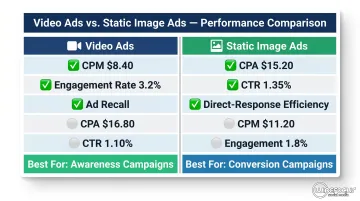
- Static image ads beat video on direct-response CPA ($15.20 vs $16.80); video leads on engagement and awareness
- Mobile load time rising from 1 to 3 seconds increases bounce probability by 32% — page speed is a conversion variable
- Scale budgets by 20–30% every few days to preserve Meta's algorithm learning; larger jumps reset it
Why Your Paid Social Ads Aren't Converting
You're Optimizing for the Wrong Goal
The most common setup mistake isn't the creative or the copy — it's the campaign objective. Meta's delivery system routes ads to people most likely to take the action you've asked it to optimize for. Select a traffic objective, and the algorithm finds clickers. Select a conversion objective, and it finds buyers.
Meta requires approximately 50 optimization events per week per ad set to exit the learning phase and stabilize delivery. If your budget can't generate that volume, the campaign stays in "Learning Limited" status — delivering inconsistent results that don't reflect actual potential.
Match your campaign objective to your actual goal, and make sure your budget supports the conversion volume the algorithm needs.
Message Mismatch and Audience-Offer Misalignment
Even with the right campaign objective, two other failure points frequently undermine performance.
Message mismatch occurs when the ad promises a specific offer — say, a free audit for HR software buyers — but clicks through to a generic homepage. Users don't find what the ad promised; they leave. The landing page headline should mirror the ad headline almost exactly.
Audience-offer misalignment is harder to spot. Broad interest-based targeting pulls in people who fit a demographic profile but have no purchase intent. High click volume with low conversion rates signals the audience is wrong, not the creative — and it inflates cost-per-lead while distorting performance data.
Ad Fatigue Is a Hidden Conversion Killer
When the same audience sees the same ad repeatedly, performance decays fast. At a frequency of 3.0–4.0, CTR drops 15–25%; at 4.0–5.0, it drops 30–40% with rising negative feedback.
Monitor frequency weekly. Refresh creative before you hit 3.0 — not after performance has already fallen.
Benchmarks to know:
| Platform | Conversion Rate | Notes |
|---|---|---|
| Facebook/Meta (all industries) | 8.78% | WordStream/LocaliQ, 2024 |
| Meta — lowest industry (Furniture) | 6.11% | — |
| Meta — highest industry (Health & Fitness) | 10.43% | — |
| LinkedIn (general) | 2.0%–3.5% | Up to 6.1% for US campaigns |
Build Audiences That Are Primed to Convert
The Three Audience Tiers
Every paid social funnel works with three distinct audience temperatures, each requiring a different message and goal:
| Tier | Who They Are | Right Message |
|---|---|---|
| Cold | Interest/demographic targeting, lookalikes | Awareness, problem agitation |
| Warm | Past engagers, video viewers, website visitors | Social proof, education |
| Hot | Cart abandoners, lead form openers, prior converters | Direct offer, urgency |
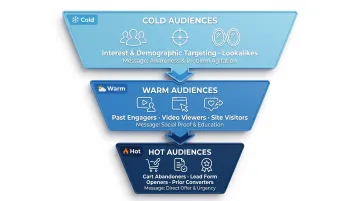
Running a conversion-focused message at cold audiences wastes budget. These users don't know you yet and need context before they'll act. Showing an awareness ad to someone who already visited your pricing page is a missed opportunity.
Custom Audiences and Lookalikes
Pixel-based custom audiences let you segment website visitors by specific pages viewed, time on site, or actions taken. Someone who spent three minutes on a product page but didn't convert is a fundamentally different prospect than someone who bounced from the homepage in five seconds. Treat them differently.
For lookalike audiences, the seed list quality matters more than its size. Building a lookalike from your top 100 customers by lifetime value will consistently outperform one built from a broad email list of 50,000 unqualified contacts.
WideFoc.us demonstrated this in a B2C health supplement campaign: by working with a data partner to build custom audiences from purchase behavior across 220 million US consumers, the campaign achieved a $0.45 average cost-per-click and over 1 million impressions in the first month.
Don't Overlook Exclusions
Audience exclusions are one of the most overlooked ways to stretch your budget. Excluding:
- Existing customers (unless you're cross-selling)
- People who converted in the last 30 days
- Audiences already in a separate nurture sequence
...prevents spend waste and keeps your conversion data clean. Without exclusions, you're paying to re-convince people who already said yes.
Craft Ad Creative That Stops the Scroll and Drives Action
The First 1–3 Seconds Decide Everything
Users on social feeds are not looking for ads. Research attributed to Meta data shows the average user pays attention to a single post for a maximum of two seconds. Your creative has to earn attention before it can ask for anything.
What interrupts passive scrolling:
- Motion in the first frame (video, animated text)
- High-contrast visuals that break the visual pattern of the feed
- A headline that speaks directly to a specific pain point, not a category
Vague creative produces vague results — broad appeal rarely translates into meaningful conversions.
Copy That Converts
High-converting ad copy follows a simple structure:
- Hook — address a specific pain point or desire in the first line
- Value proposition — what you're offering and why it matters
- CTA — one specific action, outcome-driven
"Learn More" is not a call to action. "Download the Free Audit Template" or "Get Your Custom Quote" tells users exactly what they're getting. Specific CTAs consistently outperform generic ones.
Choosing the Right Format
The static vs. video debate has a cleaner answer than most marketers expect:
| Format | Wins On | Loses On |
|---|---|---|
| Video | CPM ($8.40 vs $11.20), engagement (3.2% vs 1.8%), ad recall | CPA ($16.80 vs $15.20), CTR |
| Static Image | CPA, CTR (1.35% vs 1.10%), direct-response efficiency | Awareness, engagement |
According to 2026 performance data from Stackmatix, video wins for awareness campaigns; static wins for direct-response conversion campaigns. Choose based on your campaign objective, not personal preference or production habit.
Platform-native creative consistently outperforms repurposed content. A few format rules worth following:
- Instagram Stories and Reels: Use vertical 9:16 format with sound-on design
- LinkedIn: Apply a professional tone with precise job-title targeting in sponsored content
- Meta: Prioritize original Reels over cross-posted videos — the algorithm actively deprioritizes content carrying competitor platform logos
Align Your Landing Page with Your Ad Promise
This is where paid social campaigns most commonly break down after the click. Ad-to-landing-page continuity is the conversion mechanism — get it wrong and the click means nothing.
Message Continuity
Your landing page headline, imagery, and offer need to match the ad that sent the visitor there. If your ad promotes a free consultation for HR software, the landing page headline should read "Get Your Free HR Software Consultation" — not "Welcome to [Company Name]."
A mismatch immediately signals to users that they've been misdirected, and most will leave without converting.
What a Conversion-Optimized Landing Page Looks Like
- Single goal — no navigation links, no competing CTAs
- Clear headline that mirrors the ad
- Concise supporting copy — 3–5 sentences maximum above the fold
- Social proof — testimonials, client logos, or trust badges
- Prominent CTA visible without scrolling
WideFoc.us notes landing page copy alignment as part of their paid social campaign process, including the ability to write or refine copy for dedicated campaign landing pages.
The Mobile Imperative
Over 98% of Facebook users access the platform via mobile. Your landing page isn't a desktop experience with a mobile version — it needs to be designed for a thumb, not a cursor.
Think with Google's analysis of 11 million mobile landing pages found that as load time increases from 1 second to 3 seconds, bounce probability rises 32%. From 1 to 10 seconds, it rises 123%. Target sub-3-second load times for every paid social landing page.
Test, Retarget, and Scale What's Working
A/B Testing Done Right
Test one variable at a time. The most common mistake is changing the creative and the audience simultaneously — when performance shifts, you don't know why.
Test in this priority order:
- Hook/headline (highest conversion impact)
- CTA (second-highest impact)
- Creative format (image vs. video)
- Audience segment
- Secondary elements (button color, background image)
For Meta, an ad set needs approximately 50 conversion events per week to exit the learning phase. For LinkedIn, plan for minimum 14-day test windows with at least $700 lifetime budget per variant.
Review performance weekly. Pause underperformers after they've had enough spend to be statistically meaningful — for most campaigns, that means waiting until you have at least 50–100 conversion events before drawing conclusions.
Retargeting as a Conversion Accelerator
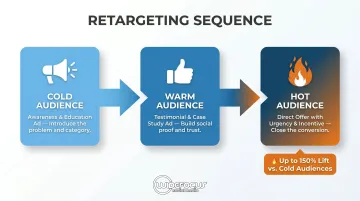
Once your testing surfaces winning creative, retargeting puts it in front of the people most likely to act. Users who've already interacted with your brand convert at dramatically higher rates than cold audiences — retargeting campaigns typically see conversion rates of 5–6%, compared to 2.5–4% for cold audiences, representing a potential lift of up to 150%.
A simple three-step retargeting sequence:
- Cold audience — awareness or education ad; introduce the problem and your category
- Warm audience (engaged with the ad or visited the site) — testimonial or case study ad; build proof
- Hot audience (visited the conversion page but didn't act) — direct offer with urgency or incentive
Scaling Without Breaking What Works
Once a campaign shows a consistent, profitable conversion rate, scale budget gradually. A 20–30% budget increase every few days gives Meta's algorithm time to adjust without resetting the learning phase. Larger jumps — doubling the budget overnight — often cause performance instability that takes days to recover.
As you scale:
- Duplicate winning ad sets into new audience segments rather than stacking budget on one
- Keep creative, targeting, and bidding changes separate from budget increases
- Give each scaled ad set at least two weeks before drawing conclusions
Frequently Asked Questions
What is a good conversion rate for paid social ads?
Conversion rates vary by platform, industry, and objective. Facebook/Meta averages 8.78% across all industries for lead campaigns (ranging from 6.11% to 10.43%); LinkedIn averages 2.0–3.5%. Internal trends matter more than cross-industry benchmarks — measure yourself against your own historical data first.
How do I know when my paid social ad creative needs to be refreshed?
Watch for rising frequency (approaching 3.0+), declining CTR, and increasing cost per conversion. These signals often appear together and indicate creative fatigue. Refresh before metrics deteriorate significantly — reactive changes cost more than proactive ones.
Should paid social ads send traffic to a website or use native lead forms?
Meta Lead Ads typically deliver 30–60% lower cost per lead but can produce lower-quality submissions. Website landing pages offer more control over the conversion experience, better CRM integration, and stronger lead quality. Use Lead Forms for volume; use landing pages for high-value, qualified leads.
How much should I spend testing paid social ads before making decisions?
Spend enough to generate at least 50 conversion events per ad set on Meta before pausing or scaling. The dollar amount varies by industry — a $15 cost-per-lead requires far less budget to reach 50 conversions than a $150 cost-per-lead. Decisions made before this threshold are statistically unreliable.
How does audience targeting affect conversion rates?
Even excellent creative underperforms when shown to the wrong audience. Targeting based on intent signals — website visits, engagement history, custom audiences from purchase data — consistently outperforms cold interest-based targeting for conversion campaigns. Audience quality is at least as important as creative quality.
What metrics should I track beyond clicks?
Click volume is a vanity metric for conversion campaigns. Track these instead:
- Cost per conversion — your primary efficiency signal
- Conversion rate — flags landing page or audience issues
- ROAS — essential for e-commerce attribution
- Lead quality — ensures volume metrics reflect real pipeline value