Introduction
Local competition for dental practices has never been fiercer. Organic reach on Facebook has collapsed—hovering between just 1% and 2% in 2025, down from roughly 16% in 2012. That means even your existing followers aren't seeing your posts without paid promotion. Meanwhile, potential patients scroll past practices that aren't actively advertising. Paid social media advertising bridges that gap—putting your practice in front of nearby patients who are actively searching for a dentist, before they book somewhere else.
This guide covers everything a dental practice needs to run paid social campaigns that generate real appointments: platform selection, audience targeting, ad creative, budget management, and HIPAA and FTC compliance. Whether you're promoting cleanings, cosmetic dentistry, or implants, you'll leave with a clear plan to run campaigns that actually fill your schedule.
TLDR:
- Organic reach on Facebook has dropped to 1-2%, making paid ads essential for visibility
- Meta (Facebook/Instagram) offers the most precise local targeting for dental practices
- Retargeting website visitors and creating lookalike audiences deliver the highest ROI
- Expect a 7-14 day learning phase before Meta optimizes your campaigns
- HIPAA requires written patient authorization before using photos or testimonials in any ad
Why Paid Social Media Advertising is a Game-Changer for Dental Practices
Why Paid Social Outperforms Traditional Dental Marketing
Paid social outperforms organic-only strategies for a simple reason: almost nobody sees your unpaid posts anymore. Organic reach on Facebook fell to 2.2% in 2025, down from 5.2% in 2020. Even practices with large follower bases struggle to reach more than a handful of people without paying to boost visibility. This decline isn't temporary — it reflects how platforms have permanently restructured their revenue models around paid advertising.
Core Advantages Specific to Dental
- Reach only people within a 5-15 mile radius of your practice — no wasted spend on users in other cities or states
- Run separate campaigns for high-value services like implants, whitening, Invisalign, or pediatric care, each with tailored messaging
- See results within weeks, not the 6-12 months SEO typically requires to generate meaningful traffic
- Track every click, impression, and conversion — unlike traditional mailers or radio spots where results are guesswork
Paid Social vs. Traditional Dental Marketing
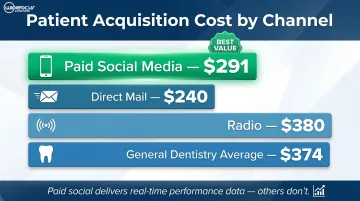
The numbers make the case clearly. Average patient acquisition cost for general dentistry is $374, but channel choice dramatically affects your efficiency. While direct mail averages $240 per patient and radio runs about $380, paid social media sits at roughly $291 per acquired patient across healthcare specialties. More importantly, paid social provides instant performance data—CTR, cost-per-lead, conversion rates—that traditional channels can't match. You know within days whether a campaign is working, not months later when the phone stops ringing.
Choosing the Right Platforms for Your Dental Ads
Platform choice can make or break a dental ad campaign. Where you run ads determines who sees them — and whether that audience is likely to book an appointment.
Facebook and Instagram
Facebook and Instagram (both managed through Meta Ads Manager) are the primary platforms for most dental practices. 77% of U.S. adults aged 30-49 use Facebook, the demographic most likely to make household dental care decisions. Among 50-64-year-olds—prime candidates for implants and restorative work—70% use Facebook, with 54% checking it daily.
Instagram reaches a younger audience: 78% of 18-29-year-olds and 68% of 30-49-year-olds use the platform. This makes Instagram ideal for promoting cosmetic services like teeth whitening, veneers, or clear aligners, where before-and-after visuals (within platform guidelines) and aspirational imagery drive engagement.
Key advantage: Running ads across both Facebook and Instagram simultaneously is easy and cost-efficient. You set up one campaign in Meta Ads Manager, and the platform optimizes delivery across both networks based on where your audience is most responsive.
TikTok
TikTok makes sense for dental practices targeting Gen Z and younger Millennials or promoting aesthetic services. 63% of U.S. adults under 30 use TikTok, and 44% of adults aged 30-49 are active on the platform. Short-form educational videos—how clear aligners work, what to expect during teeth whitening, myth-busting about dental procedures—can generate strong engagement and position your practice as approachable and modern.
The challenge: TikTok demands higher creative effort. Static images don't perform well. You need authentic, personality-driven video content that feels native to the platform, not like traditional advertising.
LinkedIn and Other Platforms
LinkedIn is rarely the right choice for patient acquisition. Patients don't scroll LinkedIn looking for a dentist.
That said, LinkedIn is valuable for B2B dental marketing: targeting corporate HR departments to promote employee dental benefit programs, connecting with multi-location DSOs for partnership opportunities, or building C-suite thought leadership for dental practice owners.
Pinterest and YouTube can support dental advertising in niche formats—infographics for oral health tips, procedure explainer videos—but neither should be your starting point. Start with Meta, add TikTok if your services skew cosmetic or your patients trend younger, and revisit other platforms once you have a baseline that's working.
Targeting the Right Patients: Audience Strategy for Dental Practices
Targeting determines whether your paid social campaign succeeds or fails. The most polished ad creative will underperform if shown to the wrong people. Dental practices must think geographically first—patients won't drive 30 miles for a cleaning—then layer on additional criteria to refine the audience.
Core Demographic Targeting
Start with location radius. For most dental practices, a 10-15 mile radius around your office is ideal. Urban practices in dense areas may tighten this to 5-7 miles; suburban or rural practices might expand to 20 miles if competition is sparse.
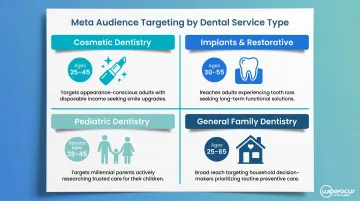
Next, align age range to the services you're promoting:
- Cosmetic dentistry (whitening, veneers): Target 25-45-year-olds who prioritize appearance and have disposable income
- Dental implants or restorative work: Target 30-55-year-olds, the age range when tooth loss and advanced dental issues become more common
- Pediatric dentistry: Target parents aged 28-45 with young children
- General family dentistry: Broaden to 25-65 to capture the full household decision-maker range
For high-value elective procedures like implants or full-mouth restorations, layer in household income targeting (typically $75,000+) to focus on patients more likely to afford the service.
Behavioral and Interest-Based Targeting
Demographics get you in the right neighborhood. Behavioral and interest-based targeting gets you in front of the right people within it. Meta's options here include:
- Interest targeting: People who follow dental health pages, cosmetic procedure accounts, or healthcare topics
- Life events: Target people who recently moved—a critical moment when patients need to establish new provider relationships, including finding a local dentist
- Life milestones: Engagement and wedding planning (strong indicator for cosmetic dentistry demand), new parents (pediatric dentistry need)
These behavioral layers help you reach people actively in-market for dental services, not just anyone within your zip code.
Retargeting and Lookalike Audiences
Retargeting is one of the highest-ROI tactics available. Install the Meta Pixel on your website to build custom audiences of people who:
- Visited your "book an appointment" page but didn't convert
- Viewed a specific service page (e.g., dental implants or Invisalign) but left without taking action
- Spent 30+ seconds on your site, indicating genuine interest
Retargeting campaigns typically deliver 2-3x better cost-per-lead performance than cold outreach—because these people already know your practice.
Lookalike Audiences scale your prospecting efficiently. Once you have a list of existing patients (email list, CRM data, or website visitors), Meta analyzes their shared characteristics (demographics, interests, online behavior) and builds a matched audience of new prospects. This lets you find patients who resemble your best existing ones without manually testing every demographic variable.
Creating Ad Content That Fills Appointment Books
Dental advertising operates under unique constraints. Ads cannot make unsubstantiated medical claims and must comply with HIPAA when patient imagery is involved. Before-and-after photos can also trigger flags under Meta's health and wellness policies. The most effective dental ads are honest, specific, and locally relevant.
Here's how to build ad content that earns clicks and fills chairs.
Ad Formats That Work for Dentists
Single image ads:
- Best for: Simple promotions (new patient specials, seasonal offers) with a clear headline and call-to-action
- Authentic practice photos outperform stock imagery — patients respond to real environments and real faces
Video ads (15-30 seconds):
- Effective for: Procedure explainers (how dental implants work), practice tours, or staff introductions that build trust before the patient walks in
- Video content showing a friendly, approachable team environment directly addresses dental anxiety, a primary barrier for non-patients
Carousel ads:
- Ideal for: Showcasing multiple services (orthodontics, cosmetic, restorative) or walking through a step-by-step treatment process
- Each card should focus on one benefit or service with a consistent CTA
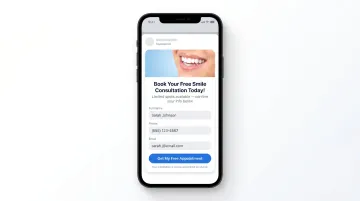
Meta Lead Ads:
- Allow patients to submit their name, phone, and email without leaving the platform
- Particularly effective for high-intent offers like free consultations for implants or new patient discounts
- Patients submit details without leaving the platform, removing a step that typically causes drop-off
Copy and Visual Best Practices for Dental Ads
Lead with the patient's problem or desire, not your practice name. Your ad headline should immediately answer "What's in it for me?"—"Get a Brighter Smile in Just One Visit" outperforms "ABC Dental—Serving Denver Since 2005."
Keep primary text under 125 characters for mobile users. Most social ads are viewed on phones where screen space is limited. Front-load the most important information.
Use your location name in the headline to signal local relevance: "Affordable Dental Implants in Austin" instantly tells users you're nearby and relevant.
Include a single, clear CTA. Don't ask users to "Learn more, book now, or call us." Pick one action and optimize the ad for that outcome.
Visual best practices:
- Authentic photography of your actual practice and real staff outperforms stock imagery in trust and engagement
- Before-and-after images can be powerful but must be used carefully—Meta restricts before-and-after imagery for cosmetic procedures. Avoid side-by-side transformation comparisons; showcase results independently with clear disclaimers
- Short team videos address dental anxiety before a patient ever contacts you — a warm face on screen does what a headline can't
Dental-Specific CTAs and Offers
Proven CTAs and offer types:
- "Book a Free Consultation" — works well for implants, Invisalign, or cosmetic cases where patients need a conversation before committing
- "Claim Your New Patient Offer" — specific dollar amounts ($99 New Patient Exam + X-Rays) outperform vague "special offer" language
- "Reserve Your Appointment" — less clinical than "Schedule" and more action-oriented
CRITICAL: The landing page or booking page your ad links to must match the offer exactly. If your ad promises "$99 New Patient Exam," that price and offer must be prominently displayed on the landing page. Mismatches between ad and landing page are a top cause of high bounce rates and low conversions.
Budgeting, Campaign Setup, and Optimization
There's no universal "right" budget for dental paid social—it depends on your market's competitiveness, the services you're promoting, and your growth goals. As a reference point, dental practices running lead generation campaigns on Facebook see an average cost-per-lead of $76.71, with an average cost-per-click of $9.78 and a click-through rate of 1.05%. A practice promoting general cleanings operates under a significantly different cost structure than one promoting full-arch implants, where patient lifetime value justifies higher acquisition costs.
Setting Up Your Campaign Structure
Recommended campaign architecture in Meta Ads Manager:
- Separate campaigns for separate goals: Awareness campaigns, lead generation campaigns, and retargeting campaigns should never be combined—they have different optimization objectives
- Tightly themed ad sets: Match one audience segment to one offer. Don't combine "new movers + parents + people interested in cosmetic dentistry" in a single ad set—the algorithm can't optimize effectively, and you won't know which audience drove results
The Learning Phase:
New Meta ad campaigns need time—typically 7-14 days and approximately 50 conversion events—before the algorithm optimizes delivery. During this learning phase, performance is less stable and costs may be higher. Avoid making significant changes—creative swaps, targeting adjustments, budget shifts—during this period, as each edit resets the learning clock and extends the stabilization window.
Those first two weeks reward patience. Working with an agency experienced in dental paid campaigns, such as WideFoc.us, can reduce trial-and-error and compress the time it takes to reach stable, meaningful results.
Key Metrics to Track and Optimize
Once campaigns are running and past the learning phase, consistent measurement is what separates practices that scale efficiently from those that keep guessing.
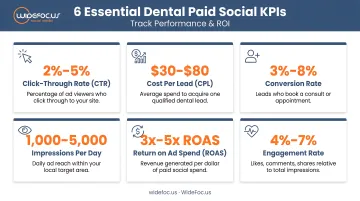
Essential KPIs for dental practices:
- Cost Per Lead (CPL): What you pay for each appointment request or consultation form submission
- Click-Through Rate (CTR): Percentage of people who see your ad and click it—dental campaigns average 1.05% CTR on Facebook
- Cost Per Click (CPC): What you pay for each click to your website or landing page
- Conversion Rate: Percentage of ad clicks that turn into booked appointments
- Return on Ad Spend (ROAS): Revenue generated divided by ad spend—critical for high-value services like implants
- Frequency: How many times the same person sees your ad—high frequency (5+ exposures) signals audience fatigue and can increase costs by 50-80%
Optimization cadence:
- Weekly: Monitor CTR and CPL to catch underperforming creatives or audiences early; pause weak performers and scale winners
- Monthly: Assess overall ROAS and rebalance budget allocation across campaigns based on what's converting
- Quarterly: Align campaigns with seasonal demand—end-of-year insurance benefits (October–November), back-to-school pediatric promotions (July–August)
Legal and Compliance Considerations for Dental Social Ads
Dental practices must navigate two critical compliance frameworks: HIPAA and FTC truth-in-advertising rules. Violations can result in significant fines, reputational damage, and loss of patient trust.
HIPAA Requirements
Dental practices are explicitly classified as HIPAA-covered entities. Any patient images, testimonials, or content that could identify a patient requires explicit written authorization before it appears in advertising.
Even tagging a patient's location in a social post — or referencing a specific treatment in response to a review — can trigger a HIPAA violation if it reveals someone is a patient.
Have a documented patient consent process before featuring any patient content in paid ads. This includes written authorization forms that specify how the content will be used, where it will appear, and for how long.
FTC and ADA Ethics Requirements
The ADA Principles of Ethics prohibit advertising that is "false or misleading in any material respect." Key rules include:
- Avoid claiming "lowest prices" or "best results" without supporting evidence
- Before-and-after imagery must reflect realistic, typical outcomes and include appropriate disclaimers
- Promotional pricing must be transparent about conditions (e.g., "new patients only," "excludes insurance")
The FTC requires that all health claims be supported by "competent and reliable scientific evidence" — meaning peer-reviewed studies or clinical research, not anecdotal patient stories.
State Dental Board Rules
State dental boards layer additional advertising requirements on top of federal FTC rules and ADA standards. Requirements vary by state, so before running price-based promotions or comparative advertising, consult your state dental association or legal counsel to confirm what's permitted.
Frequently Asked Questions
How much should a dental practice budget for paid social media ads?
Most single-location practices start with $1,500–$3,000/month for meaningful testing and optimization. High-value services like implants can justify higher spend, given that patient lifetime value often exceeds $10,000–$20,000.
Which social media platform is best for dental practice advertising?
Facebook and Instagram (via Meta Ads Manager) are the top starting point for most practices due to their local targeting capabilities and broad adult demographic reach. TikTok is a secondary option for cosmetic-focused practices or campaigns targeting younger audiences.
What types of dental services perform best in paid social ads?
High-value elective services—dental implants, cosmetic dentistry, Invisalign/clear aligners, and teeth whitening—perform best because patients actively research them and respond to clear offers. General cleanings work better as awareness or reactivation campaigns for existing patient lists.
How does HIPAA affect dental social media advertising?
HIPAA requires written patient authorization before using any identifiable patient information (photos, testimonials, or treatment details) in ads. Even indirect disclosures—like confirming someone is a patient in a review response—can constitute a violation.
How long does it take to see results from paid dental social ads?
Campaigns typically need a 7-14 day learning phase before Meta's algorithm optimizes delivery. Most practices see meaningful lead volume within the first 30-60 days, with performance improving further as data accumulates and creative is refined.
Should a dental practice manage paid social ads in-house or work with an agency?
In-house management offers control but demands real time and platform expertise most practices don't have on staff. Agencies with paid social experience typically deliver lower cost-per-lead and faster ramp-up—especially for practices without a dedicated marketing hire.