Introduction
B2B marketers face a persistent frustration: generic social media agencies that optimize for vanity metrics—impressions, likes, shares—instead of what actually matters: pipeline, qualified leads, and revenue. When your sales cycle spans months and your buying decisions involve CFOs, IT directors, and end users, an agency that treats your campaigns like consumer flash sales will burn through budget without generating a single qualified opportunity.
B2B buying cycles involve multiple stakeholders consuming 7–10 pieces of content before vendor selection, demanding precise targeting to reach decision-makers at the right stage. According to the Content Marketing Institute's 2025 research, 84% of B2B marketers use paid channels and 73% use social media advertising.
Yet 56% still struggle to attribute ROI to those efforts. Choosing the wrong paid social agency makes that attribution problem worse.
This guide covers the services a qualified B2B paid social agency should offer, what pricing looks like in 2026, and how to evaluate candidates so you choose a partner that drives real business outcomes—not just dashboard metrics.
Key Takeaways
- B2B paid social requires specialized expertise—campaigns must nurture long sales cycles, target buying committees, and tie spend directly to pipeline revenue
- Core services cover full-funnel campaign architecture, ABM targeting, persona-specific creative testing, and CRM-integrated attribution reporting
- Expect $4,500–$11,000/month in agency fees plus $2,000–$5,000+ in ad spend for mid-market B2B; fixed retainers align incentives better than percentage-of-spend models
- Evaluate agencies on B2B fluency, creative testing rigor, and how well they integrate with your sales team and CRM
Why B2B Paid Social Demands a Specialized Approach
B2C paid social targets individuals making fast, often emotional purchase decisions—impulse buys, limited comparison shopping, single decision-makers. B2B targets buying committees navigating months-long evaluation processes. 3.1–4.6 departmental groups influence the average purchase, and buyers typically consume 7–10 pieces of content before selecting a vendor. Your ads must educate and nurture over time, not just convert on the spot.
Multi-Stakeholder Complexity
A CFO evaluating ROI, an IT director assessing security and integration, and an end user prioritizing ease-of-use may all influence the same purchase—but each needs different messaging. The CFO wants cost-per-acquisition data and contract flexibility; the IT director needs API documentation and compliance certifications; the end user cares about interface and support. Audience segmentation and funnel-stage targeting aren't optional—they're the difference between qualified pipeline and wasted impressions.
Why Organic Alone Isn't Enough
Organic social builds brand presence, but it lacks the precision B2B pipeline goals demand. Paid amplification provides targeting controls needed to reach the right decision-makers systematically:
- Job title, seniority level, and department
- Company size and industry vertical
- Specific named accounts for ABM campaigns
LinkedIn reports that 89% of B2B marketers use the platform for lead generation, and 62% say it actually delivers. Paid social doesn't replace organic; it amplifies your best content to the audiences that matter most, at scale.
That self-serve dynamic is only growing. 67% of B2B buyers now prefer a rep-free experience, making self-guided digital touchpoints—including paid social—essential for pipeline generation.
Core Services a B2B Paid Social Agency Should Offer
Full-Funnel Campaign Architecture
A qualified agency builds campaigns across awareness, consideration, and decision stages—not just bottom-funnel lead gen ads. Each stage requires different ad formats and content:
- Awareness stage: Thought leadership content (whitepapers, research reports, webinars) served via Sponsored Content to cold audiences segmented by firmographics
- Consideration stage: Case studies, product comparison guides, and demo videos targeted to engaged audiences and website visitors
- Decision stage: Direct offers (free trials, consultation bookings, pricing calculators) with Lead Gen Forms to minimize friction
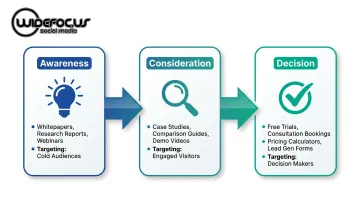
Messaging must stay consistent across touchpoints so a prospect moving from awareness to decision experiences a coherent narrative, not disjointed tactics.
Account-Based Marketing (ABM) Capabilities
ABM campaigns target specific named accounts or lookalike segments—critical for B2B companies with high annual contract value deals. A strong agency can:
- Upload and manage account lists for targeting (using matched audiences or account targeting features)
- Segment by buyer role within target accounts (finance, IT, operations)
- Serve personalized creative to buying committee members simultaneously
- Track account-level engagement and pipeline contribution
Agencies that skip ABM capabilities end up burning budget on broad audiences unlikely to convert.
Creative Development and A/B Testing
B2B audiences are niche, so creative fatigue happens faster than in consumer campaigns. A strong agency produces persona-specific creative variants, tests headlines, visuals, and CTAs systematically, and refreshes assets based on performance data rather than guesswork.
Systematic testing includes:
- Documented test hypotheses (e.g., "CFOs respond better to ROI-focused headlines than feature lists")
- Controlled variables (test one element at a time)
- Statistical significance thresholds before declaring winners
- Refresh cycles based on frequency data (impressions per user, engagement decay)
Agencies without a structured testing process plateau quickly as audiences tire of repetitive creative.
Attribution and Pipeline Reporting
This is what separates serious B2B paid social agencies from generic ones: the ability to connect ad spend to pipeline metrics—cost-per-lead, cost-per-opportunity, cost-per-closed-won deal, MQL-to-SQL conversion rates—rather than stopping at impressions and clicks.
According to a benchmark survey by The MX Group, 73% of B2B marketers have increased emphasis on measurement and attribution to prove ROI. Most agencies still report only platform-level vanity metrics.
CRM-integrated reporting should include:
- Multi-touch attribution models (linear, time-decay, U-shaped, W-shaped) that reflect complex buyer journeys
- Cost-per-opportunity and pipeline contribution by campaign, ad set, and creative
- Channel-specific customer acquisition cost (CAC) and payback period
- Lead quality metrics (MQL rate, SQL rate, opportunity conversion rate, closed-won rate)
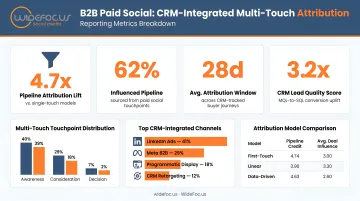
Without CRM integration, you can't distinguish campaigns that generate junk leads from those that actually drive revenue.
Community Management and Audience Engagement
Paid campaigns don't operate in isolation. When a prospect clicks your Sponsored Content, visits your LinkedIn Company Page, and finds posts from six months ago with zero activity, trust evaporates immediately.
A capable agency integrates paid amplification with real-time engagement, content publishing, and reputation management. WideFoc.us takes this approach by pairing paid campaigns with active organic community management, so every touchpoint a prospect encounters reinforces the same credible brand presence.
Which Platforms Work Best for B2B Paid Social
LinkedIn: The Primary B2B Paid Social Platform
LinkedIn dominates B2B paid social because its targeting is unmatched. 89% of B2B marketers use it for lead generation — and it's easy to see why. You can target by job title, seniority, company, industry, company size, skills, and education, making it the default platform for reaching business decision-makers.
Main LinkedIn ad formats:
- Sponsored Content: In-feed ads supporting single image, carousel, video, document, or event formats
- Sponsored Messaging: Message Ads and Conversation Ads delivered directly to LinkedIn inboxes
- Lead Gen Forms that pre-fill with LinkedIn profile data, cutting friction at the point of conversion
- Text Ads: Pay-per-click or impression-based placements in the right rail — low cost, easy to self-serve
- Dynamic Ads: Personalized placements (Follower Ads, Spotlight Ads, Content Ads) that pull from member profile data
LinkedIn's official targeting documentation details locations, audience attributes (company, job experience, education, demographics), and matched audiences for account-based targeting.
Secondary Platforms Worth Considering
LinkedIn won't be the right fit for every campaign or budget. These platforms earn a place in many B2B strategies:
- Facebook/Meta: Lower cost-per-click than LinkedIn, with strong retargeting capabilities. Best for mid-funnel awareness when your ICP is active on the platform.
- YouTube: Ideal for thought leadership, product demos, and educational content that reaches decision-makers during the research phase.
- Reddit and Quora: Niche communities where technical buyers and practitioners seek peer advice — useful for highly specific audience segments.
Start with audience research: where do your ideal buyers actually spend time online? Let that answer drive platform selection.
Integrated Organic and Paid Strategy
B2B paid social performs best when it's connected to your organic strategy, not running in isolation. Organic content testing reveals which topics resonate with your audience; paid then amplifies those proven winners to cold audiences at scale. Retargeting website visitors and engaged followers adds another layer, keeping your brand visible throughout longer B2B buying cycles.
B2B Paid Social Agency Pricing: What to Expect
Monthly Retainer Tiers
Entry-level ($4,500–$6,000/month):
- Single-platform management (typically LinkedIn)
- Basic campaign setup and optimization
- Monthly reporting with platform-level metrics
- Email support and quarterly strategy calls
Mid-tier ($6,000–$9,000/month):
- Multi-platform management (LinkedIn + Meta or YouTube)
- CRM integration and pipeline reporting
- Dedicated account manager
- Bi-weekly optimization and monthly strategy calls
- Creative recommendations and refresh cycles
Full-service ($10,000–$20,000+/month):
- ABM capabilities with account list management
- Advanced multi-touch attribution modeling
- Executive partnership and sales team integration
- Custom creative development and systematic A/B testing
- Weekly optimization and strategic planning
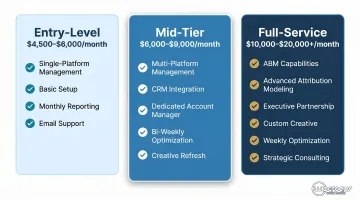
These are agency fees only, separate from ad spend paid directly to platforms.
Ad Spend Minimums
Most B2B-focused agencies require minimum monthly ad spend of $2,000–$5,000 because below certain thresholds, data volume is too low for meaningful optimization. LinkedIn's higher cost-per-click (typically $4–$9) means smaller budgets generate insufficient impressions and clicks to identify winning audiences, creative, and messaging. Agencies can still run campaigns below these minimums, but results may be less consistent and testing cycles take longer.
Fixed Retainer vs. Percentage-of-Spend Models
Percentage-of-spend models can misalign incentives: the agency earns more when you spend more, regardless of efficiency. At 15–20% of ad spend, there's a built-in financial motive to push budgets higher even when performance has plateaued.
Fixed retainers align agency incentives with performance improvement rather than budget inflation. The agency earns the same whether your campaign spends $3,000 or $5,000, so their focus shifts to efficiency and results. WideFoc.us uses a hybrid model: $300 flat fee for budgets up to $1,500, or approximately 20% of ad spend above that threshold—acknowledging the real workload required even at lower spend levels.
What Should Be Included at Any Price Point
Regardless of tier, any legitimate B2B paid social agency should include:
- Campaign setup and ongoing optimization
- Performance dashboards (at minimum: impressions, clicks, CTR, conversions, cost-per-lead)
- Regular strategy calls (at least monthly)
- Creative recommendations and refresh guidance
- Clear performance benchmarks tied to your business goals
These aren't premium add-ons — they're table stakes. Any agency that can't commit to them isn't structured for B2B success.
When In-House Management Makes More Sense
Once you know what a full-service agency delivers, the build-vs-buy question becomes easier to answer. If total monthly investment (fees + ad spend) falls below $6,000–$8,000, in-house management may be more cost-effective — though you trade breadth of expertise for budget savings.
A full-time social media manager costs $70,000+ annually in salary alone (over $90,000 with benefits and overhead). For comparable investment, an agency brings an entire team: strategists, account managers, designers, paid specialists, analysts, and more. The case for an agency grows stronger as your budget, targeting complexity, and ABM requirements scale up.
How to Evaluate and Choose a B2B Paid Social Agency
Assess B2B Fluency, Not Just Social Media Expertise
A strong B2B paid social agency understands buyer journeys, sales cycles, and what "qualified lead" means in a business context. In discovery calls, ask:
- How have you managed campaigns for products with 6–12 month sales cycles?
- How do you differentiate messaging for economic buyers versus technical evaluators?
- What metrics do you track beyond MQLs—cost-per-opportunity, pipeline contribution, closed-won attribution?
WideFoc.us, for example, has spent 19+ years working exclusively in B2B and B2C social campaigns, which translates into fluency with the longer sales cycles and multi-stakeholder dynamics that standard social agencies often underestimate.
Evaluate Attribution and Reporting Depth
Ask to see sample dashboards. Look for:
- Cost-per-opportunity and pipeline contribution by campaign
- Channel-specific CAC and payback period
- Multi-touch attribution models
- MQL-to-SQL and SQL-to-opportunity conversion rates
Red flag: Any agency that can only show platform-level metrics (impressions, CTR, cost-per-click) without connecting spend to revenue outcomes.
Understand Their Creative and Testing Process
Ask:
- How do you develop creative—templates, custom design, or a mix?
- How frequently do you refresh assets?
- How do you document test hypotheses and track results?
An agency without a systematic A/B testing process (documented hypotheses, controlled variables, statistical significance thresholds) is likely to plateau quickly on B2B audiences that are small and easily over-saturated.
Check Alignment on Collaboration and Transparency
B2B paid social works best when the agency operates as an extension of your team:
- Attending regular strategy calls
- Incorporating sales team feedback on lead quality
- Adjusting targeting based on closed-won deal data
- Sharing performance data transparently
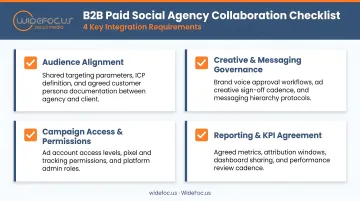
Agencies that resist deep client collaboration, refuse to share login credentials, or treat campaign details as proprietary are red flags.
Red flag: Withholding platform access or performance data is a dealbreaker—you should own your accounts and have visibility into every campaign decision.
HubSpot offers a downloadable agency evaluation checklist to assess partners across capabilities and fit.
Frequently Asked Questions
What is B2B social media management?
B2B social media management encompasses planning, publishing, monitoring, and optimizing social media content and paid campaigns specifically for business audiences. The focus is on reaching decision-makers, nurturing long sales cycles, and driving qualified leads—not mass consumer engagement or vanity metrics like follower counts.
What are common social media rules and frameworks (like the 5-5-5 rule, the 3-3-3 rule, and the 7 C's)?
These are practical content frameworks (such as the 7 C's: Content, Community, Conversation, and others) used primarily for organic social strategy. While useful as planning guides, B2B paid social layers targeting precision, funnel architecture, and CRM-integrated attribution on top of these fundamentals, making them insufficient on their own for performance-driven campaigns.
What platforms work best for B2B paid social advertising?
LinkedIn is the dominant platform for B2B paid social due to unmatched professional targeting (job title, seniority, industry, company size). Meta (Facebook/Instagram) works well for retargeting and mid-funnel nurturing, while YouTube supports video-based thought leadership. Platform selection should follow audience research and campaign objectives, not assumptions.
How long does it take to see results from B2B paid social campaigns?
Initial data and optimization signals typically emerge within 30–60 days as campaigns gather impressions and clicks. Meaningful pipeline impact usually takes 3–6 months, given longer B2B sales cycles where buyers consume multiple content pieces before engaging sales. Consistent measurement is essential; resist drawing conclusions before the 90-day mark.
When should a B2B company hire a paid social agency rather than manage campaigns in-house?
Hiring an agency makes the most sense when campaigns involve multi-platform management, ABM complexity, or budgets above $6,000–$8,000 monthly (fees + spend). Agencies deliver specialized expertise across strategy, creative, optimization, and attribution at a lower cost than building an in-house team. Simpler, single-platform campaigns with modest budgets are often manageable in-house.
What should a B2B paid social agency include in monthly reporting?
Quality reporting goes beyond impressions and clicks. Strong monthly reports should cover:
- Cost-per-lead and cost-per-opportunity
- MQL and SQL volume with conversion rates
- Pipeline contribution and revenue attribution
- Creative performance breakdowns
- Clear recommendations for the next optimization cycle
Reports should connect ad spend to revenue outcomes using CRM-integrated data, not just platform dashboards.