The data tells a different story. According to the Content Marketing Institute's 2025 research, 89% of B2B marketers use organic social media as their top content distribution channel — ahead of email, blogs, and every other tactic. It's already the dominant channel. The question is whether you're using it with intention.
This guide covers how to set the right goals, choose the platforms worth your time, create content that resonates with business buyers, amplify reach through employees and influencers, and measure results that leadership actually cares about.
Key Takeaways
- B2B social media targets professionals making organizational decisions — content must address business outcomes, not personal desires
- LinkedIn is non-negotiable for B2B — start there, then add 1-2 platforms where your buyers already spend time
- 70% of B2B buyers watch video during the purchase process — lo-fi, authentic video outperforms high-budget production value
- Employee-shared content generates 8x more engagement than brand page posts
- Measure engagement trends, click-through rate, and pipeline influence — follower counts alone tell you nothing
What Makes B2B Social Media Different
B2B social media operates under fundamentally different rules than consumer marketing — and the structural differences shape every strategic decision you'll make.
The Buying Group Problem
When you're selling to a business, you're rarely selling to one person. Gartner estimates the average B2B buying group involves 6–10 stakeholders. Each one brings different priorities, objections, and information needs. Your content needs to address a CFO's ROI concerns, a CTO's integration questions, and an end user's workflow worries — often simultaneously.
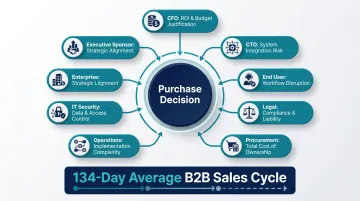
Add to that a sales cycle that's grown to an average of 134 days for B2B SaaS deals, and you start to understand why a single viral post doesn't close business.
The Trust Gap
Only 29% of B2B buyers trust information from vendors, according to Forrester. Over 90% trust their peers. That means your company-branded content starts at a credibility deficit before it's even read.
What earns trust in B2B social media:
- Thought leadership that teaches without an obvious sales agenda
- Customer voices, peer reviews, and case studies
- Consistent expertise demonstrated over months, not days
- Personal accounts from real people inside the organization
B2B social media builds relationships and credibility over time. Treat it as a long-game trust channel, not a direct conversion tool, and your strategy will reflect how buyers actually make decisions.
Step 1: Define Your Goals and Know Your Audience
Set Goals That Actually Guide Decisions
"More followers" is not a goal. It's a hope. A real goal looks like: Increase LinkedIn engagement rate by 15% over 90 days to generate more inbound demo requests from mid-market SaaS companies.
Use the SMART framework — Specific, Measurable, Attainable, Relevant, Time-bound — and connect every goal to a business outcome, not a platform metric. Companies that exceed revenue goals are 93% more likely to use documented buyer personas to guide strategy. Documented personas give your content direction, your team alignment, and your results something to measure against.
Map Content to Funnel Stages
Different content serves different purposes at different times:
| Funnel Stage | Goal | Content Types |
|---|---|---|
| TOFU (Awareness) | Generate curiosity | Industry insights, relatable observations, data posts |
| MOFU (Consideration) | Support evaluation | Case studies, demos, comparison content, how-to guides |
| BOFU (Decision) | Reinforce and convert | Testimonials, success stories, ROI proof points |
Don't post exclusively at one stage. Most B2B brands over-invest in BOFU promotional content and under-invest in TOFU material that actually builds the audience in the first place.
Build Your Publishing Foundation
Once you know what content each funnel stage needs, the next question is execution. Start with a 90-day content calendar before you even think about posting frequency. Consistent publishing earns algorithmic favor — and the planning discipline behind a calendar keeps your strategy from becoming reactive.
Audit competitors first. Look for where they're silent, which formats earn engagement, and where your perspective adds something they're not offering. That's where your brand has room to differentiate.
Step 2: Choose the Right Platforms for B2B
Start With LinkedIn — Then Be Strategic About Everything Else
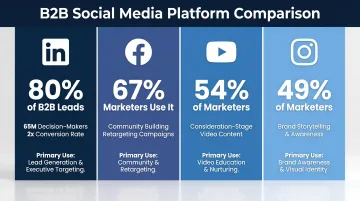
LinkedIn is the non-negotiable starting point. With 65 million decision-makers, 90 million senior-level influencers, and 4 out of 5 members driving business decisions within their organizations, no other platform concentrates professional buying power the same way. LinkedIn also generates 80% of all B2B social media leads and produces conversion rates 2x higher than other social channels.
But LinkedIn alone isn't a complete strategy.
The supporting cast depends on your audience and goals. 67% of B2B content marketers use Facebook — primarily for community groups, retargeting, and reaching broader business audiences. YouTube matters for buyers in consideration mode; 54% of B2B marketers use it, and it's where buyers go to watch product walkthroughs and customer reviews before they commit. Instagram, used by 49% of B2B marketers, plays a growing role in brand awareness, particularly for younger decision-makers.
The Video Reality
70% of B2B buyers incorporate video into their purchase decisions. That number alone should prompt a hard look at your video output.
What's less intuitive: lo-fi video — smartphone-shot, unpolished, conversational — achieves 40% higher click-through rate than studio-produced content. A sales engineer explaining a product concept in 90 seconds on their phone often lands better than a $10,000 explainer video.
Where to start:
- Pick 2–3 platforms based on where your specific audience is active
- Establish consistent output on those platforms before expanding
- Build video into your LinkedIn presence from day one, not as an afterthought
Step 3: Create Content That Speaks to Business Decision-Makers
The Content Mix That Actually Works
B2B social content isn't one thing. Effective programs deliberately balance:
- Thought leadership and industry perspectives — original takes on market trends, not commentary on obvious news
- Original data and research — proprietary insights your audience can't get elsewhere
- How-to and educational posts — practical guidance that solves real problems
- Customer success stories — specific outcomes, not generic praise
- Short product demos — especially useful for consideration-stage buyers on YouTube and LinkedIn
The 80/20 rule applies here: roughly 80% of posts should deliver value to the audience, 20% can directly promote the brand. Feeds that read like a continuous sales pitch lose followers steadily. Feeds that consistently teach something retain them.
Why Customer Voices Outperform Brand Content
93% of B2B buyers consider online reviews important when making purchase decisions, and 31% consult review sites more than any other source. This pattern extends to social media — customer testimonials, employee spotlights, and peer success stories carry more weight than anything your marketing team writes about itself.
Share customer wins publicly. Feature the humans behind your client relationships. Let buyers see themselves in the stories you tell.
AI in the Content Workflow
AI tools can accelerate ideation, generate first drafts, and help repurpose long-form content into social posts. Used well, they cut production time without sacrificing quality. The risk is relying on them too heavily.
Generic AI output is detectable — by audiences and increasingly by algorithms. To keep content credible:
- Edit every draft for brand voice before publishing
- Add specific data points, client examples, or original perspective
- Apply strategic judgment about what to post, not just what to produce
The brands winning on social aren't publishing the most AI-assisted content. They're the ones where human judgment shapes what AI generates.
The proof is in execution. WideFoc.us has generated over 20 million impressions and 1 million link clicks across its B2B client portfolio by pairing platform-specific content strategy with hands-on human oversight. For B2B fintech clients, that approach has produced more than 1.2 million monthly impressions and over 3,000 monthly website clicks — placing social ahead of every other marketing-generated traffic source.
Step 4: Amplify Reach Through Employee Advocacy and Influencer Partnerships
Employee Advocacy: Your Most Underused Asset
Employees carry something a brand page never can: personal credibility. That's what makes employee advocacy one of the highest-leverage moves in B2B social media.
Content shared by employees generates 8x more engagement than the same content from a brand page. Leads from employee-shared content are 7x more likely to convert, and 67% of decision-makers prefer thought leadership from an identifiable author over faceless corporate posts.
Running an effective program:
- Provide pre-approved, ready-to-share posts — remove the need for employees to create content from scratch
- Run LinkedIn lunch-and-learns to get sales teams comfortable posting and engaging on the platform
- Recognize contributors publicly — acknowledgment sustains momentum far better than mandates
- Connect advocacy to professional development — programs that feel like obligations fade fast; those tied to career growth stick
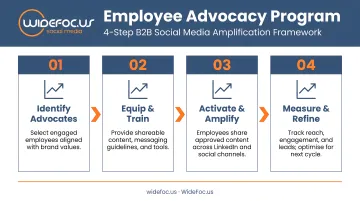
WideFoc.us builds this model into its C-Suite Thought Leadership service — executive LinkedIn profile optimization, ghostwritten posts, and sales team enablement sessions that turn personal profiles into consistent lead sources.
B2B Influencer Marketing: How to Choose the Right Partners
75% of B2B marketers now use influencer marketing, and 93% plan to increase investment. B2B influencers aren't celebrities — they're industry analysts, niche practitioners, active LinkedIn creators, and respected voices in specific verticals.
LinkedIn is the primary channel, with 96% of B2B influencer practitioners identifying it as their most effective platform. Short-form video on other platforms is growing fast as a secondary channel for awareness and credibility building.
Mix nano, micro, and macro influencers based on your objective: nano and micro tend to deliver deeper engagement with specific audiences; macro expands reach. Evaluate partners on engagement quality, content relevance, and audience composition — not follower count alone.
Step 5: Measure What Matters and Prove ROI
Metrics That Tell the Real Story
Follower count is a context metric, not a performance metric. Focus reporting on:
- Engagement rate trends — directional movement matters more than the absolute number
- Click-through rate — signals content relevance and audience intent
- Lead volume and quality — specifically, how many leads from social are converting further down the funnel
- Pipeline influence — deals where social touchpoints appeared at any point in the journey
- Revenue attribution — even partial attribution, where provable
Average LinkedIn engagement benchmarks sit around 3.85% for personal profiles, with document and carousel posts reaching 6–7%. Use these as reference points, not targets.
The Attribution Challenge
58% of B2B marketers identify measuring content performance as a top challenge. This is partly a tooling problem and partly a structural one — B2B deals close through conversations, not clicks, which makes tracing social's influence difficult.
Practical solutions:
- UTM parameters on every link — no exceptions
- CRM pipeline notes — train sales to log social interactions as touchpoints
- MQL and SQL tracking tied to social campaigns, not just website sessions
- Social listening to capture brand mentions and sentiment that never show up in analytics
Some influence will remain invisible. Build the business case anyway, using both quantitative data and qualitative pipeline signals — together, they tell a more complete story than either alone.
Reporting to Leadership
Frame social ROI in business language, not platform language. "We increased LinkedIn engagement by 22%" means nothing to a CFO. "Social contributed 34 qualified leads last quarter at a cost-per-lead 40% below paid search" justifies budget.
Position social media as a pipeline contributor, not a marketing line item. When the data supports it, connect social activity directly to lower customer acquisition costs, higher lead quality, and compressed sales cycles.
Frequently Asked Questions
What is B2B social media marketing?
B2B social media marketing is the use of social platforms to promote products, services, or brand awareness to other businesses — reaching decision-makers and industry professionals, not individual consumers. The primary goals are lead generation, relationship building, and thought leadership.
Is social media good for B2B marketing?
Yes. Social media supports brand awareness, lead generation, thought leadership, and relationship development across the full sales cycle. A growing share of B2B revenue is influenced by social touchpoints, with 74% of B2B marketers reporting content marketing successfully generated demand or leads in 2024.
Which is the best B2B social networking site?
LinkedIn is the leading B2B platform — it generates 80% of all B2B social media leads and concentrates the highest density of decision-makers. Facebook, YouTube, and Instagram each serve specific use cases depending on industry, audience, and content format.
What does a B2B agency do?
A B2B marketing agency develops and executes strategies to reach business buyers: social media, content creation, paid campaigns, community management, and performance measurement. These services are tailored to longer sales cycles and multi-stakeholder buying decisions.
Is a social media agency B2B?
Social media agencies can serve both B2B and B2C clients. A B2B-focused agency like WideFoc.us specializes in strategies built for business buyers: professional credibility, qualified lead generation, and content tailored to longer sales cycles.
How much does a B2B marketing agency cost?
Costs vary based on scope and services. Retainer engagements at agencies like WideFoc.us typically run $4,500–$11,000 per month for full-service management. When comparing options, prioritize track record and ability to tie social activity to measurable outcomes over price alone.