The challenge? Many B2B companies approach social media as an afterthought, posting sporadically without a clear strategy, measurable goals, or understanding of what actually drives business outcomes. This guide walks you through building a B2B social media strategy that delivers real results: qualified leads, stronger brand authority, and measurable ROI—not just vanity metrics.
Key Takeaways
- Set business-aligned goals tied to revenue, not just engagement
- Prioritize LinkedIn for B2B reach, then layer in YouTube, Facebook, or emerging platforms based on where your audience actually spends time
- Build a content mix where 70-80% educates or adds value, and only 20-30% promotes
- Use employee advocacy to amplify organic reach — it generates 561% more reach than brand channels
- Measure ROI using multi-touch attribution, pipeline influence, and customer acquisition cost
What Sets B2B Social Media Strategy Apart
B2B social media operates under fundamentally different rules than B2C. The structural differences shape every aspect of your strategy.
Multiple stakeholders, longer timelines: According to Forrester's 2024 State of Business Buying report, an average of 13 people are involved in B2B purchase decisions, with 89% of purchases crossing two or more departments. Gartner research consistently shows 6-10 decision-makers for complex B2B solutions.
That buying committee includes very different people with very different priorities:
- CFOs evaluating ROI and total cost of ownership
- Technical users assessing features and integration requirements
- Procurement teams comparing vendors and contract terms
Your social content must speak to all three — often simultaneously.
The sales cycle reflects this complexity. The 6sense 2025 B2B Buyer Experience Report found that the average B2B buying cycle runs 10.1 months, with approximately 27 touchpoints before a purchase decision.
Seventy percent of that journey is self-directed — completed before a prospect ever contacts sales. Your social strategy needs to serve that research phase with educational, value-driven content.
The 95/5 Principle: Why Always-On Content Matters
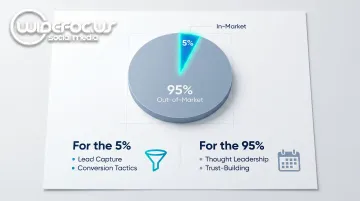
Research by Professor John Dawes of the Ehrenberg-Bass Institute, conducted jointly with the LinkedIn B2B Institute, reveals a striking reality: at any given time, only about 5% of your B2B audience is actively in-market and ready to buy. The other 95% are out-of-market — they don't need your solution today, next month, or even this quarter.
This principle has profound implications:
- Short-term lead capture campaigns will only ever reach the 5%
- The 95% need long-term brand-building content that keeps you top-of-mind
- When their buying window opens months or years later, you want to be the first name they remember
- Consistent, valuable content builds the trust and credibility required to win consideration when they finally enter market
The 95/5 rule means your social presence needs to work even when no one is actively buying. Thought leadership, educational content, and authentic brand-building must anchor your strategy — not just promotional posts chasing immediate conversions.
B2B Doesn't Mean Boring
These structural differences don't justify dull, overly formal content. They mean your strategy must account for longer decision timelines, multiple audience personas, and value-driven content that builds credibility over time. The best B2B social accounts balance professionalism with personality, data with storytelling, and expertise with approachability.
Set Goals That Connect Social to Business Outcomes
Undefined goals are the number one reason B2B social media efforts stall. Without clear targets, you can't decide what to post, where to post, or whether it's working. Treat social media as a strategic business channel tied to revenue, pipeline, and customer acquisition—not an afterthought bolted onto your content calendar.
Why Goal-Setting Matters
Content Marketing Institute's 2025 B2B research found that 58% of B2B marketers report difficulty attributing sales to content efforts, and only 49% feel their organization measures performance accurately. Without clear goals, tactics drift, results become unmeasurable, and leadership loses confidence in social's contribution to the business.
The solution starts with the SMART goal framework: goals must be Specific, Measurable, Attainable, Relevant, and Time-Bound.
Example of a SMART B2B social goal:
"Increase LinkedIn engagement rate from 4.2% to 5.5% over the next 90 days by publishing four thought leadership posts per week from executives and subject matter experts, targeting decision-makers in fintech companies."
It names the platform, the content type, the audience, a concrete target, and a deadline—with median B2B LinkedIn engagement sitting at 5.72%, a move from 4.2% to 5.5% is ambitious but realistic.
Four Core B2B Social Media Goal Categories
- Brand awareness — Track impressions, reach, share of voice, and branded search volume among target accounts and decision-makers.
- Lead generation — Track leads from social sources, gated content conversion rates (whitepapers, webinars), and lead quality scores.
- Customer retention — Track customer engagement rates, user-generated content, NPS shifts, and retention rates over time.
- Thought leadership — Track executive profile growth, content sharing, speaking invitations, and inbound partnership inquiries.
Most B2B programs pursue two or three of these simultaneously—just make sure each goal has a distinct KPI set so you can measure progress independently.
Meaningful Metrics vs. Vanity Metrics
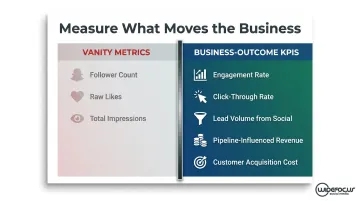
Not all metrics matter equally. Vanity metrics—follower count, raw likes, total impressions without context—feel good but rarely connect to business outcomes.
Focus on business-relevant KPIs:
- Engagement rate: Likes, comments, shares divided by impressions or followers—signals content resonance
- Click-through rate (CTR): Percentage of viewers who click links to your website or landing pages
- Lead volume from social: Tracked via UTM parameters or platform-specific conversion tracking
- Pipeline-influenced revenue: Deals where social touchpoints appeared in the buyer journey
- Customer acquisition cost (CAC): Total social spend divided by new customers acquired through social channels
CMI's 2025 research shows 81% of B2B marketers track engagement and 71% track website traffic, but only 54% track lead generation. That's the core problem: most teams measure activity, not outcomes. Build your KPI dashboard around the numbers executives actually ask about—pipeline influenced, revenue contribution, and cost per acquisition.
Know Your Audience and Choose the Right Platforms
B2B buyer personas are more complex than B2C. A single purchase decision often involves multiple stakeholders—end users focused on usability, managers evaluating team impact, and C-suite executives concerned with strategic alignment and ROI. Each persona needs different messages at different stages of the buying journey.
Build Multi-Persona Strategies
Map your personas to funnel stages:
- Awareness: Industry trends, relatable challenges, and data-driven insights that position your brand as credible and relevant
- Consideration: How-to guides, case studies, and product comparisons that demonstrate real expertise
- Decision: Customer testimonials, ROI calculators, and product demos that reduce purchase risk and move buyers to act
Use Social Listening and Competitor Analysis
Get sharper audience insights by monitoring what questions buyers ask in industry communities, what content they engage with on competitor accounts, and what pain points surface in LinkedIn groups or Reddit threads. Tools like social listening platforms and LinkedIn analytics reveal which topics resonate, which formats perform, and which gaps your content can fill.
LinkedIn: The B2B Starting Point
CMI's 2025 research shows that 98% of B2B marketers use LinkedIn for organic content distribution and 78% use it for paid campaigns. Eighty-two percent report their greatest success on LinkedIn compared to other channels. This dominance isn't surprising—LinkedIn is purpose-built for professional networking, thought leadership, and account-based marketing outreach.
LinkedIn should anchor your B2B social strategy. Prioritize:
- Executive and employee thought leadership posts
- Company page updates featuring industry insights and educational content
- LinkedIn articles and newsletters for long-form expertise
- Targeted paid campaigns reaching decision-makers by job title, company size, and industry
Don't Stop at LinkedIn: Strategic Multi-Platform Presence
While LinkedIn dominates B2B, limiting your presence to one platform means missing stakeholders who research elsewhere.
YouTube for demos and education: 70% of B2B buyers and researchers watch videos throughout their purchase journey. YouTube functions as a search engine for product demos, tutorials, and explainer content. CMI data shows 64% of B2B marketers actively use it.
Facebook and Instagram for culture and community: These platforms humanize your brand through behind-the-scenes content, company culture, and customer stories. They're particularly effective for reaching stakeholders who keep their professional and personal social feeds separate.
TikTok for emerging B2B audiences: While only 19% of B2B marketers currently use TikTok, adoption is climbing as younger professionals move into buying roles. Short-form, authentic video explaining complex topics can build unexpected reach with this audience.
Start Focused, Then Scale
Recommendation: Start with 2-3 platforms and build consistency before expanding. Chasing every network at once pulls resources in too many directions — posting frequency drops, engagement stalls, and results suffer across the board. Master LinkedIn and one secondary platform (typically YouTube or Twitter/X for B2B audiences), then expand once you've established a sustainable content rhythm and proven ROI.
Build a B2B Content Strategy That Drives Real Results
Content is where strategy becomes tangible. The right mix of formats, topics, and distribution cadence separates B2B brands that drive pipeline from those that just make noise.
The 70/20/10 Content Mix Framework
A widely adopted industry guideline suggests 70-80% of content should educate, entertain, or provide value to your audience—industry insights, how-to guides, thought leadership, data-driven posts. Only 20-30% should directly promote your brand or product.
This ratio builds trust. Audiences tune out feeds that constantly sell. But when you consistently deliver value—solving problems, sharing research, offering actionable advice—they reward you with attention, engagement, and consideration when their buying window opens.
Map Content Types to Funnel Stages
Top-of-funnel (brand awareness):
- Industry trend analysis and market research
- Relatable storytelling about common challenges
- Data visualizations and infographics
- Timely commentary on industry news
Mid-funnel (education and consideration):
- Case studies showing real customer outcomes
- Product demos and feature explainers
- Expert Q&As and AMAs (Ask Me Anything)
- Comparison guides and buying frameworks
Bottom-of-funnel (conversion and retention):
- Customer testimonials and video reviews
- ROI calculators and cost-benefit analyses
- Product spotlights highlighting differentiation
- Customer success stories
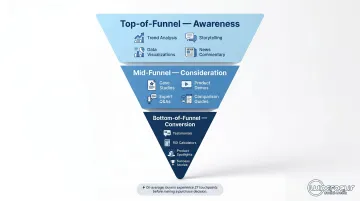
Important caveat: B2B conversion rarely happens from a single social touchpoint. With 27 touchpoints on average before purchase, your content must work collectively across the funnel to move prospects forward over weeks or months.
Format Diversity Is a Competitive Advantage
CMI's 2025 research found that 58% of B2B marketers cite short-form video as the most effective format. LinkedIn reports that video posts are shared 20x more than other content types. Yet many B2B brands still rely primarily on text updates and static images.
High-performing B2B content formats:
- Short-form video (under 90 seconds): Lo-fi, authentic vertical video consistently outperforms polished production—think smartphone selfie-style explainers, not corporate talking heads
- Carousels and multi-slide posts for step-by-step guides, listicles, and frameworks
- Polls and interactive content to drive engagement and gather audience insights
- Data graphics and charts that visualize research, survey results, or industry benchmarks
- LinkedIn newsletters: Build a subscribed audience for longer-form thought leadership
Each platform has its own content culture. What performs on LinkedIn often falls flat on Instagram or X — tailor format and messaging to match each channel's norms and audience expectations.
Build a Content Calendar for Consistency
Consistency signals credibility to both algorithms and audiences. A 90-day content calendar should:
- Map content pillars (3-5 core themes aligned with business goals)
- Include a rhythm of evergreen (timeless educational posts) and timely content (industry news, seasonal campaigns)
- Leave room for real-time engagement or trend-jacking when opportunities arise
- Assign ownership, deadlines, and KPIs to each piece
Maintaining that consistency while managing campaigns, analytics, and client deliverables is where many B2B teams hit a wall. WideFoc.us manages this level of strategic content planning end-to-end for B2B and B2C clients. In 2024, the agency delivered over 20 million impressions and 1 million link clicks through insight-driven, custom content strategies—demonstrating what disciplined, goal-driven execution achieves over time.
Amplify Reach Through Employee Advocacy and Thought Leadership
Employee advocacy is one of the highest-ROI tactics available to B2B brands, yet it remains underutilized. People trust recommendations from individuals far more than from corporate accounts — and the statistics below make that gap impossible to ignore.
Why Employee Advocacy Works
The numbers speak for themselves:
- MSLGroup research found employee-shared brand messages earn 561% more reach than the same content posted by brand channels
- Content shared by employees generates 8x more engagement than posts from brand accounts
- IBM data shows leads from employee advocacy programs convert 7x more often than other lead sources
The trust differential is clear: 87% of B2B buyers trust peer recommendations over brand content. When your sales team, subject matter experts, and executives share insights from their personal profiles, they tap into authentic networks built on professional relationships and earned credibility.
Structure a Simple Employee Advocacy Program
You don't need a large team to start—even a handful of active voices can meaningfully expand organic reach.
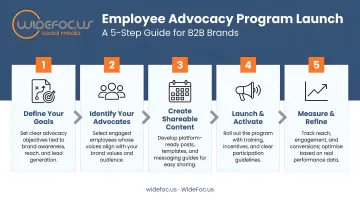
Five steps to launch employee advocacy:
- Identify willing advocates: Start with executives, sales teams, and subject matter experts who already have professional networks and a natural reason to share industry insights
- Provide pre-approved content or guidelines: Make sharing easy with ready-to-post content, suggested talking points, or a content library employees can pull from
- Highlight the value to employees: Frame advocacy as personal branding—building their industry visibility, establishing expertise, and expanding professional networks
- Measure participation and reach impact: Track how many employees participate, how often they share, and the reach and engagement their posts generate
- Recognize and reward participation: Publicly acknowledge top contributors, share success stories, and tie advocacy to professional development goals
B2B Influencer and KOL Partnerships
Beyond employee networks, partnerships with industry experts and key opinion leaders (KOLs) can lend credibility and expand reach to new segments. Forrester predicts that 75% of enterprise B2B companies will increase influencer relations budgets in 2026 — a signal that influencer marketing has moved from experiment to established strategy.
B2B influencers are respected practitioners, analysts, authors, and conference speakers whose opinions carry real weight within specific industries. Collaboration formats that work well include:
- Co-created content and guest posts that position both parties as experts
- Webinars or podcasts that tap into the influencer's existing audience
- Case studies or research reports that lend third-party credibility to your claims
Measure ROI and Continuously Refine Your Approach
Most B2B social programs stall not from lack of effort, but from measuring the wrong things. Moving beyond engagement metrics to track lead volume, conversion rates, pipeline influence, and revenue contribution is what turns social activity into a business case.
What Good B2B Social Measurement Looks Like
Track these business-outcome metrics:
- Lead volume from social sources: Use UTM parameters to track traffic and conversions back to specific posts or campaigns
- Conversion rates on gated content: Measure how many social visitors download whitepapers, register for webinars, or request demos
- Sales pipeline influenced by social touchpoints: Identify deals where social interactions appeared in the buyer journey using CRM attribution data
- Customer acquisition cost (CAC): Calculate total social spend divided by customers acquired through social channels
- Revenue contribution: Attribute closed-won revenue to campaigns or touchpoints using multi-touch attribution models
According to the Demand Gen Report's 2024 Marketing Measurement & Attribution Benchmark Survey, 73% of B2B marketers prioritize showing ROI from all marketing investments, and 70% focus on articulating marketing's impact on pipeline and revenue. This reflects executive expectations: social must tie to business outcomes, not just activity metrics.
The B2B Attribution Challenge
With sales cycles averaging 10+ months and roughly 27 touchpoints across multiple stakeholders, no single post will draw a straight line to revenue. A prospect might discover you through a LinkedIn ad, read three blog posts over two months, attend a webinar, download a case study, and then request a demo — so which touchpoint actually gets credit?
Solutions to the attribution challenge:
- Use multi-touch attribution models: Give partial credit to every touchpoint in the buyer journey rather than only crediting the first or last interaction
- Benchmark performance over time: Track rolling quarterly or annual performance rather than obsessing over individual post ROI
- Combine quantitative and qualitative signals: Supplement hard data with sales team feedback on which content prospects mention and which campaigns generate higher-quality conversations
6sense's 2025 attribution research found that 57% of B2B marketers use both sourced and influenced attribution—recognizing that social often plays an influencing role across multiple touchpoints rather than being the sole source of a lead.
Report ROI in Language Executives Care About
Gartner's 2025 CMO Spend Survey revealed marketing budgets have flatlined at 7.7% of overall company revenue, increasing pressure on CMOs to demonstrate direct revenue impact. This environment demands that social media reporting speak the language of finance, not marketing — pipeline contribution, cost efficiency, and deal velocity.
Frame social ROI reporting around:
- Customer acquisition cost trends: Show how social reduces CAC compared to other channels
- Lead quality signals: Demonstrate that social-sourced leads convert at higher rates or close faster
- Pipeline velocity influence: Prove that social touchpoints accelerate deal progression through stages
- Share of voice and competitive positioning: Quantify how your brand presence compares to competitors in target accounts' feeds
Avoid leading with engagement stats—executives rarely care about likes. Lead with pipeline contribution, cost efficiency, and revenue impact.
Build a Test-and-Learn Culture
The best-performing B2B social accounts evolve based on data, not opinion. Your strategy should include regular experiments—testing post formats, publishing times, messaging angles, and CTA types—with documented learnings applied to future content.
Create a quarterly experimentation roadmap:
- Q1: Run a format test — short-form video, carousels, and text-only posts — to learn which drives the most engagement and click-through for your audience
- Q2: Swap out CTAs across equivalent posts (download, learn more, schedule a demo) and track which language converts at each funnel stage
- Q3: Compare employee-amplified content against company page posts — the reach difference often surprises teams who haven't measured it directly
- Q4: Refine paid campaign targeting by isolating one variable (job title, company size, or intent signals) to improve lead quality without increasing spend
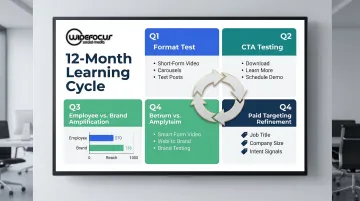
Each quarter's findings feed the next round of decisions. Over 12 months, this creates a compounding strategic advantage — your team knows what works for your specific audience, not just what works in general.
Frequently Asked Questions
How should B2B companies use social media?
B2B companies should use social media to build brand awareness among target accounts, establish thought leadership through expert insights, and nurture leads with educational content across the buyer journey. The goal is to engage multiple decision-makers in buying committees — not just push product promotions.
What is B2B social media management?
B2B social media management is the ongoing process of planning, publishing, monitoring, engaging, and analyzing social media activity specifically designed to reach business buyers and decision-makers. It requires a consistent strategy, content calendar, and performance tracking system tied to business outcomes.
What are B2B social media campaigns?
B2B social media campaigns are structured, goal-driven initiatives with defined audiences, content, timelines, and KPIs—such as a LinkedIn thought leadership series, product launch campaign, or lead generation push. They differ from always-on posting by focusing efforts around specific business objectives.
What is the 95/5 rule for B2B?
The 95/5 rule, rooted in Ehrenberg-Bass Institute research, holds that only about 5% of B2B buyers are actively in-market at any given time, meaning 95% need long-term brand-building content. This makes consistent, value-driven social presence critical for being remembered when buying windows eventually open.
What is the 5-5-5 rule for social media?
The 5-5-5 rule is a daily engagement framework suggesting you leave 5 meaningful comments on posts from accounts you follow, 5 on posts from accounts you don't follow, and 5 on posts discovered via relevant hashtags. It's designed to build community and prevent feeds from becoming overly self-promotional.
What is the 3-3-3 rule in marketing?
The 3-3-3 rule refers to capturing attention in 3 seconds, keeping engagement for 3 minutes, and ensuring brand recall for 3 days. It's a practitioner framework for designing content when most posts are scrolled past in under a second.