Paid social changes this equation. Unlike broad display advertising, paid social lets you target by job title, company size, industry, and seniority — putting your message in front of the right people on the platforms where they actually spend time.
This post covers everything you need to run effective B2B paid social campaigns: which platforms to prioritize, how to build a strategy that maps to your funnel, which ad formats convert, how to set a realistic budget, and how to measure ROI across a long sales cycle.
Key Takeaways
- 84% of B2B marketers use paid channels to distribute content, with social media advertising leading the mix
- LinkedIn generates 80% of B2B social media leads and outperforms Facebook by 277% for B2B conversion
- B2B buying committees now average 6–10 stakeholders — your targeting must reach multiple roles, not just one
- Lead Gen Forms on LinkedIn convert at 13% — more than three times the rate of standard landing pages
- Last-click attribution misses most of the picture — long B2B sales cycles require CRM integration to measure ROI accurately
Why B2B Paid Social Media Advertising Delivers Results
The Core Difference from B2C
B2C advertisers target demographics. B2B advertisers target professionals — by job function, seniority level, company size, and industry vertical. That distinction matters because paid social can reach a CFO evaluating accounting software or a VP of Engineering comparing DevOps tools, not just anyone who fits a general age bracket.
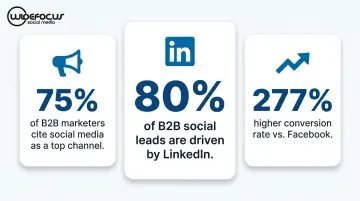
LinkedIn's 2024 B2B Marketing Benchmark Report makes the platform's dominance hard to ignore:
- 75% of B2B marketers cite social media as a top channel for reaching their audiences
- LinkedIn drives 80% of B2B leads generated across all social platforms
- LinkedIn converts at a rate 277% higher than Facebook for B2B purposes
The Brand Recall Effect
Not every decision-maker clicks an ad the first time they see it. In B2B, that's expected — purchases take time, build through internal consensus, and close only after trust has been established across multiple interactions.
Dreamdata's 2025 research found that the average B2B buying journey spans 211 days and requires 76 touches across multiple channels before a deal closes. Repeated paid social exposure builds the brand recall that makes your company the one they call when they're finally ready to buy.
Accounts exposed to LinkedIn ads before encountering paid search convert at a 46% higher rate. That lift is a direct return on awareness spend, and it compounds across the full length of the buying cycle.
Best Platforms for B2B Paid Social Advertising
No B2B company should advertise everywhere at once. The smarter play: go deep on one or two platforms your buyers actually use, then expand once you have a proven playbook.
LinkedIn is the default starting point for most B2B paid social strategies. With over 1.3 billion registered members and 4 out of 5 users driving business decisions at their organizations, it's the only platform built specifically around professional identity.
The targeting capabilities are what set it apart: you can layer job title, seniority, company size, industry, skills, and even specific company lists (for account-based marketing). The tradeoff is cost — LinkedIn CPCs typically run $5–$9 depending on audience seniority and industry, significantly higher than Meta. But lead quality reflects that premium.
Key LinkedIn ad formats for B2B:
- Sponsored Content — native feed posts promoting offers, content, or product announcements
- Lead Gen Forms — native forms that pre-populate with LinkedIn profile data, converting at an average 13% vs. 4% for landing pages
- Message Ads / Conversation Ads — direct inbox placements for personalized outreach
- Document Ads — downloadable content with Lead Gen Forms attached, driving 2x higher form completion than standard feed formats
Meta Ads (Facebook & Instagram)
Meta plays a real role in B2B — particularly for retargeting and demand generation. Business decision-makers spend 74% more time on Facebook per day than the average user, and they don't stop being decision-makers when they leave the office.
Meta's strength in B2B lies in:
- Retargeting warm audiences — website visitors, video viewers, and email list matches
- Lookalike expansion — scaling beyond your known audience using behavioral signals
- Lower CPCs — typically $0.30–$1.50, making it cost-effective for top-of-funnel volume
Instagram works particularly well for visual-forward B2B industries: technology products, manufacturing equipment, architecture, design — anywhere seeing the product or service in action influences the buying decision.
YouTube and Niche Platforms
YouTube is the second-largest search engine in the world, with over 2.5 billion monthly active users. For B2B awareness campaigns, skippable pre-roll and in-stream video ads can introduce your brand efficiently at scale. Research from Google and Millward Brown Digital found that 70% of B2B buyers watch video throughout their path to purchase.
In specialized categories — cybersecurity, industrial equipment, niche SaaS — trade publication ad networks and professional community platforms can deliver pre-qualified audiences worth testing if budget allows.
How to Build a B2B Paid Social Media Strategy
Step 1: Define Goals by Funnel Stage
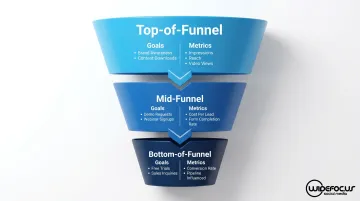
Every campaign decision — platform, format, budget, KPIs — should flow from a clear funnel-stage objective:
| Funnel Stage | Goals | Key Metrics |
|---|---|---|
| Top-of-funnel | Brand awareness, content downloads | Impressions, reach, video views |
| Mid-funnel | Demo requests, webinar signups, lead forms | Cost per lead, form completion rate |
| Bottom-of-funnel | Free trials, sales inquiries | Conversion rate, pipeline influenced |
Mixing awareness and conversion objectives in the same campaign wastes budget. Keep them separate.
Step 2: Build Buyer Personas for the Full Committee
B2B purchase decisions don't happen in isolation. Gartner's 2025 research places the average buying committee at 6–10 stakeholders, with complex enterprise deals involving even more. Your targeting needs to reach all key decision-makers — not just the job title most likely to fill out a form:
- Economic buyer — approves the budget and signs off on ROI
- Technical evaluator — vets integrations, security, and implementation
- End user — assesses day-to-day usability and fit
- Executive sponsor — champions the purchase internally
Go beyond job title in your persona work. Understand what content each role consumes, what problems they're solving, and whether they're more reachable on LinkedIn during work hours or Meta in the evenings.
Step 3: Start with a 90-Day Campaign Plan
A 90-day window is the minimum needed to gather statistically meaningful data, especially for B2B. WideFoc.us, a Denver-based B2B social media agency, uses this same 90-day threshold before drawing firm conclusions from paid social campaigns — recognizing that one month rarely provides enough data to optimize conversion funnels with confidence.
Structure the 90 days with awareness campaigns in the first four weeks, then layer in conversion campaigns once retargeting pools are large enough to work with.
Step 4: Layer Your Audience Targeting
On LinkedIn:
- Layer job function + seniority + industry + company size
- Add company lists for ABM campaigns
- Exclude current customers to avoid wasting spend
On Meta:
- Start with custom audiences from website visitors or CRM uploads
- Expand with lookalikes at 1–3% similarity
- Layer behavioral interests for cold audiences
Beyond layering cold audiences, retargeting deserves its own budget line. Website visitors, video viewers, and lead form abandoners are warmer than any cold audience — serve them different messaging that acknowledges they've already engaged with your brand.
Step 5: Amplify What's Already Working Organically
Paid social performs best when it's not reinventing content from scratch. Rather than building campaigns in isolation, use paid budget to extend what's already gaining traction:
- Boost high-performing organic posts to expand reach beyond your existing followers
- Promote gated assets like whitepapers to audiences already showing intent signals
- Drive event attendance by pairing paid targeting with organic promotion already underway
WideFoc.us integrates paid and organic campaigns under a single strategy for B2B clients, with monthly performance reviews that assess both channels together. That approach contributed to over 20 million impressions and 1 million link clicks across client accounts — results that compound when the two channels reinforce each other rather than run in parallel.
B2B Ad Formats and Content That Convert
Sponsored Content and Carousel Ads
Single-image sponsored posts work well for direct offers: whitepaper downloads, demo requests, and event registrations. Carousel ads work better when a single frame isn't enough. Use them to walk through a multi-step process, highlight several product features side by side, or present a condensed case study across slides.
Every visual and copy element should serve the same purpose: remove ambiguity about what you're offering and what happens when someone clicks.
Video Ads
Short-form video (15–30 seconds) consistently outperforms longer formats for attention and completion. The first 3 seconds are the only seconds that matter for retention — the hook must immediately signal relevance to the viewer's role or problem.
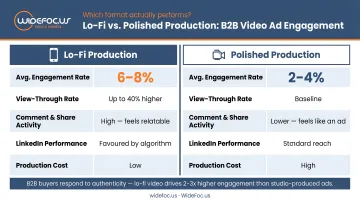
One counterintuitive finding: lo-fi, smartphone-shot video tends to outperform polished production on LinkedIn. Decision-makers respond to authenticity. A founder talking directly to camera about a real business problem often generates better engagement than a $10,000 brand video.
LinkedIn Lead Gen Forms and Meta Instant Forms
Native lead forms are the highest-converting format for mid-funnel B2B offers. LinkedIn Lead Gen Forms pre-populate with profile data, eliminating the friction of manual form completion — which is why they convert at 13% versus the 4% average for external landing pages.
When to use native forms vs. landing pages:
- Lead Gen Forms: Content downloads, newsletter signups, event registrations, lower-commitment offers
- Landing pages: High-intent conversions where you want full control over the experience, detailed qualification questions, or complex offer explanations
Sponsored Messaging
LinkedIn Message Ads and Conversation Ads place your content directly in a prospect's inbox. They work well for event invitations, personalized demo requests, and gated content offers targeted to a precise list.
Tone matters more here than anywhere else. A Message Ad that opens like a cold sales pitch will generate opt-outs fast. Lead with a problem the reader actually has, offer something worth their time, and make the next step feel like their choice — not a funnel.
Budgeting and Measuring ROI for B2B Paid Social
Setting Your Budget
Social media spending accounts for approximately 11.3% of total marketing budgets, according to the CMO Survey from Duke University and Deloitte (Spring 2025). For paid social specifically, that percentage represents only a portion of overall social spend.
For B2B companies newer to paid social, $1,000–$2,500/month in ad spend is a reasonable starting point to generate enough data for meaningful optimization. Below that threshold, learning cycles take longer and results are harder to interpret.
LinkedIn's higher CPCs mean fewer clicks per dollar compared to Meta — but the lead quality and audience precision tend to justify the difference for most B2B use cases.
Key Metrics by Campaign Type
Awareness campaigns:
- Impressions, reach, video view rate, brand lift
Lead generation campaigns:
- Cost per lead (CPL), lead form completion rate, conversion rate
Pipeline and revenue attribution:
- MQLs, SQLs, pipeline influenced, closed/won revenue
The Attribution Challenge
B2B attribution is complicated by long sales cycles — averaging 6.5 to 10+ months. A campaign that ran in Q1 may not show revenue impact until Q4 or later, which means last-click attribution systematically undervalues paid social by crediting only the final touchpoint before conversion.
47% of B2B teams now use multi-touch attribution, up from 31% in 2023 — a recognition that no single touchpoint tells the full story. To demonstrate value across the full cycle, focus on two levels of measurement:
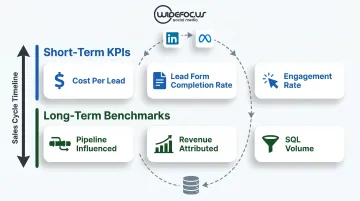
- Short-term KPIs: CPL, lead form completion rate, engagement rates
- Long-term benchmarks: Pipeline influenced, revenue attributed, SQL volume
Connect your ad platforms to your CRM so leads can be tracked from first touch through close — not just to the form fill.
B2B Paid Social Advertising Best Practices
Four principles consistently separate B2B campaigns that convert from ones that just spend budget.
Test one variable at a time. A/B test ad creative, copy, or CTAs — but change only one element per test. Split-testing headline vs. image vs. CTA simultaneously makes it impossible to know what drove the result.
Refresh creative every 4–6 weeks. B2B audiences are small and targeted, meaning the same people see your ads repeatedly. LinkedIn recommends refreshing ad content at least once per month. When frequency scores climb above 3 and CTR starts dropping, that's creative fatigue — act before performance craters.
Match ad and landing page messaging exactly. If your ad promises a free competitive analysis, the landing page should open with exactly that. Any mismatch between ad and destination destroys conversion rates and signals to the platform that your ads aren't relevant.
Use AI tools, but set the objectives yourself. LinkedIn's predictive audiences, Meta Advantage+, and AI-powered bidding can genuinely improve campaign efficiency — but they optimize toward the goal you give them. If the objective is wrong, the AI optimizes toward the wrong outcome: clicks instead of qualified pipeline. Human judgment still drives strategy, audience definition, and brand accuracy.
Frequently Asked Questions
What is the best social media platform for B2B paid advertising?
LinkedIn is the primary platform for most B2B paid social campaigns due to its professional targeting capabilities — job title, seniority, industry, and company size. Meta Ads are effective for retargeting and reaching professionals outside of work hours. The right choice depends on your target audience, budget, and campaign goals.
How much should a B2B company budget for paid social media advertising?
Social media accounts for roughly 11.3% of total marketing budgets per the CMO Survey. For B2B paid social specifically, $1,000–$2,500/month in ad spend is a practical starting point. LinkedIn's higher CPCs require setting realistic CPL expectations relative to your average deal size.
How is B2B paid social advertising different from B2C?
B2B targets professional roles and buying committees with decision cycles that span months or years. B2C targets individuals with faster purchase decisions. B2B ads focus on education, trust-building, and lead generation — not immediate conversion.
What ad formats work best for B2B paid social media?
LinkedIn Lead Gen Forms, Sponsored Content, carousel ads, and short-form video consistently perform well for B2B. Format choice should align with funnel stage: Lead Gen Forms for mid-funnel offer conversions, carousels for complex product explanations, video for top-of-funnel awareness.
How do you measure ROI for B2B paid social media campaigns?
Connect ad platform data to your CRM to track leads through the pipeline. Key metrics include cost per lead, MQL and SQL rates, pipeline influenced, and closed/won revenue attributed to paid social. Multi-touch attribution models are more accurate than last-click for long B2B sales cycles.
Should B2B companies use LinkedIn or Facebook ads?
LinkedIn wins for cold outreach to specific roles and companies. Facebook (Meta) works best for re-engaging warm audiences — typically at a lower CPC than LinkedIn. The strongest B2B programs use both: LinkedIn to open doors, Meta to stay top-of-mind until the deal closes.