Introduction
Every day, marketing teams grapple with a false choice: "Should I focus on organic or paid social?" This either/or thinking is precisely why many brands plateau despite consistent effort and substantial ad spend. Treating organic and paid social as competing strategies rather than complementary forces caps growth and leaves audiences under-engaged.
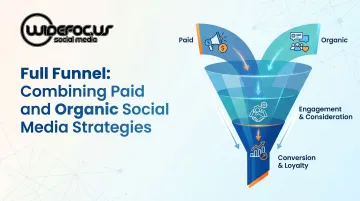
Average organic reach declined approximately 62% between 2020 and 2023, while US social media ad spend surged to $88.8 billion in 2024. These opposing trends reveal a fundamental shift: organic alone can't deliver scale, and paid ads without authentic organic presence lose credibility. A full-funnel approach that intentionally maps organic and paid to each stage of the customer journey solves both problems—delivering better reach, stronger trust, and measurable ROI.
That integration looks like this in practice: in 2024, WideFoc.us combined organic and paid campaigns to generate 20 million impressions and 1 million link clicks for clients across B2B and B2C sectors — results that neither channel would have produced working alone.
Key Takeaways
- Organic social builds brand trust and long-term relationships—primarily at the top and middle of the funnel—but reach has dropped 62% since 2020
- Paid social delivers precise targeting and rapid reach—most powerful at middle and bottom of the funnel—with US ad revenue hitting $88.8 billion in 2024
- Running them in silos wastes effort and budget through inconsistent messaging and missed retargeting opportunities
- A full-funnel strategy uses organic content data to inform paid campaigns, boosts top performers, and retargets warm audiences to convert them into customers
The Role of Organic Social Media in Your Marketing Funnel
Organic social encompasses unpaid content—posts, videos, stories, comments—that builds brand presence and community over time. This content primarily reaches existing followers, though platform algorithms occasionally extend it to similar audiences through shares and engagement signals.
Where Organic Fits in the Funnel
Organic content serves two distinct funnel roles. At the top of the funnel, it answers "Who is this brand?" for new audiences discovering your company through shares, hashtags, or recommendations. Further down, it builds trust when warm prospects research before committing — showing genuine voice and expertise that a paid ad simply can't convey.
Beyond those roles, organic performs specific functions paid ads can't replicate:
- Demonstrates brand personality and values through consistent, genuine voice
- Shares expertise via educational content that positions your brand as a trusted resource
- Addresses customer questions publicly, building transparency
- Handles service interactions in real time, showcasing customer care
- Displays social proof through reviews, testimonials, and community engagement
The Organic Reach Problem
The challenge? Facebook's average organic reach rate sits at just 1.65%, while Instagram averages 3.50%. Even high-performing Instagram Reels only achieve 30.81% reach for smaller accounts. This means even excellent content reaches a fraction of your potential audience without amplification.
Organic content also carries real costs — most small businesses invest 3-10 hours per week, plus creative resources and strategic planning. That investment deserves a bigger return than 1.65% reach can deliver. Paid amplification closes that gap, extending your best organic content to audiences it would never reach on its own.
The Role of Paid Social Media in Your Marketing Funnel
Paid social includes any content promoted through advertising spend—sponsored posts, display ads, video ads, lead gen forms—designed to reach targeted audiences beyond your existing followers.
Where Paid Fits in the Funnel
Paid social accelerates results at every funnel stage:
- Top of funnel: Expands reach to cold audiences who match your customer profile but don't know your brand yet
- Middle of funnel: Drives specific actions like email sign-ups, content downloads, and webinar registrations
- Bottom of funnel: Pushes conversions including purchases, demo requests, and lead form submissions
Why Paid Social Works
The targeting capabilities give paid social a precision advantage organic simply can't match:
- Demographic targeting: Age, location, job title, income level, education
- Interest-based targeting: Hobbies, behaviors, purchase intent signals
- Lookalike audiences: Built from CRM data or existing followers to find similar prospects
- Retargeting: Re-engage users who visited your website or engaged with previous content
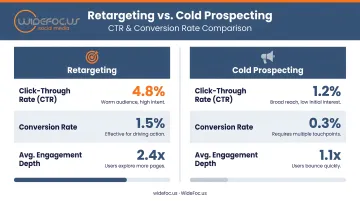
Paid campaigns also deliver measurable, trackable data (impression share, click-through rate, cost per lead, conversion rate) that organic social can't match in precision or speed. Research shows retargeting campaigns on Meta achieved a 2.86% CTR and 4.30% conversion rate in 2024 versus prospecting at just 1.25% CTR and 2.25% conversion rate.
The Credibility Catch
Running ads without a credible organic presence quietly undermines your results. When users click an ad and land on a dormant profile or sparse page, brand credibility drops and conversion rates follow. Your paid ads drive traffic to your organic profile. If it's not active and engaging, you're burning ad spend with little to show for it.
Why Running Organic and Paid in Silos Is Holding You Back
Many brands divide social media management between a content team handling organic and a separate team or agency running paid ads. The two rarely share data or align messaging, creating compounding problems that erode performance across both channels.
Disconnected Teams Create Costly Blind Spots
When organic and paid teams operate independently:
- Effort gets duplicated as both teams create similar content without coordination
- Brand voice becomes inconsistent when ad copy contradicts organic tone
- Retargeting windows close while warm prospects slip through the cracks
- Creative testing insights from paid campaigns never inform organic content
Research indicates businesses with a unified brand image across platforms can boost revenue by 23%, while McKinsey found that companies excelling at personalization generate 40% more revenue from those efforts than slower-growing competitors.
Siloed Metrics Hide the Full Customer Journey
Siloed reporting distorts attribution and obscures how channels feed each other. While 98% of marketers view attribution as vital, only 29% consider themselves successful at it, and just 31% are confident in their data accuracy.
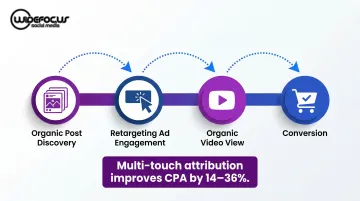
When paid and organic are measured independently, it becomes impossible to trace a path like this: a user discovers your brand through organic content, clicks a retargeting ad three days later, then converts after watching an organic video testimonial. That journey looks like three unrelated touchpoints — when it's actually one conversion story.
The fix isn't a bigger budget — it's a connected strategy.
How to Build a Full-Funnel Integration Strategy
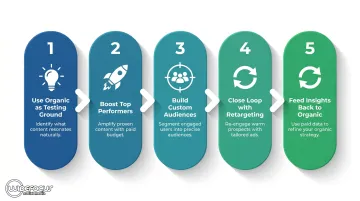
Most brands treat paid and organic as separate budgets with separate goals. The stronger approach is building them as a single system — five interconnected tactics that feed results from one channel directly into the other.
1. Use Organic as a Testing Ground
Organic content reveals what messaging resonates before you spend a dollar. Posts with high engagement rates, shares, and saves signal content that's worth amplifying. Use this data to determine which posts get paid budget and how to write paid creative.
The 2025 Sprout Social Index found that 75% of marketing leaders rank both paid and organic social media as top priorities, recognizing that organic tests ideas before scaling proven strategies with paid promotion.
2. Boost to Amplify
Instead of creating separate ad creative from scratch:
- Identify top-performing organic posts through engagement data
- Boost them through the advertising manager (not the native boost button) to gain proper targeting controls
- Lower risk, faster to execute, and backed by proven engagement data
3. Build Audiences Through Integration
Use tracking pixels on your website and CRM data to build custom audiences:
- Website visitors who didn't convert
- Email subscribers not yet customers
- Past purchasers ready for upsells
Then create lookalike audiences from these groups for cold prospecting. This bridges the gap between organic community-building and paid acquisition.
4. Close the Loop with Retargeting
Retargeting is the funnel's closing mechanism. A user discovers your brand through organic content, visits the website, and leaves without converting. A retargeting ad with a specific offer, testimonial, or case study re-engages them at the right moment. Retargeting delivers 10x higher CTR than standard display ads and makes prospects 70% more likely to convert.
For a regional home services company, WideFoc.us combined consistent organic content with geo-targeted paid campaigns. The integrated strategy delivered a 512% increase in website traffic from Facebook and Instagram, with 9x qualified customer leads generated in the first eight weeks.
5. Feed Insights Back to Organic
Results like those don't stop at the paid campaign level. A/B testing in paid campaigns generates audience insight that flows back upstream. Which headlines, visuals, and CTAs perform best? Feed these findings back into organic content strategy, creating a continuous improvement loop.
WideFoc.us manages this full loop for clients — from organic content and community management through paid campaign execution — so each channel consistently sharpens the other.
Measuring the Success of Your Combined Strategy
Siloed KPIs undermine integration. Measuring organic reach separately from paid reach, or tracking conversion rate without examining the organic touchpoints that preceded it, creates a fragmented and misleading picture.
Key Metrics by Funnel Stage
Top-of-funnel (Awareness):
- Combined reach and impressions across organic and paid
- Follower growth rate
- Organic engagement rate (comments, shares, saves)
Middle-of-funnel (Consideration):
- Website traffic from social channels
- Email sign-ups and lead magnet downloads
- Video view completion rates
- Content engagement depth (time on page, scroll depth)
Bottom-of-funnel (Conversion):
- Cost per lead
- Conversion rate
- Return on ad spend (ROAS)
- Customer acquisition cost
Use Multi-Touch Attribution
Tracking these metrics across funnel stages only tells part of the story — attribution closes the loop by showing which channel combinations actually drove results.
Companies using multi-touch attribution models see CPA improvements of 14-36% compared to single-touch approaches. Use UTM parameters on all paid and organic links to track the actual path users take from social touchpoints to conversion. That path data lets you attribute results to the right channel combination — not just the last click.
Meta introduced "engage-through attribution" in March 2026, creating a measurement category that segments social-specific actions separately from traditional click-through attribution. This addresses the limitation that click-based metrics fail to capture the social-specific engagement behaviors that drive pipeline — shares, saves, and profile visits that rarely register as clicks but still move buyers through your funnel.
Frequently Asked Questions
What is the difference between organic and paid social media?
Organic social is unpaid content—posts, videos, stories—that builds community and reach over time through authentic engagement. Paid social is advertised content that reaches targeted audiences beyond your followers for a fee, delivering faster reach and measurable conversions.
How much of my social media budget should go to paid versus organic?
There's no universal split—organic requires investment in content and creative resources even without ad spend. Most brands allocate 60-70% to paid and 30-40% to organic content creation, but adjust based on business goals, funnel stage priorities, and industry benchmarks for your sector.
Which platforms work best for combining organic and paid social media?
The best platforms depend on your target audience. LinkedIn works well for B2B professional services, while Instagram and Facebook excel for B2C consumer brands. The strongest results come from platforms where organic reach and paid targeting options are both robust.
How do I know which organic posts to boost with paid spend?
Boost posts that are already performing well organically—high engagement, shares, or saves signal the content resonates. This performance indicates the content is more likely to convert with amplification, making it lower risk and more cost-effective than creating paid-only ads from scratch.
Can small businesses benefit from a combined paid and organic social strategy?
Yes—small businesses benefit because boosting top-performing organic content requires far less upfront investment than building paid campaigns from scratch. A strong organic presence also lowers paid ad costs through higher engagement rates, stretching every marketing dollar further.
How does retargeting fit into a full-funnel social media strategy?
Retargeting targets users who already interacted with your brand—visited the website, engaged with a post, or watched a video. It's one of the highest-ROI tactics because it re-engages warm prospects who showed interest rather than reaching cold audiences, consistently outperforming cold prospecting on conversion.