The gap between brands running 2023-era paid social approaches and those adapting to 2026 realities is measurable. It shows up in wasted ad spend, declining conversion rates, and audience reach that keeps shrinking despite rising budgets. Understanding what's changed — and why — isn't a strategic bonus. It's table stakes.
This guide breaks down the four biggest paid social trends reshaping the landscape in 2026, the forces driving them, and what brands need to do differently to stay competitive.
Key Takeaways
- AI now drives ad targeting and creative decisions across every major platform — treat it as core infrastructure, not a feature
- Short-form video dominates, but longer-form content is making a genuine comeback for consideration-stage campaigns
- US social commerce is projected to cross $100 billion in 2026, making in-app purchase paths a primary conversion channel
- Meta holds 67.3% of social ad spend, but TikTok and LinkedIn are taking real ground — single-platform strategies carry measurable risk
- Brands that build first-party data strategies and full-funnel campaign structures today will hold a structural advantage going into 2027
Trend 1: AI Takes Over Paid Social Creative and Targeting
Creative Is Now the Targeting Signal
The most consequential shift in paid social over the past 18 months has nothing to do with audience settings — it's about what Meta's infrastructure actually reads to decide which ads enter the auction.
Meta's Andromeda retrieval system, rolled out across accounts in late 2024 and early 2025, fundamentally changed how ad matching works. Rather than relying primarily on demographic targeting parameters, Andromeda evaluates the creative content itself — visuals, copy, video elements, and emotional tone — to determine which ads get served to which users. Audience settings still exist, but they play a reduced role. The creative is doing the targeting work.
The practical implication: advertisers running 8–20 genuinely different creative concepts inside simplified campaign structures are rewarded. Minor tweaks — swapping a headline color, changing a CTA button — are treated as duplicates. Meaningful creative diversity is what drives distribution.
The Numbers Behind AI-Driven Creative
The adoption numbers reflect how fast this shift is moving:
- 8 million+ advertisers now use at least one of Meta's GenAI ad creative tools, with video generation features driving 3%+ higher conversion rates in tests
- Meta Advantage+ sales campaigns deliver 9% lower cost per acquisition and 7% lower cost overall
- Creative quality now accounts for approximately 70% of campaign performance outcomes, making it the single largest lever available to advertisers
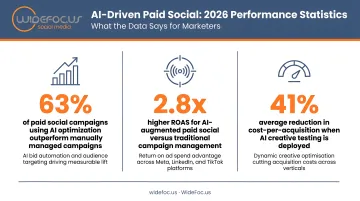
Meta isn't alone in this. TikTok's Smart+ and LinkedIn's Predictive Audiences follow the same logic: platform-native AI tools that optimize based on in-platform signals, not third-party data. Across every major channel, the message is consistent — feed the algorithm better creative, and it handles the rest.
AI Still Needs Human Strategy
Handing campaigns entirely to automation without clear goals, strong creative input, and regular performance review produces diminishing returns. AI scales execution. It doesn't generate the brief, define the audience insight, or decide when a campaign direction isn't working — that still requires human judgment.
This is the operating principle at WideFoc.us, where the agency's position is direct: "AI assists with drafting. It does not replace strategic oversight or performance accountability." Their campaigns across Meta, LinkedIn, TikTok, and Pinterest are managed by strategists and account managers who interpret performance data and adjust creative direction — using AI to scale execution, not substitute for thinking.
ChatGPT Enters the Ad Ecosystem
OpenAI began testing ads in ChatGPT on February 9, 2026, initially for Free and $8 Go tier users. A dedicated ChatGPT Ads Manager launched in May 2026, expanding to the UK, Canada, Australia, and several other markets, with ads matched to conversation context and chat history.
For brands targeting high-intent, research-mode audiences, this is a channel to track now and test early — before pricing becomes competitive and inventory tightens.
Trend 2: The Video Content Spectrum — Short-Form Rules, Long-Form Returns
Short-Form Still Leads — But It's Not the Whole Story
Short-form video (under 60 seconds — Reels, TikTok, YouTube Shorts) remains the dominant paid social format. Short-form video views grew 36% year-over-year, and marketers have ranked it the number one ROI format for the third consecutive year, with 57% of marketing budgets now including a dedicated short-form video allocation.
But the landscape is no longer one-dimensional. Platforms are extending maximum video lengths, and user behavior is shifting. TikTok now supports videos up to 10 minutes. YouTube's algorithm has consistently favored longer watch times. Users who arrived on these platforms for quick clips are staying for depth.
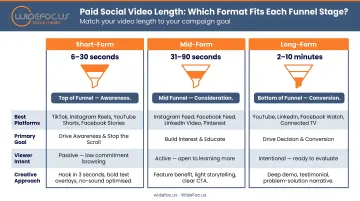
Matching Video Length to Campaign Objective
The right video length depends entirely on where the campaign sits in the funnel:
| Format | Length | Best For |
|---|---|---|
| Short-form (Reels, Shorts, TikTok) | Under 60 seconds | Awareness, conversion, product discovery |
| Mid-form video | 1–2 minutes | Engagement, consideration |
| Long-form video | 2–5+ minutes | Trust-building, education, deeper consideration |
Longer formats build credibility that a 15-second clip simply cannot. A B2B brand explaining a complex software solution needs room to demonstrate value. A B2C brand walking through a product in context benefits from that time to persuade — not just interrupt.
2026 Video Ad Best Practices
Regardless of length, these principles apply across paid video formats:
- Add captions and text overlays — most social video is consumed without audio, so visual storytelling carries the message
- Hook viewers in the first 3 seconds; if those seconds don't earn attention, the rest doesn't matter
- Shoot in native, UGC-style formats, especially on TikTok and Reels, where authentic-feel content consistently outperforms polished studio ads
- Optimize for portrait orientation — vertical video is non-negotiable for feed and Stories placements
Catalog product videos in Reels format deserve a close look. According to Meta for Business, catalog product video ads drive 20% more conversions per amount spent compared to static catalog ads. For B2C brands with product libraries, this intersection of video and social commerce is one of the clearest revenue levers available in 2026.
Trend 3: Social Commerce Goes Mainstream
The $100 Billion Inflection Point
Social commerce — the direct integration of shopping into social media platforms — has officially crossed into mainstream buying behavior. US social commerce sales grew from $87 billion in 2025 to a projected $100+ billion in 2026, an 18% year-over-year increase. Globally, the market sits at over $1.4 trillion.
This isn't a future-state projection anymore. TikTok Shop generated over $500 million in US sales between Thanksgiving and Cyber Monday 2025 alone. Meta introduced new commerce tools at Shoptalk 2026 designed to eliminate the boundary between content and purchase.
The Conversion Path Has Changed
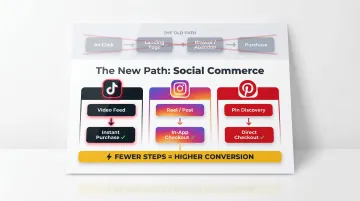
The traditional paid social funnel — ad click → landing page → purchase — is no longer the only path, and increasingly not the preferred one. Platforms are building in-app checkout directly into the content discovery experience:
- TikTok Shop enables purchase without leaving the video feed
- Instagram Shopping connects Reels and feed posts directly to checkout
- Pinterest's shopping tools are expanding for intent-driven categories like home, fashion, and beauty
For paid campaign strategy, this means conversion-objective campaigns now point to in-app purchase paths rather than external landing pages. Fewer steps between discovery and purchase means higher conversion rates — but it requires creative that functions as both ad and storefront simultaneously.
Rethinking Creative for In-App Purchase Intent
When the ad IS the storefront, creative has to carry more weight. That means moving beyond brand awareness to answer "why buy now" — with every element working together:
- Lead with a purchase trigger: urgency, social proof, or a specific benefit
- Show the product in active use, not staged on a white background
- Use platform-native CTAs ("Shop Now," "Buy on TikTok") — not generic "Learn More" directives
The results from campaigns built around this approach are measurable. For a health supplement brand, WideFoc.us ran paid social campaigns across Instagram, TikTok, Pinterest, and Facebook tied to ROAS and average order value — generating over 1 million impressions in the first month, 4,030 link clicks at $0.45 cost-per-click, and 300,000+ impressions from Pinterest alone.
Trend 4: Platform Shifts and Budget Diversification for 2026
The Fragmented Landscape
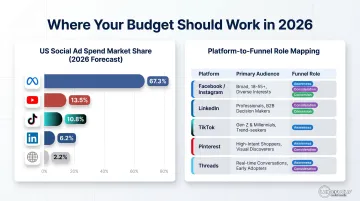
Meta still dominates. In Q3 2025, Meta held 67.3% of US social ad spend, followed by YouTube (13.5%), TikTok (10.8%), and LinkedIn (6.2%). Total US social network ad spending is projected to exceed $121 billion in 2026.
Market share percentages don't tell the full story, though. Several platforms are growing fast in both revenue and reach:
- LinkedIn hit $8.2 billion in ad revenue in 2025 (up 18.3% year-over-year), with WARC forecasting $11.3 billion by 2027
- Pinterest delivered 16% revenue growth in Q1 2025 with record user counts
- TikTok continues to gain share, particularly in social commerce
- Threads opened to all global advertisers in April 2025 and now reaches 400 million monthly active users
No single platform owns your audience — which is exactly why funnel role, not just reach, should drive where your budget goes.
Matching Platforms to Funnel Objectives
The most common error in platform diversification: spreading budget evenly without assigning each channel a specific funnel role. Every platform should have a defined job.
| Platform | Primary Audience | Funnel Role |
|---|---|---|
| Facebook/Instagram | Broad reach across demographics | Awareness + Conversion |
| B2B decision-makers, professionals | Consideration + Lead Gen | |
| TikTok | 18–34, discovery-driven behavior | Awareness + Social Commerce |
| Intent-driven shopping categories | Consideration + Conversion | |
| Threads | Engaged Meta audiences, text-first | Incremental awareness reach |
WideFoc.us manages paid campaigns across all of these platforms, with platform-specific performance benchmarks guiding allocation decisions. Their results reflect the strategy: a B2B fintech client achieved 1.2 million monthly impressions through LinkedIn and Facebook combined. A national window treatment franchise generated 3 million+ impressions monthly at under $1.00 cost-per-click. Pinterest campaigns have repeatedly delivered clicks at $0.10 per click — a fraction of typical display costs.
Emerging Platforms: Monitor Before You Invest
Not every new platform warrants immediate budget. The real skill is recognizing when a channel crosses from experimental to essential — then acting quickly.
Two platforms worth watching now:
- Threads: Already testable through Meta Ads Manager with minimal added overhead — incremental reach within a campaign structure you've already built
- ChatGPT ad inventory: Genuinely new territory; early movers in search-intent categories will gain a measurement and optimization head start
The broader principle: track audience density and ad tooling maturity, and when a platform clears both thresholds, move with intent.
What's Driving These Paid Social Shifts — and What to Watch Next
The Three Forces Reshaping Paid Social
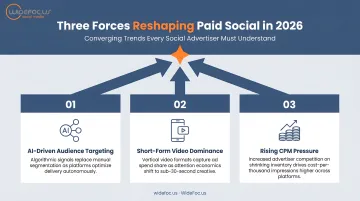
Three converging pressures explain why the paid social landscape is shifting this fast:
1. AI and machine learning acceleration — Every major platform has rebuilt its ad infrastructure around AI-driven targeting. As third-party data becomes less reliable, platforms substitute platform-side signals and creative analysis (like Meta's Andromeda) to maintain targeting precision. This shift is structural, not cyclical.
2. Privacy regulation — iOS ATT opt-in rates sit at approximately 35% as of Q2 2025, meaning roughly two-thirds of iOS users are blocking ad tracking. The IAB has warned that privacy legislation now poses a larger long-term threat to ad measurement than cookie deprecation itself. The result: advertisers are being pushed toward first-party data infrastructure and platform-native conversion APIs (Meta's CAPI, LinkedIn Insight Tag) to maintain measurement accuracy.
3. Consumer behavior shifts : Users want authenticity over broadcast messaging, and shopping to be frictionless. Increasingly, they're also using social platforms as search engines — 49% of US consumers now use TikTok as a search engine, up from 41% in 2024. Building search-intent keywords into paid social creative isn't just an SEO consideration; it directly affects how platform algorithms distribute ads.
Signals Worth Watching
As 2026 continues, keep attention on:
- Shares replacing likes as the primary algorithm signal — Instagram's Adam Mosseri confirmed that DM shares per reach is now the most heavily weighted distribution signal for Reels. TikTok has shifted similarly. Ads designed to be forwarded, not just viewed, get compounding algorithmic distribution
- Private channels as brand touchpoints — DMs and broadcast channels are replacing public feed engagement as meaningful audience connections
- ChatGPT's ad ecosystem maturation — early inventory is live; the question is whether search-intent audiences prove more valuable than display-intent ones
- Social search optimization — treating paid creative copy with the same keyword intentionality as paid search
Building the Advantage Now
These signals point in the same direction: the brands gaining ground in 2026 are the ones building now, not catching up later.
Flexible strategies rooted in first-party data, creative diversity, and full-funnel platform thinking tend to outperform reactive ones — regardless of how the algorithm changes next. WideFoc.us has been developing this kind of data-informed paid social strategy for B2B and B2C clients since 2007, with results including a $0.05 cost-per-fan for an auto parts brand and a healthcare campaign that contributed to $14 million in donations.
Frequently Asked Questions
How do you create a paid social ad strategy?
Define your target audience, set clear campaign objectives (awareness, consideration, or conversion), select platforms where that audience is active, develop creative and messaging aligned to each objective, set a realistic budget, launch, and optimize based on performance data. The process is iterative — what works in month one rarely looks identical to what works in month six.
What is paid social advertising and how does it work?
Paid social means paying platforms to show targeted ads to specific audiences. Advertisers set budgets, targeting parameters, and goals; the platform's algorithm matches the right ad to the right user based on behavioral signals and demographics, billing by cost-per-click or cost-per-impression.
Which social media platform is best for paid social in 2026?
There's no universal answer. Meta suits broad consumer reach; LinkedIn leads for B2B decision-makers; TikTok captures younger audiences; Pinterest drives intent-based shopping. Start where your audience is most active and expand from there.
How much budget do I need to start with paid social ads?
Most platforms allow campaigns to start at $5–10/day, but generating usable data and running A/B tests typically requires a larger commitment. WideFoc.us recommends $1,000–$2,500/month for small local businesses and $2,000–$5,000/month for mid-market B2B companies as realistic starting points.
What's the difference between paid social and organic social media?
Organic social reaches your existing followers through unpaid content, subject to platform algorithms. Paid social guarantees reach to a defined audience — including non-followers — through ad spend. They work best together: paid amplifies what organic content reveals about what your audience actually responds to.
How do I measure the ROI of a paid social campaign?
Track click-through rate (CTR), cost per acquisition (CPA), return on ad spend (ROAS), and conversion rate as your core metrics. Use Meta Pixel or LinkedIn Insight Tag for attribution, and tie each metric back to your original campaign objective to confirm the spend is earning its place.