The gap between wasted spend and real ROI usually comes down to one thing: understanding what actually drives the numbers. Platform choice, campaign objective, industry competition, creative quality, and whether you manage campaigns yourself or work with an agency all pull the cost levers in different directions. Misread any one of them and you're either underbudgeting to the point where campaigns can't optimize, or throwing money at the wrong platform entirely.
This article breaks down platform pricing benchmarks, the real cost components of a paid social program, the key factors that determine the right spend level for your business, and the budget mistakes that quietly drain results.
Key Takeaways
- Social media ad costs range from $0.44 to $5.58+ per click depending on platform, with most businesses spending $500–$10,000/month in ad spend alone
- Cost drivers: competitive industries, B2B audiences, conversion-focused objectives, LinkedIn targeting, and Q4 seasonality
- Local businesses and awareness campaigns can start lean — B2B lead gen and e-commerce brands typically need higher budgets
- Start with a goal, then work backward through platform, audience, and expected cost-per-result to find your number
How Much Do Social Media Ads Cost?
Social media advertising doesn't have a fixed price. The same campaign goal can cost vastly different amounts depending on platform, audience, and ad quality. Businesses that misunderstand this either underbudget (leaving campaigns without enough data to optimize) or overspend on the wrong platform.
Platform Cost Benchmarks
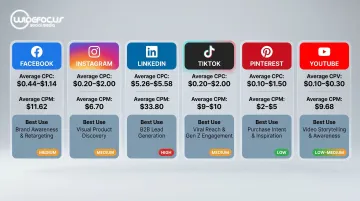
Here's how the major platforms compare on cost:
| Platform | Average CPC | Average CPM | Best For |
|---|---|---|---|
| $0.44–$1.14 | $11.62 | Broad reach, conversion campaigns | |
| $0.20–$2.00 | $6.70 | Visual brand awareness, DTC | |
| $5.26–$5.58 | $33.80 | B2B decision-maker targeting | |
| TikTok | $0.20–$2.00 | $9.00–$10.00 | Short-form video, younger audiences |
| $0.10–$1.50 | $2.00–$5.00 | Visual discovery, retail/lifestyle | |
| YouTube | $0.10–$0.30 CPV | $9.68 | Video awareness, tutorials |
(Sources: AdRoll 2026 platform cost breakdown, Cometly LinkedIn benchmarks)
LinkedIn is the most expensive platform by a wide margin — CPC regularly exceeds $5 across every industry category. Pinterest and TikTok offer the lowest entry costs for awareness campaigns, with Pinterest CPMs as low as $2.00.
Two metrics drive most of these comparisons: CPM (cost per 1,000 impressions) for awareness campaigns, and CPC for traffic and lead generation. Platforms charge differently based on the objective you select, so the same platform can feel expensive or efficient depending on your goal.
Monthly Budget Ranges by Business Size
| Business Stage | Monthly Ad Spend | What It Gets You |
|---|---|---|
| Entry-level / testing | $500–$1,500 | Limited reach, early audience data |
| Active growth | $1,500–$5,000 | Meaningful A/B testing, consistent delivery |
| Competitive / multi-platform | $5,000–$10,000+ | Broader reach, faster optimization, more ad sets |
Most small businesses start in the $500–$1,500 range — enough to gather early signals, but not enough to reach conclusions about what actually works. Crossing into the $1,500–$5,000 tier is where the algorithm gets enough data to optimize and multiple ad variations can run simultaneously.
What Determines How Much You Should Spend?
The "right" budget isn't a fixed number. It's the output of several interconnected factors.
Campaign Objective
Campaign goal is the single biggest cost driver. Awareness campaigns (optimized for CPM) cost less per impression but don't drive direct revenue. Conversion and lead-gen campaigns cost more per action but produce measurable business outcomes.
The problem: businesses that conflate these objectives end up measuring the wrong results. A campaign optimized for reach will generate impressions. It won't generate leads. Budget allocation should follow the objective, not the other way around.
Industry and Audience Competition
Your industry directly impacts what you pay. According to WordStream's Facebook benchmark data, CPC varies widely by sector:
- Finance & Insurance: $3.77 CPC
- B2B / Technology: $2.52 CPC
- Real Estate: $1.81 CPC
- Retail / E-commerce: $0.70 CPC
- Apparel: $0.45 CPC
High-competition sectors cost more because more advertisers are bidding for the same narrow audience. A fintech company and an apparel brand can run nearly identical campaigns on Facebook and pay 8x different CPCs.
Platform and Audience Fit
Cost and ROI are inseparable from whether your audience actually uses the platform. LinkedIn's $5.58 average CPC is often justified for B2B brands targeting executives and decision-makers. WideFoc.us's B2B fintech clients, for example, have seen LinkedIn and Facebook campaigns become their top-performing traffic source with over 1.2 million monthly impressions.
That same $5.58 CPC would be hard to justify for a B2C lifestyle brand whose audience spends their time on Instagram and Pinterest.
Choosing a platform because it's cheap rather than because your audience is active there is an expensive mistake.
Ad Creative Quality
Every major platform — Meta, TikTok, LinkedIn — uses quality signals (relevance score, engagement rate, CTR) to determine what you pay. High-quality, engaging creative gets rewarded with lower CPMs and CPCs. Poor creative raises costs and limits delivery.
WideFoc.us has driven Pinterest CPCs as low as $0.10 for B2C clients with strong visual creative, well below the platform average. Creative quality acts as a budget multiplier in both directions.
Timing and Seasonality
CPM and CPC rates fluctuate throughout the year. Facebook CPMs typically rise 30–50% in Q4 compared to Q3, according to LeadEnforce's seasonal analysis. During peak retail periods like Black Friday, CPCs have been known to double or triple.
January is worth paying attention to. Holiday advertising competition drops sharply while consumer demand holds — making Q1 an efficient window to test new creative and build audience data before spring scaling.
The Hidden Costs of Social Media Advertising
The platform ad spend is only one part of what running social media ads actually costs. Underestimating the full picture is one of the most common reasons campaigns fall short.
Content Creation
Every ad requires copy and creative — and these have real costs whether produced in-house or outsourced:
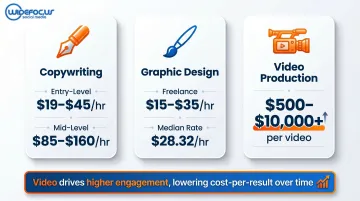
- Freelance copywriting: $19–$45/hour (entry-level) to $85–$160/hour (mid-level), per Upwork and Mediabistro
- Graphic design: $15–$35/hour on Upwork; national median wage of $28.32/hour per BLS
- Video production: $500–$10,000+ per video depending on complexity
Video and animation typically cost more upfront but tend to drive higher engagement — which lowers your cost-per-result over the campaign's run. Weak creative is often why a well-funded campaign underperforms, so treat production costs as part of the budget — not an afterthought.
Agency Management Fees
Working with a social media agency adds a management fee on top of ad spend. Industry ranges:
- Freelancers / small agencies: $500–$1,500/month
- Mid-sized agencies: $1,500–$5,000/month
- Full-service agencies: $5,000–$20,000+/month
WideFoc.us structures paid social management fees at $300 flat for budgets up to $1,500/month, or 20% of ad spend above that threshold, charged separately from the ad spend itself. Ad spend goes directly to the platform and buys exposure; management fees turn that exposure into clicks and revenue.
WideFoc.us requires a 90-day minimum commitment because one month rarely produces enough data for confident optimization decisions.
Testing Budget
Effective social advertising requires a real testing budget. Running too few ad variations — or stopping campaigns before they generate enough data to act on — wastes the entire investment.
The widely recommended framework: allocate 10–20% of your campaign budget specifically for A/B testing creative and audience combinations. For Meta, a daily budget of roughly $50–$100 is typically needed to generate sufficient data within a reasonable testing window. Each ad variation needs to generate 10–20 conversions before you can call a winner.
How to Set the Right Social Media Ad Budget for Your Business
The most effective ad budgets start with a goal — not a dollar figure. Work backward from the outcome you need, and the number becomes obvious.
Start With Goals, Not a Number
Define the business outcome first. If you need 50 leads per month and your expected cost-per-lead is $25, your minimum monthly ad spend is $1,250 — before creative or management costs. That's a real number tied to a real goal, not a guess.
This approach forces two questions most advertisers skip. First: what is a conversion actually worth to your business? Second: what conversion rate is realistic for this campaign type?
The Revenue Percentage Rule
A common benchmark: the SBA recommends small businesses allocate 7–8% of gross revenue to marketing (for businesses under $5M in revenue with healthy margins). Paid social typically accounts for 11–25% of a company's total advertising budget within that allocation.
Newer or growth-stage businesses often need to invest at the higher end — sometimes 12–20% of revenue — to build awareness and audience data from scratch.
B2B vs. B2C Considerations
The right platform mix, and therefore the right budget, differs significantly between B2B and B2C:
B2B:
- LinkedIn-led strategy with longer sales cycles
- Higher cost-per-lead, but higher customer lifetime value
- Metrics tied to MQLs, SQLs, and pipeline impact
- WideFoc.us B2B clients on LinkedIn + Facebook have driven 1.2M+ monthly impressions with social becoming the top marketing traffic source
B2C:
- Platform-flexible: Meta, TikTok, and Pinterest all viable depending on audience
- Faster conversion cycles with metrics tied to ROAS and purchase rates
- WideFoc.us B2C clients have achieved CPCs as low as $0.10 on Pinterest and $0.45 on Meta with conversion campaigns built from custom audience data
Neither approach costs more by default — but they demand different platforms, different creative, and patience with very different ROI timelines.
The Test-and-Scale Approach
Regardless of whether you're running B2B or B2C campaigns, the same testing logic applies. Here's the practical framework:
- Pick one platform and one audience — keep initial spend between $500–$1,500/month
- Test two to three ad variations — vary the creative, hold the offer constant
- Review results after 2–4 weeks — you'll have enough data to spot cost-per-result patterns
- Cut what's underperforming, increase what's working — then scale budget incrementally
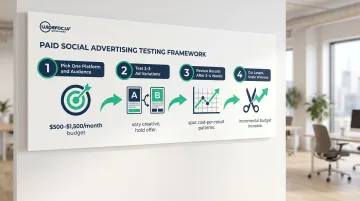
Scaling before proving ROI is one of the costliest mistakes brands make. The 90-day minimum WideFoc.us recommends for new paid social engagements exists for this reason — campaigns need time to test creative, tune targeting, and improve conversion paths.
Common Budget Mistakes That Quietly Drain Your Ad Spend
Common Budget Mistakes That Drain Your Ad Spend
- Optimizing for CPC or CPM instead of ROAS or cost-per-lead. Vanity metrics look good in reports. They don't indicate whether the campaign is profitable.
- Treating creative costs as separate from the ad budget. Weak creative is often the main reason a well-funded campaign underperforms. Budget for it from the start — it's not an afterthought.
- Spreading budget across too many platforms too soon. A $1,000/month budget split across five platforms means none of them get enough data to optimize. Start with one or two.
- Ignoring the feedback loop between creative and data. If you're not reviewing performance by ad variant — not just by campaign — you're missing where the money is actually going.
The businesses that get the most from their ad budgets aren't necessarily the biggest spenders. They match spend to a clear objective, pick the right platform for their audience, and cut what isn't working before doubling down on what is. That discipline matters more than the dollar amount.
Frequently Asked Questions
How much should I spend on social media advertising?
There's no universal number. Most small to mid-sized businesses start with $500–$2,000/month in ad spend, but the right amount depends on goals, industry competition, and platform choice. The more useful question: what cost-per-result do you need to make the investment worthwhile?
How much does an average social media campaign cost?
Most businesses spend $15–$200/day in ad spend, depending on goals and platform. Factor in creative production and management fees, and a realistic all-in monthly cost for a managed campaign typically runs $1,500–$8,000+.
Which social media platform is the cheapest to advertise on?
Pinterest and TikTok tend to have the lowest CPMs and CPCs. But cheapest isn't the right filter — the platform where your audience is active and engaged will deliver the best ROI regardless of base rates.
What is a good ROAS for social media ads?
The industry average Facebook ROAS is 2.19:1, well below the commonly cited 4:1 benchmark. High-margin businesses can sustain 2:1, but thin-margin e-commerce often needs 5:1 or higher just to break even — so set targets based on your margin structure, not a generic number.
How much should a small business spend on social media ads per month?
$500–$1,500/month is a reasonable starting range for one or two platforms. The priority: stay focused rather than spreading a small budget thin across multiple channels at once.
Is it better to manage social media ads in-house or hire an agency?
In-house management works when there's dedicated expertise and real bandwidth. If strategy, creative, and optimization would otherwise fall to someone without that background, an agency is worth considering — poor campaign decisions tend to cost more than agency fees do.