Introduction: Why Paid Social Advertising ROI Starts With Strategy
Many ecommerce brands pour thousands of dollars into paid social campaigns each month, yet struggle to draw a clear line from ad spend to actual revenue. This disconnect rarely stems from platform shortcomings—Facebook, Instagram, TikTok, and Pinterest all offer powerful conversion tools. Instead, campaigns fail because they lack a strategic foundation.
Without clear audience segmentation, platform alignment, or creative testing frameworks, even generous budgets produce disappointing returns.
This guide walks through the core pillars of profitable paid social advertising: choosing the right platforms, building high-converting audiences, developing creative that earns attention, allocating budget strategically across the funnel, and measuring what truly drives ecommerce growth. Whether you're launching your first campaign or scaling existing efforts, these principles apply across all major social platforms.
TLDR:
- Match platforms to product type and buyer demographics—Meta dominates broad reach, TikTok excels for younger audiences
- Segment audiences by intent: cold prospecting, warm retargeting, and hot cart abandoners each need distinct messaging
- Refresh creative every 1-4 weeks to combat ad fatigue
- Video drives engagement; static formats often convert more efficiently
- Allocate majority of budget to high-ROAS retargeting; build awareness through lookalike prospecting campaigns
- Track ROAS, CPA, and conversion rate together; multi-touch attribution prevents undervaluing awareness campaigns
Why Paid Social Advertising Is an Ecommerce ROI Powerhouse
Paid social functions as a full-funnel growth engine. At the top of the funnel, it builds brand awareness among cold audiences who've never heard of your products. In the middle, it nurtures consideration through retargeting campaigns that remind shoppers what they viewed. At the bottom, it drives direct purchases with dynamic product ads and urgency-driven offers. This versatility makes paid social uniquely valuable compared to single-stage channels like search ads, which primarily capture existing demand.
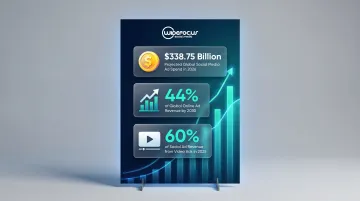
The numbers back this up. Worldwide social media advertising spend is projected to reach $338.75 billion in 2026, growing at an annual rate of 18.4%. By 2030, social media is expected to command 44% of global online ad revenue, reaching $640 billion. Video formats alone accounted for 60% of total social media ad revenue in 2025, reflecting how platforms have evolved to prioritize engaging, visual storytelling.
Brands achieving the highest ROI treat paid social as an integrated growth lever — one component of a broader strategy, not a standalone traffic fix. What separates top performers from the rest:
- Align creative messaging tightly to audience intent at each funnel stage
- Run structured A/B tests on copy, visuals, and offers continuously
- Optimize against margin-aware ROAS targets, not just click volume
- Reinvest budget based on performance data, not assumptions
The pattern is consistent: strategic discipline drives results more reliably than raw spend.
Choose the Right Platform for Your Ecommerce Goals
Platform selection drives campaign efficiency. Spreading budget thin across every channel dilutes learning and prevents any single campaign from gathering enough conversion data to optimize effectively.
The smarter approach: start with one or two platforms aligned to your product, audience, and creative capabilities, then expand based on measured performance.
Matching Platform to Goal
Each major platform serves distinct ecommerce use cases:
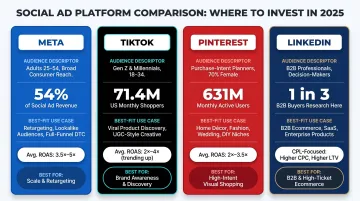
- Facebook/Instagram (Meta): Broadest reach, most mature ad ecosystem. Meta held 54% of social media ad revenue in 2025. Best for retargeting and conversion campaigns — average ROAS: 2.2:1 prospecting, 3.6:1 retargeting.
- TikTok: Video-first platform for younger buyers. 71.4 million Americans shopped on TikTok in 2025, up 24.5% year-over-year. Strong for beauty, health, and fashion targeting Gen Z.
- Pinterest: High-intent discovery with 631 million monthly users. 96% of top searches are unbranded, and shopping ads convert 2.6x better than other ad types. Best for home, fashion, and gifting.
- LinkedIn: Suited for B2B ecommerce and higher-ticket products sold to professionals. Not recommended as a primary DTC retail channel.
Start by measuring cost per purchase and ROAS by channel. Once you identify what converts profitably, scale budget there before expanding to additional platforms. A $2,000 monthly budget concentrated on Meta with proven 4:1 ROAS outperforms $500 spread across four platforms with unclear attribution.
Build High-Converting Audiences: Targeting and Retargeting
Effective paid social campaigns recognize that not all audiences are equal. A cold prospect seeing your brand for the first time needs a different message—and often a different offer—than someone who abandoned a cart three days ago. That hierarchy breaks down into three tiers:
- Cold audiences: New traffic via interest/demographic targeting or lookalike modeling
- Warm audiences: Past site visitors, video viewers, social engagers
- Hot audiences: Cart abandoners, past purchasers
Custom and Lookalike Audiences
Build custom audiences from first-party data: customer email lists, website visitors tracked via pixel, past purchasers. These become seeds for lookalike audiences—AI-generated audience groups that mirror your best customers. Lookalikes expand reach to net-new buyers while keeping targeting precision high.
Segment audiences by intent level. Someone who abandoned a cart in the last 72 hours needs urgency messaging ("Complete your order—free shipping ends tonight"). A cold lookalike audience seeing your brand for the first time needs value storytelling: what the product does, who it's for, and why it matters.
Retargeting Strategies for Ecommerce
Retargeting consistently delivers the highest ROAS for ecommerce brands because it targets people who already demonstrated purchase intent. Retargeted users are 43% more likely to convert than first-time visitors, with average CTRs around 0.7%—roughly 10x higher than standard display ads.
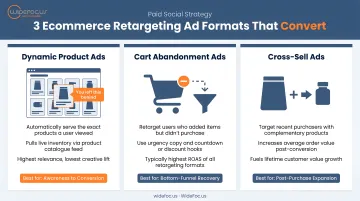
Three retargeting formats drive the most ecommerce impact:
- Dynamic product ads: Pull from your product catalog feed to automatically show shoppers the exact items they viewed — no manual creative needed
- Cart abandonment ads: Re-engage users who left mid-checkout with urgency copy ("Free shipping ends tonight") or a limited-time incentive to close the gap
- Post-purchase cross-sell ads: Follow up with recent buyers using complementary product recommendations — one of the fastest ways to grow customer lifetime value
Set frequency caps to avoid irritating warm audiences with excessive ad exposure. Exclude recent buyers from the same product ads they just purchased—nothing frustrates customers faster than seeing ads for items already in their possession. With the average cart abandonment rate sitting at 70.19%, retargeting is a baseline requirement for any ecommerce brand serious about profitability.
Ad Creative That Stops the Scroll and Drives Sales
Perfect targeting fails if creative doesn't capture attention in the first 1-2 seconds. Before a user swipes past, your ad needs to make the product's value obvious to the right person. That's a tight window.
Visuals and Video
High-performing ecommerce creative includes:
- Short product demo videos (15-30 seconds)
- UGC-style clips filmed like organic content, not polished ads
- Before/after visuals
- Carousel ads showcasing multiple products or features
- Static images with bold text overlays
Video ads generate 87% more engagement than static ads, but static ads deliver 34% lower cost-per-acquisition across most industries. Meta's own research shows that campaigns combining both formats achieve 17% higher conversion lift than static-only campaigns. Running both simultaneously lets platform algorithms route each format to where it performs best.
Ads that look like organic content consistently outperform polished brand creative — users scroll past obvious ads but stop for content that feels native to the feed. On TikTok specifically, creator-led content achieves up to 193% higher view-through rates versus standard brand content.
Visuals set the hook, but copy closes the deal. Getting both right — in the same ad — is where most ecommerce campaigns either gain or lose ground.
Ad Copy and CTAs
Strong ecommerce ad copy follows these principles:
- Lead with one key benefit, not multiple features
- Keep body copy scannable — short sentences, clear structure
- Address a pain point or desire in the opening hook
- Include social proof (reviews, ratings, customer count) where possible
Match your call-to-action to campaign intent:
- "Shop Now" — bottom-funnel ads where the user is ready to buy
- "Learn More" — awareness and consideration campaigns building interest
- "Claim Offer" — promotional campaigns with a time-sensitive incentive
Mismatched CTAs quietly kill click-through rates. Using "Learn More" on a direct-response conversion campaign signals browsing, not buying, and the algorithm reads that signal too.
Combat Ad Fatigue
Even strong creative wears out. On TikTok, high-spend accounts experience creative burnout within 3-5 days; on Meta, within 7-14 days. Plan refresh cycles every 2-4 weeks for high-spend campaigns and keep a backlog of creative variations ready to rotate in before performance declines. When thumb-stop rates fall below 30%, it's a critical warning that creative is failing.
Budget Allocation: Spend Smarter Across the Funnel
The most common budget mistake in ecommerce paid social: spreading spend too evenly across too many campaigns, audiences, and platforms. This dilutes learning and prevents campaigns from gathering the ~50 conversions per week needed to exit Meta's learning phase and optimize effectively.
Funnel-Based Budget Distribution
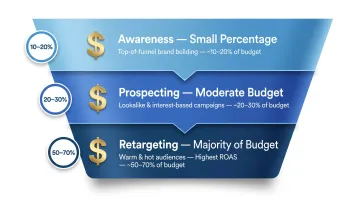
Allocate budget based on expected return:
- Majority to retargeting: Highest ROAS campaigns targeting warm and hot audiences
- Moderate to prospecting: Lookalike and interest-based campaigns that feed the retargeting pool
- Small percentage to awareness: Top-of-funnel brand building, if recognition is a strategic goal
Meta requires approximately 50 optimization events within 7 days for ad sets to exit the learning phase. Significant edits—budget changes exceeding 20%, creative swaps, targeting modifications—reset this phase. Scale in 20% increments every 48-72 hours to maintain algorithmic stability.
Campaign Budget Optimization (CBO) on Meta and similar automated budget tools on TikTok shift spend toward the best-performing ad sets in real time, without requiring manual adjustments. For campaigns with 3+ ad sets, this tends to meaningfully improve overall return by concentrating budget where it's already working.
The Landing Page Connection
Even a perfectly optimized ad budget can bleed ROI the moment someone clicks through to a poor landing page. A 1-second delay in page load time reduces conversions by 7%, and 53% of mobile visitors abandon pages that take longer than 3 seconds to load.
Your post-click experience needs to match what the ad promised — fast load times, mobile-optimized layout, and messaging that picks up where the creative left off.
Minimum Budget Guidance
For conversion-focused ecommerce campaigns, start with $15-$50 per day per campaign to generate enough data for optimization. Lower budgets risk falling into "learning limited" status, where the algorithm can't gather sufficient conversion signals to optimize effectively.
Work backward from your expected cost per purchase: if your target CPA is $25, budget at least $75-$125 daily (3-5x CPA) to give the algorithm enough room to learn.
Measure, Test, and Optimize for Compounding ROI
Tracking only CTR or impressions gives a misleading picture of campaign health. Focus on metrics that directly connect to ecommerce profitability:
- ROAS (Return on Ad Spend): Revenue generated per dollar spent
- Cost per purchase (CPA): What you pay to acquire each customer
- Click-through rate (CTR): Percentage of users who click your ad
- Add-to-cart rate: How many clicks result in cart additions
- Conversion rate: Percentage of clicks that result in purchases
The average ecommerce ROAS is 2.87:1 (mean) but only 2.04:1 (median), indicating that top performers skew the average. Most ecommerce advertisers achieve below 3:1. The commonly cited "good" ROAS range of 3x-5x represents well-optimized campaigns, not starting-point expectations. Calculate your break-even ROAS based on profit margins—that's your true performance floor.
Attribution and Measurement
Last-click attribution may undervalue top-of-funnel efforts by as much as 40% because shoppers often discover brands through social, then convert later via search or direct traffic. Adopt multi-touch attribution or platform-native attribution windows matched to your actual sales cycle: 7-day for impulse products, 28-day for higher-consideration purchases.
A/B Testing Framework
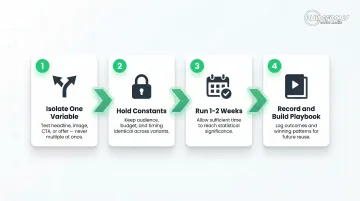
Disciplined testing separates average paid social performance from exceptional ROAS:
- Isolate one variable per test — headline, image vs. video, CTA, or offer
- Hold everything else constant: same audience, budget, and timing
- Run each test 1-2 weeks minimum to reach statistical significance
- Record outcomes and build a reusable playbook of what converts
Small wins compound over time. A 10% improvement in CTR combined with a 15% improvement in conversion rate yields 26.5% overall lift. Consistent testing is how brands achieve 4x-5x ROAS while competitors struggle to break even.
That compounding effect is exactly what disciplined agency management accelerates. WideFoc.us has run paid social campaigns across Meta, TikTok, and Pinterest for ecommerce brands that want to shorten the testing cycle and reach profitability faster — without burning budget on guesswork. If your team is stretched thin or your current results have plateaued, an outside perspective built on structured testing can shift the numbers quickly.
Frequently Asked Questions
What is a good ROAS for ecommerce social media ads?
ROAS benchmarks vary by industry, margin, and product price point. Most ecommerce brands target 3x-5x ROAS as a baseline, but understanding your break-even ROAS—based on profit margins and acceptable customer acquisition cost—is more meaningful than chasing an industry average.
Which social media platform gives the best ROI for ecommerce?
Facebook and Instagram consistently deliver strong ecommerce ROI due to their targeting depth and shopping integrations. The best choice depends on your product type and audience: TikTok excels for younger, video-forward brands, while Pinterest drives high purchase intent for home, fashion, and gifting categories.
How much should an ecommerce brand spend on paid social media advertising?
Start with a modest test budget of $15-$50 per day per campaign to gather data, then scale based on ROAS performance rather than a fixed percentage of revenue. Ensure each campaign has enough budget to generate approximately 50 conversions per week to exit the platform's learning phase.
What metrics should I track to measure paid social media ROI?
Track ROAS, cost per purchase (CPA), click-through rate (CTR), conversion rate, and add-to-cart rate together. Viewed as a set, these metrics reveal whether campaigns drive profitable growth or merely rack up impressions.
How do I reduce ad spend waste on paid social?
Waste typically stems from poor audience segmentation, creative fatigue, and spreading budget too thin across too many campaigns. Fix it by refreshing creative every 2-4 weeks, consolidating campaigns, and directing spend toward proven high-ROAS audiences.
Should I manage paid social ads myself or hire an agency?
Self-managing works for brands with in-house expertise and time to test and optimize continuously. An experienced agency can shorten the learning curve, bring platform best practices, and often deliver better ROAS through structured testing and audience strategy—particularly valuable for scaling brands or those new to paid social.