Introduction
Facebook has 3.07 billion monthly active users globally — and yet many small business owners post consistently and see almost nothing in return. That gap between platform size and actual results is the central frustration of Facebook marketing in 2026.
The problem is almost never the platform — it's the strategy behind the posts. Organic reach for business pages has compressed to roughly 1.1% to 5.2% depending on page size, meaning a post seen by 100 people when you have 2,000 followers isn't a glitch — it's the new normal.
This guide walks through what it actually takes to close that gap: building a properly optimized Business Page, developing a content strategy that drives real engagement, running budget-conscious ads with precise targeting, and measuring outcomes tied to leads, conversions, and revenue.
TL;DR — Key Takeaways
- A complete, optimized Facebook Business Page is non-negotiable before any marketing begins
- Pair organic content with paid promotion — relying on posts alone limits how many potential customers actually see your business
- Facebook's targeting tools let small businesses find the right customers without big-brand budgets
- Track leads, traffic, and conversions — follower counts and likes don't reflect real business growth
Why Facebook Still Matters for Small Businesses in 2026
The "is Facebook dead?" question comes up constantly. The answer is no — but the platform has changed significantly, and strategy matters more than it ever did.
The Audience Opportunity Is Still Unmatched
According to Pew Research Center's 2025 Social Media Fact Sheet, 68% of all U.S. adults use Facebook — and the breakdown across age groups is fairly consistent:
| Age Group | % of U.S. Adults on Facebook |
|---|---|
| 18–29 | 67% |
| 30–49 | 75% |
| 50–64 | 69% |
| 65+ | 58% |
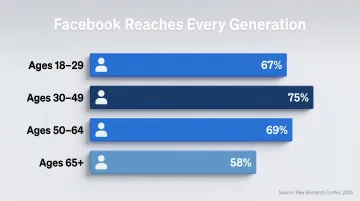
This isn't a platform skewing toward one demographic. It spans generations, which means a local HVAC company, a fintech startup, and a 55+ community developer can all find their target audience here. U.S. adult users spend an average of 30.9 minutes per day on the platform, with over half of that time on video content.
What Makes Facebook Uniquely Valuable for Small Businesses
No other platform bundles all of this at no base cost:
- A free Business Page with built-in analytics
- Granular paid targeting by age, location, income, and interests
- Facebook Groups for organic community building
- Messenger for direct customer communication
- Meta Business Suite for managing everything in one place
The Real Story on Organic Decline
Organic reach has dropped sharply — there's no sugarcoating it. But lower organic reach isn't the same as an ineffective platform. Facebook has added meaningful tools that offset the decline:
- Reels with algorithmic distribution that exposes content to new audiences
- Improved social search so Business Pages surface in Google results
- AI-powered ad delivery that gives even small budgets precise targeting
2026 is a strong time to invest, provided you stop treating a Business Page like a bulletin board.
Setting Up Your Facebook Business Page the Right Way
A half-finished Business Page costs you credibility before a single post goes live. Get the foundation right first.
Core Setup Steps
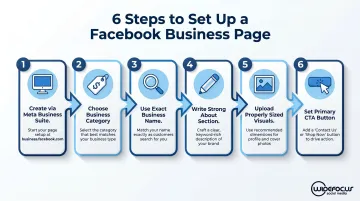
- Create via Meta Business Suite at business.facebook.com — never from a personal profile. This unlocks Ads Manager, analytics, and automation tools from day one.
- Choose the right business category — it affects how Facebook surfaces your Page in local and topic-based searches.
- Use your exact business name for search discoverability. Keyword-stuffing the Page name (e.g., "Joe's Plumbing — Denver Plumber Emergency Repair") violates Meta's policies and can get the Page removed.
- Write a strong About section — keep your most important information in the first 101 characters of your Page intro, since that's what displays before truncation.
- Upload properly sized visuals:
- Profile photo: minimum 320×320 pixels (displays as a circle)
- Cover photo: 851×315 pixels at under 100KB for fastest load
- Set a primary CTA button — Book Now, Contact Us, Shop, or whichever matches how customers convert.
Don't Skip These Two Steps
Once the basics are in place, two steps trip up most small businesses — both have long-term consequences if skipped.
Fill in every data field: hours, phone number, website, and address. Facebook uses this information for local search rankings. In 2026, Facebook increasingly functions as a search engine, and Google is actively indexing and ranking Facebook Page content for local businesses.
Install the Meta Pixel on your website before you run a single ad. Every day it sits unconfigured is audience data you'll never recover. The pixel builds retargeting audiences from website visitors — the seed for Custom Audiences and Lookalike Audiences down the road. You can complete the initial installation directly through Meta Business Suite.
Building a Facebook Content Strategy That Drives Results
The 80/20 Foundation
Eighty percent of posts should educate, entertain, or create value for your audience. Twenty percent can directly promote your products or services. This isn't a rigid rule — it's a calibration. The algorithm rewards content that generates real comments and shares, and overtly promotional posts rarely do.
Content Formats to Rotate
Mix these formats weekly to keep the feed varied and hit different distribution mechanisms:
- Reels (under 60 seconds): Highest algorithmic reach for discovery and new audiences
- Photo carousels: Before-and-after sequences, step-by-step processes, product comparisons
- Text posts: Questions, tips, and announcements — simple formats that drive comments
- Stories: Time-sensitive offers, behind-the-scenes glimpses, polls
- Facebook Live: Q&As, product demos, local events — high engagement while live
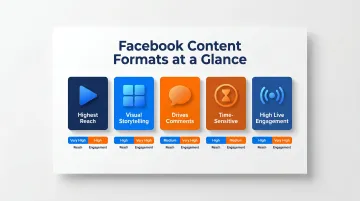
Buffer's analysis of 45 million+ posts found that images lead Facebook engagement with a 5.20% median rate, compared to 4.84% for video. Reels win on reach (getting in front of new people), while images win on engagement (getting existing followers to interact). Use both deliberately.
A Practical Posting Cadence
3–4 posts per week is sustainable for most small businesses without burning out. A sample weekly mix:
- 1 Reel (discovery and reach)
- 1 community/engagement post (question, poll, or local shoutout)
- 1 educational post (tip, how-to, industry insight)
- 1 soft promotional post (product highlight, offer, testimonial)
Quality over quantity — every time. Three strong posts outperform seven filler posts in algorithmic distribution and audience trust.
Writing Captions That Stop the Scroll
The first 125 characters of your caption appear before the "See More" cutoff. Front-load them:
- Open with a bold question, surprising fact, or direct statement
- Use natural language that matches how your customers actually search
- End with a clear call to action
- Limit hashtags to one or two — this isn't Instagram
When to Get Help
Getting the caption right is one thing — producing four quality posts every week, week after week, is another challenge entirely. For business owners already stretched thin, that's where outside support pays off. WideFoc.us works with B2B and B2C brands to build and execute content strategies that hold up under the algorithm's scrutiny. Their Facebook management for a national window treatment franchise generated 14,000 monthly website clicks and 3 million+ impressions.
Facebook Advertising for Small Businesses: Getting Results on a Budget
Boosted Posts vs. Ads Manager
These are not the same tool, and confusing them wastes money.
| Boosted Posts | Ads Manager | |
|---|---|---|
| Best for | Amplifying content that's already performing | Leads, sales, conversions |
| Targeting | Basic (age, gender, interests) | Full precision targeting |
| Objectives | Engagement and awareness | All campaign objectives |
| Complexity | Low — takes 2 minutes | Higher — worth the learning curve |
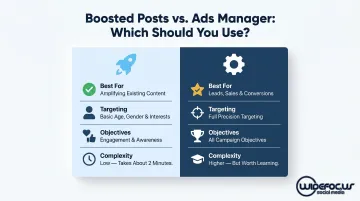
The rule of thumb: boost posts that are already generating organic engagement. Use Ads Manager when you want a specific business outcome.
Targeting Tools That Give Small Businesses a Real Edge
This is where Facebook genuinely gives small businesses an advantage over traditional advertising:
- Custom Audiences: Retarget people who visited your website, watched your videos, or are already on your email list
- Lookalike Audiences: Find new users who share traits with your existing customers — Meta builds these from your Custom Audience data
- Interest and behavior targeting: Reach people based on income level, competitor brand affinities, life events, and purchasing behavior
The Meta Pixel must be installed on your website to enable website-based Custom Audiences — install it on day one, before you need it, so the data is already building when you're ready to run campaigns.
Budget Guidance for Small Businesses
According to WordStream's 2025 Facebook Ads benchmarks, average CPC sits at $0.70 for traffic campaigns and $1.92 for leads campaigns — though this varies significantly by industry (dental practices pay up to $9.78 per lead; restaurants pay as low as $0.74).
Practical starting points:
- $5–$20/day to test messaging before scaling
- Facebook's minimum is $1/day for impression-based campaigns, $5/day for click-based
- Use Advantage+ Campaign Budget (formerly CBO) to let Meta automatically shift spend toward the best-performing ad sets
WideFoc.us has achieved $0.08 CPC and $0.05 cost-per-fan for clients — well below industry benchmarks — by pairing tightly defined audience segments with iterative ad creative testing rather than running broad campaigns and hoping for the best.
Creative Testing and Ad Fatigue
Facebook CPM can increase 30–50% when ad fatigue sets in, and a frequency metric above 3 is a reliable warning sign.
Keep creative fresh:
- Refresh ads every 7–10 days for small audiences
- Every 14–21 days for larger audiences
- A/B test one variable at a time — headline, image, CTA, or audience
- Never assume last month's winning creative will hold indefinitely
Measuring What Matters: Facebook Analytics for Small Business
Metrics That Actually Matter
Track these:
- Reach — unique people who saw the content
- Engagement rate — (likes + comments + shares + reactions) ÷ reach × 100
- Click-through rate (CTR) — for ad campaigns
- Cost per lead : for service businesses running lead gen campaigns
- ROAS (return on ad spend) — for e-commerce; calculated as purchase conversion value ÷ amount spent
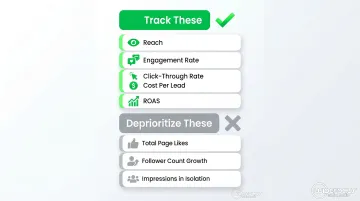
Vanity metrics to deprioritize:
- Total page likes
- Follower count growth
- Impressions in isolation
A page with 500 highly engaged followers converting to customers is more valuable than one with 10,000 followers and no business results.
Knowing which metrics matter is only half the equation — you also need the tools to capture them reliably.
Using Pixel Data and Page Insights
Meta Business Suite includes an Active Times feature showing when your specific audience is most active — use this to set posting times instead of generic benchmarks.
To connect Facebook traffic to actual business outcomes, use UTM parameters — tracking tags appended to URLs that tell Google Analytics exactly where each visitor originated. Meta Business Suite includes a built-in URL builder. All three parameters below are required for clean attribution:
utm_source= facebookutm_medium= the bid type (cpc, cpm)utm_campaign= the specific campaign name
Connecting Metrics to Business Outcomes
Monthly analytics reviews should answer one question: what's actually working, and where should we reallocate time and budget?
- Service businesses: Focus on cost per lead from ads
- E-commerce: Track ROAS through Meta's conversion reporting
- Community-driven brands: Monitor response satisfaction and Group engagement
WideFoc.us's campaign for a regional home services company achieved a 512% increase in form fills and 9x qualified leads in the first eight weeks — numbers that surface only when the right metrics are in place from day one.
Frequently Asked Questions
Is $10 a day enough for Facebook ads?
At the 2025 average CPC of $0.70, $10/day delivers roughly 14 clicks on a traffic campaign — a workable starting point. Conversion-focused campaigns may need more budget for Meta's algorithm to exit its learning phase.
Are Facebook ads worth it for small businesses?
Yes, when campaigns are targeted and tied to a specific business goal. Intentional Ads Manager campaigns consistently outperform boosted posts — start small, test your creative, then scale what's working.
What are some accessible Facebook marketing ideas for small businesses?
A few proven starting points:
- Post Reels, behind-the-scenes content, and customer testimonials
- Run a local awareness ad targeting your service area
- Host a Facebook Live Q&A about your product or service
- Join or create a niche Facebook Group to build community without ad spend
How often should a small business post on Facebook?
Three to four times per week is sustainable and effective. Consistent, quality posts outperform frequent, low-effort ones — and the algorithm rewards engagement signals like comments and shares far more than raw posting frequency.
How do I increase organic reach on Facebook in 2026?
Reels currently receive the highest algorithmic distribution for reach. Posts that generate comments (not just likes) signal quality to the algorithm. Use your Page Insights Active Times data to post when your specific audience is online — not when generic guides say to.
Do I need a Facebook Business Page or can I use my personal profile?
A Business Page is required for any professional marketing. Personal profiles don't have access to Ads Manager, Page Insights, CTA buttons, or Meta Business Suite — all of which are essential for running an effective Facebook marketing strategy.
![Social Media Marketing for Plumbers: An Actionable Guide [2026]](https://file-host.link/website/widefoc-thpoao/assets/blog-images/7d114326-c1c2-4b8d-a12f-756a61ecb41e/1778706227357988_c834c6b423e048638769571c88cc7653/1080.webp)