Introduction
Most patients have already made up their mind about your practice before they ever pick up the phone. They've read your Google reviews, scrolled your Instagram, and compared your star rating against the dentist two miles away.
The numbers back this up. According to BrightLocal's 2024 Local Consumer Review Survey, 97% of consumers read online reviews for local businesses, with 41% saying they "always" read them. The ADA reports that 84% of the public trust online reviews to guide healthcare decisions.
For dental practices, those numbers have a direct consequence: your digital presence is a primary patient acquisition channel — one that either earns trust before the first appointment or quietly redirects prospective patients to another practice down the road.
This guide covers how to build a social media strategy that attracts new patients, how to manage your online reputation proactively, and how to handle reviews — including the HIPAA compliance rules that trip up even well-intentioned practices.
Key Takeaways
- 97% of consumers read online reviews before choosing a local business — your reputation is your first impression
- Google, Facebook, and Instagram are the three platforms dental practices must actively manage
- Educational content, patient testimonials, and behind-the-scenes posts consistently outperform promotional posts
- A systematic review request process — text or email sent right after a visit — can double or triple review volume
- HIPAA prohibits confirming patient relationships in public responses — even positive ones — with real financial penalties for violations
Why Your Online Reputation Directly Impacts Patient Growth
Your clinical quality is invisible until a patient walks through the door. What's visible — and what drives the decision to book — is your online profile.
The Numbers Are Hard Filters, Not Soft Preferences
Star ratings and review counts aren't just nice-to-haves. They're decision thresholds:
- 68% of consumers require at least 4 stars before considering a business; 31% require 4.5 or above
- Dental-specific data shows call volume declines sharply below 4.7 stars, regardless of how many reviews you have
- Practices with 500+ Google reviews generate 2–3x more calls than those with fewer than 100
- 47% of consumers won't use a business with fewer than 20 reviews — full stop
- 60% of patients have actively avoided a doctor because of negative online reviews
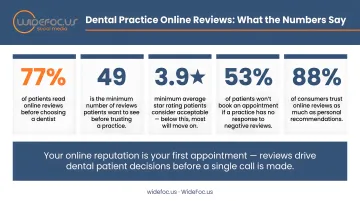
That last statistic isn't about reduced bookings — it's about elimination. Bad reviews don't cost you a few patients; they remove your practice from consideration before anyone picks up the phone.
The Local Competition Factor
Dental practices compete within a tight geographic radius, often offering nearly identical services. When two practices are equidistant and clinically comparable, the patient defaults to the one with more reviews, a higher rating, and more recent feedback.
74% of consumers want reviews from within the last three months. A practice with 80 reviews from two years ago looks stagnant next to a competitor with 40 reviews from the past 90 days.
Trust Before the First Appointment
Around 36% of patients experience dental anxiety — and for many, the decision to book comes down to whether a practice feels safe before they've set foot inside. A warm, active social media presence and a strong review profile signal approachability in ways that clinical credentials alone cannot.
That reassurance built online is often what converts a hesitant searcher into a scheduled appointment.
Which Social Media Platforms Dentists Should Prioritize
Not every platform deserves equal attention. Here's where to focus and why.
Facebook: Where Appointment Decision-Makers Are
Pew Research Center data from 2025 shows 73% of adults aged 30–49 and 65% of those aged 50–64 use Facebook — and the majority use it daily. These are the parents booking family checkups and the adults managing their own dental care.
Facebook also supports direct appointment booking integrations, and patient reviews on the platform contribute to broader reputation signals. If you're only active on one platform, make it Facebook.
Instagram: Built for Before-and-After Results
Instagram skews younger — 53% of adults aged 18–29 use it — making it the natural home for cosmetic and elective dental content. The engagement data backs this up: a peer-reviewed study of 150 dental Instagram posts found clinical case and before-and-after content averaged 2,640 likes compared to just 1,144 for practice advertisements.
That gap matters. If you're investing time in Instagram, document real patient outcomes — not polished promotional graphics.
Once Facebook is established, Instagram is the logical next layer for practices offering cosmetic services.
YouTube and Google Business Profile
91% of U.S. adults use YouTube — the second-largest search engine. Dental procedure explainer videos and FAQ content rank in Google search and continue generating views and trust long after they're published.
Your Google Business Profile operates differently from social platforms, but it demands the same consistency. Review signals account for approximately 16% of local pack ranking factors, and routine actions — responding to reviews, adding photos, answering Q&A — directly influence whether your practice appears when someone searches "dentist near me."
Key GBP habits to build:
- Respond to every review within 48 hours
- Add new photos monthly (operatories, team, before-and-afters with consent)
- Monitor and answer the Q&A section regularly
Social Media Content That Builds Trust and Drives Bookings
Educational Content: The Foundation
Oral health tips, procedure explanations, and myth-busting posts do something promotional content can't — they demonstrate expertise without feeling like an ad. This type of content is also highly shareable, which extends your reach organically.
Effective formats include:
- Short-form video (procedure walkthroughs, "what to expect" clips)
- Carousel posts explaining a process step-by-step
- Q&A posts addressing common patient fears
- Infographics on oral hygiene routines
The goal isn't to sell. It's to become the practice patients think of when a dental question comes up.
Patient Testimonials as Social Proof
Turning a strong Google review into a branded social post amplifies positive sentiment beyond the review platform itself. It also reaches followers who may never visit your Google profile directly.
85% of consumers are more likely to use a business after reading positive reviews. When that review appears in someone's Instagram feed rather than requiring them to seek it out, the impact compounds.
Behind-the-Scenes and Team Content
Staff introductions, office tours, and "day in the practice" reels are chronically underused, yet consistently among the highest-performing content types. They reduce dental anxiety by making your team feel familiar before a first visit. A patient who already feels like they "know" the hygienist is far more likely to book than one walking in cold.
This content costs almost nothing to produce and builds emotional connection that no ad can replicate.
Consistency Over Volume
Posting sporadically signals an inactive practice — and inactivity undermines trust just as much as a bad review does. Sprout Social recommends 2–5 posts per week on Facebook for optimal visibility without overwhelming your audience.
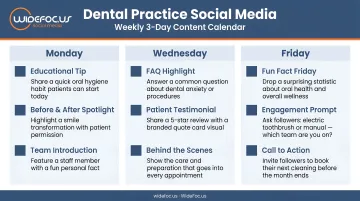
A realistic content calendar looks like:
- Monday: Educational tip or oral health myth
- Wednesday: Team spotlight or behind-the-scenes content
- Friday: Patient testimonial post or before-and-after (with consent)
Maintain consistent visuals, tone, and branding across every platform.
Dental practices juggling multiple platforms often find that partnering with a dedicated social media agency keeps their strategy consistent without pulling clinical staff away from patient care. WideFoc.us has worked with healthcare clients since 2007, building content strategies across Facebook and Instagram that cover creation, monitoring, and analytics under one roof.
Building and Protecting Your Online Reputation Proactively
Claim and Optimize Your Listings First
Reputation management starts with visibility. Claim your profiles on:
- Google Business Profile (highest priority)
- Healthgrades and Zocdoc (healthcare-specific searches)
- Yelp and Dentistry.com
- Facebook (reviews here contribute to overall reputation signals)
Ensure your NAP (Name, Address, Phone) information is identical across every platform. Inconsistent information confuses search engines and prospective patients alike, and it directly hurts your local search rankings.
Generate Reviews Systematically
Most satisfied patients won't leave a review without a nudge. The fix is simple: send a text or email with a direct review link immediately after the appointment, while the experience is fresh.
BrightLocal found that 83% of consumers who were asked to leave a review followed through — a dramatically higher rate than unprompted reviews. The key is making it frictionless: one link, one tap.
Post-visit surveys also work as a private feedback channel. When a patient signals dissatisfaction, your team can reach out to resolve the issue before it escalates to a 1-star public review. Route only patients who indicate a positive experience toward your public review platforms.
Monitor Your Reputation Continuously
Proactive reputation management means knowing what's being said before a problem grows. Set up:
- Google Alerts for your practice name
- Reputation management software (Swell, Podium, Birdeye) for consolidated monitoring
- Regular manual checks on Healthgrades, Yelp, and Zocdoc
Monitoring is only half the equation. Once you've identified your strongest reviews, put them to work: share them as Instagram story highlights, Facebook posts, and website testimonials. This connects your reputation management to your broader social media presence, building consistent trust signals across every touchpoint in the patient journey.
Responding to Reviews: What Protects (and What Damages) Your Reputation
Responding to Positive Reviews
Every public response is read by future patients, not just the reviewer. Keep responses:
- Brief — 2–3 sentences is plenty
- Warm but non-specific — no treatment details, no procedure mentions
- HIPAA-compliant — don't confirm the person is a patient or reference anything clinical
A compliant positive response looks like: "Thank you so much for taking the time to share your experience — we truly appreciate it and look forward to seeing you again!"
Responding to Negative Reviews
The cardinal rules:
- Never respond when emotional — wait until you can write calmly
- Never confirm a patient relationship — this is a HIPAA violation
- Never discuss treatment specifics — even if the patient already has
- Never offer incentives publicly to update or remove a review
A compliant negative response acknowledges the concern professionally, expresses genuine commitment to patient satisfaction, and invites the person to contact the practice directly. Write it for the prospective patients reading it — they're the real audience.
After posting publicly, reach out privately. Patients who feel genuinely heard often update or remove negative reviews. That pattern of consistent follow-through builds the kind of practice reputation that new patients notice before they ever book an appointment.
HIPAA Compliance in Review Responses
This is where practices get into serious trouble. In December 2022, HHS/OCR settled with New Vision Dental for $23,000 after the practice disclosed patient PHI in social media review responses. A separate enforcement action resulted in a $50,000 civil penalty against another dental practice for the same type of violation.
What HIPAA prohibits in any public response:
- Confirming or denying the reviewer is a patient
- Mentioning any treatment, procedure, or appointment detail
- Referencing any personal health information, even if the patient already shared it publicly
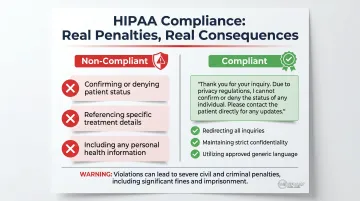
Compliant response: "We take all patient feedback seriously. Please contact our office directly at [phone number] so we can address your concerns."
Non-compliant response: "We're sorry your crown procedure didn't meet your expectations — we'd love the chance to make things right." (Confirms patient relationship and references treatment — both violations.)
The HIPAA Privacy Rule makes no exception for well-intentioned responses. If a response requires any clinical context to make sense, it shouldn't be posted.
Frequently Asked Questions
What is online reputation management for dentists?
ORM for dentists is the ongoing process of monitoring and managing how a practice appears across review sites, directories, and social platforms — including generating reviews, responding to feedback, and correcting inaccurate listings. The goal is building the trust signals that attract new patients before they contact your office.
Which platform is most important for dental practice reputation?
Google is the highest priority — it directly influences local search rankings and is where most patients look first. Healthgrades, Yelp, and Zocdoc matter for healthcare-specific searches and should be actively maintained alongside your Google Business Profile.
How are social media and online reputation management connected?
They're two sides of the same coin. Positive reviews can be repurposed as social content to extend their reach, and an active social presence reinforces the credibility your reputation management efforts build.
How do dentists get more Google reviews?
Send a text or email with a direct Google review link immediately after each appointment. Speed and simplicity drive completion — the faster and easier you make the process, the more patients follow through. Verbal or in-office-only requests produce significantly lower follow-through.
How should a dentist respond to a negative review?
Keep it brief, calm, and general — acknowledge the concern without confirming treatment details, express commitment to patient satisfaction, and invite the person to contact the practice directly. Remember: your response is written for future patients reading it, not just the reviewer.
What social media content works best for dental practices?
Educational posts (oral health tips, procedure explanations), patient testimonials (review graphics, video testimonials), and behind-the-scenes team content consistently outperform promotional posts — they build trust, ease patient anxiety, and turn followers into booked appointments.
![Social Media Marketing for Plumbers: An Actionable Guide [2026]](https://file-host.link/website/widefoc-thpoao/assets/blog-images/7d114326-c1c2-4b8d-a12f-756a61ecb41e/1778706227357988_c834c6b423e048638769571c88cc7653/1080.webp)