Introduction
Before a patient ever calls your office, they've already Googled you. They've read your reviews, scrolled your Facebook page, and maybe watched a provider video on YouTube. For healthcare organizations, social media is where trust is built — or lost — long before the first appointment.
According to Healthgrades, 75% of patients turn to online reviews as their first step when searching for a new physician, and 90% include those reviews in their final decision. Your social media presence is part of that decision — whether you've shaped it intentionally or not.
Healthcare social media comes with real complexity. HIPAA compliance, FDA oversight, platform advertising restrictions — the guardrails are strict, but they're navigable with the right approach. This guide covers what healthcare organizations need to know: which platforms to use, how to build a strategy, what to post, how to stay compliant, and how to measure what actually matters.
Key Takeaways
- 75% of patients check online reviews before choosing a provider, making social media a direct patient acquisition channel
- Focus on 2-3 platforms matched to your audience rather than stretching across every platform
- Every content workflow needs a HIPAA compliance checkpoint before anything goes live
- Track engagement rate, referral traffic, and appointment conversions — not follower counts
- Reels and TikTok drive the highest healthcare engagement rates — accuracy and evidence-based content are non-negotiable
Why Social Media Is No Longer Optional for Healthcare Organizations
Healthcare organizations that treat social media as optional are losing patients before those patients ever make contact.
Research from PMC shows 40% of consumers say information found on social media directly impacts how they manage their own health — and among adults aged 18-24, that number climbs to 90% trusting medical information shared within their social networks.
Patient Acquisition and Retention
Consistent social media activity works on two timelines simultaneously:
- Acquisition: Keeps your organization visible when patients are actively searching for care — two-thirds of consumers who visit a Healthgrades physician profile schedule an appointment within a week
- Retention: Maintains connection between visits through educational content, wellness tips, and seasonal health reminders that reinforce the patient-provider relationship
- Referrals: Peer sharing amplifies reach organically — patients who engage with your content become informal advocates
The Misinformation Problem You Can Solve
That same trust in peer networks has a dark side. On some social media platforms, falsehoods are 70% more likely to get shared than accurate news, according to WHO.
Healthcare organizations occupy a unique position of authority. When your providers post accurate, credible health information, you're not just marketing — you're counterbalancing a genuine public health problem. Active social profiles let you:
- Deliver crisis communication quickly during outbreaks or emergencies
- Address local health misinformation directly, before it spreads
- Reach underserved populations at a fraction of traditional media costs
The trust gap is real: only 2% of Americans trust health information on social media "a lot," while 82% trust their primary care doctor. Posting credible, provider-backed content is how you convert that institutional trust into genuine online authority.
Choosing the Right Social Media Platforms for Healthcare
The worst social media strategy is trying to be everywhere. Pick 2-3 platforms based on your audience demographics and content goals, then execute them well.
Here's how each platform maps to healthcare use cases:
Facebook and Instagram
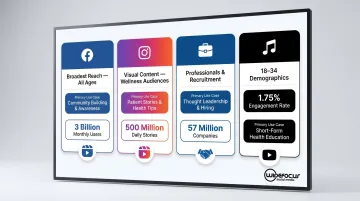
Facebook remains the broadest-reach platform across age groups. It's the right choice for:
- Community health updates and local event promotion
- Targeted health awareness campaigns using paid ads
- Multi-generational audiences (particularly valuable for family medicine, pediatrics, and senior care)
- Community groups for condition-specific education and support
Instagram is built for visual content — wellness tips, patient success stories, and behind-the-scenes culture posts all perform well here. Reels drive higher interaction rates than standard posts for healthcare accounts, making short-form video a priority format. Instagram skews toward younger, wellness-oriented audiences.
LinkedIn and TikTok
LinkedIn serves a different purpose entirely. Use it for:
- Thought leadership from physicians and executives
- Recruiting medical talent (92% of healthcare employers plan to use social media for recruitment)
- Sharing research, clinical insights, and industry news
TikTok reaches younger demographics through short educational videos and myth-busting content. It delivers the highest healthcare engagement rate at approximately 1.75% — but 40-50% of health content on TikTok contains misinformation. If you post there, factual accuracy has to be non-negotiable — every claim sourced, every statistic verified.
YouTube
YouTube operates differently from the platforms above — it functions as a search engine as much as a social platform. Long-form procedure explainers, patient education series, and provider Q&As live here and surface directly in Google results. If your organization can produce quality video consistently, YouTube extends your discoverability well beyond social feeds.
How to Build a Healthcare Social Media Strategy That Works
Most healthcare social media efforts stall because activity replaces strategy. These five steps give your program a framework that connects what you post to outcomes you can actually measure.
Step 1: Define SMART Goals
Every healthcare social media strategy needs objectives that are specific, measurable, and time-bound. Vague goals like "increase awareness" don't guide decisions or measure progress.
A SMART healthcare goal looks like this: "Increase appointment request form submissions from social media referral traffic by 20% within six months by publishing three educational posts per week on Facebook and Instagram."
Common goal categories for healthcare:
- Patient education and health literacy
- Brand awareness and provider reputation
- Appointment-request generation
- Talent recruitment
- Crisis communication readiness
Step 2: Define Audience Personas
Healthcare audiences aren't monolithic. Your content strategy should distinguish between:
- Prospective patients seeking condition information or provider comparisons
- Current patients needing follow-up education and retention touchpoints
- Caregivers researching options for family members
- Healthcare professionals engaging with clinical or research content
Each group uses different platforms, consumes content differently, and needs different information. One-size-fits-all content underserves all of them.
Step 3: Build a Content Calendar Around Health Moments
A structured content calendar does two things: it keeps posting consistent, and it ensures you're tapping into timely conversations.
Plan around:
- Health awareness months (Mental Health Awareness Month, Heart Health Month, Breast Cancer Awareness Month)
- Seasonal health events (flu season, allergy season, back-to-school vaccinations)
- Trending public health topics surfaced through social listening
Consistency matters more than sheer volume. Healthcare benchmarks from Hootsuite suggest 3-4 posts per week on Facebook, 3 posts per week on Instagram, and roughly 2 posts per week on LinkedIn.
Step 4: Set Up a Compliant Approval Workflow
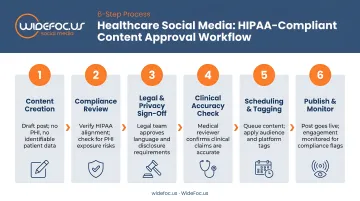
For healthcare, the content approval process is not optional. A compliant workflow includes:
- Content creation — draft copy, visuals, captions
- Medical accuracy review — clinical team sign-off on health claims
- HIPAA compliance review — verify no PHI is present, consent documentation confirmed
- Brand and legal review — tone, claims, FDA fair balance requirements
- Scheduling and publishing
- Community management — monitoring comments and routing health inquiries privately
Skipping steps creates liability. The OCR settled with Elite Dental Associates for $10,000 after the practice disclosed patient PHI while responding to social media reviews — a preventable violation.
The workflow you build depends heavily on who owns it — which makes team structure the next critical decision.
Step 5: Choose the Right Team Structure
Healthcare organizations can manage social media in-house, through an agency, or through a hybrid model. Each has trade-offs:
| Model | Best For | Trade-offs |
|---|---|---|
| In-house | Organizations with dedicated marketing staff | Bandwidth constraints, compliance training burden |
| Agency | Organizations needing full execution + strategy | Requires onboarding, partner vetting |
| Hybrid | Teams with execution capacity but gaps in strategy | Requires clear role and ownership boundaries |
For healthcare organizations without dedicated social media staff, partnering with an agency that understands regulated industries can close the compliance and strategy gap quickly. WideFoc.us has worked with healthcare and health-adjacent clients since 2007 and offers both full-service management and a consulting model for in-house teams that need strategic direction without full outsourcing.
What to Post: Healthcare Content That Educates and Engages
Educational Content
Educational posts are the foundation of any healthcare social media presence. This includes:
- Common condition explainers written for non-medical audiences
- Preventive care tips and seasonal health guidance
- Responses to trending health topics and misinformation
- Fast facts and statistics formatted as shareable graphics
Infographics work well for dense health data because they translate complex information into a format people actually share. Video takes it further — across platforms, video generates up to 1,200% more shares than text or image posts combined.
Patient Stories and Testimonials
Patient success stories humanize your organization in ways that clinical content can't. But consent isn't negotiable. Under the HIPAA Privacy Rule, any use of patient content for marketing purposes requires a valid written HIPAA authorization that specifies the information being used, its purpose, and an expiration date.
Keep shared stories compliant:
- No diagnoses, specific treatment details, or identifiable health conditions
- No full names or photos without explicit written authorization
- No information that could be cross-referenced to identify the individual
A recurring "patient spotlight" series works well when consent documentation and content review are built into the process from the start.
Behind-the-Scenes and Culture Content
Staff introductions, day-in-the-life posts, new equipment showcases, and office culture moments build trust before a patient ever visits. This content performs especially well on Instagram Stories and TikTok — and doubles as recruitment content at no additional production cost.
Paid Social Campaigns
Organic content builds authority, but it has limits — particularly when patient acquisition is the goal. Paid social campaigns on Facebook and Instagram let healthcare organizations reach specific demographics with appointment-booking CTAs, service promotions, or health awareness messaging.
Key platform restrictions to know:
- Meta prohibits ads that imply negative self-perception or shame around body type
- Weight loss and cosmetic procedure ads must target users 18 and older
- Sexual and reproductive health ads must focus on medical efficacy, not lifestyle framing
Paid campaigns work best when they amplify organic content that's already performing, not replace it.
HIPAA Compliance and Regulatory Guardrails for Healthcare Social Media
Compliance failures on social media are documented, expensive, and — in most cases — entirely preventable.
Core HIPAA Obligations
Protected Health Information (PHI) includes any individually identifiable information related to a patient's health condition, care, or payment — in any form, including comments, photos, and direct messages.
The most common social media violations:
- Responding to patient reviews with health details (even to defend the practice)
- Tagging patients in photos without explicit written authorization
- Commenting on a patient's condition in a public thread
- Staff posting case details — even without names — that could identify individuals
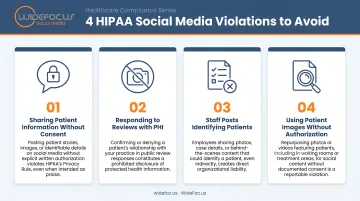
These violations share a common thread: clinical details surfacing in public spaces. When a patient reaches out publicly with a health question or complaint, move the conversation to a private, secure channel. Clinical details have no place in a public comment thread.
HIPAA governs patient data. A separate — and equally enforced — set of rules governs what healthcare organizations can say about treatments and products.
FDA Requirements for Promotional Content
Any social media content promoting a drug, device, or treatment must:
- Reflect only approved uses
- Disclose material risks — not just benefits
- Not be misleading through selective omission
In September 2025, the FDA issued an industry-wide letter describing deceptive drug advertising on social media as "the current norm" and announced escalated enforcement. Pharmaceutical and device marketers should audit all promotional content against FDA fair balance requirements before the next post goes live.
Operational Best Practices
- Train every employee with social media access on HIPAA requirements — not just the marketing team
- Conduct periodic audits to catch inadvertent violations before they become enforcement actions
- Document approval workflows; if it's not written down, it didn't happen
- Define escalation paths for negative comments, patient inquiries, and crisis situations before they arise
Measuring What Matters: Healthcare Social Media KPIs and Performance
Follower counts are not a business metric. What matters is whether social media activity is moving organizational goals.
The KPIs That Connect to Outcomes
| Metric | What It Tells You |
|---|---|
| Engagement rate | Content resonance with your audience |
| Reach | Audience growth and content distribution |
| Website referral traffic | Social-to-site conversion activity |
| Appointment form completions from social | Direct patient acquisition attribution |
| Audience sentiment | Patient perception and trust signals |
Healthcare engagement rate benchmarks by platform (Hootsuite/Rival IQ, 2025):
- TikTok: ~1.75%
- LinkedIn: ~1.1%
- Instagram: 0.31–0.36%
- Facebook: 0.04–0.06%
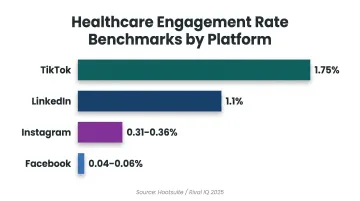
If your Facebook engagement is sitting below 0.04%, content quality or posting frequency needs attention. If LinkedIn is well above 1.1%, you're building genuine professional traction.
Using Analytics to Refine Strategy
Monthly performance reviews should answer:
- Which content formats (video, infographic, text post) drive the most engagement?
- Which topics generate the most saves, shares, and link clicks?
- What posting times correlate with higher reach?
WideFoc.us includes monthly insights reporting in every client engagement, covering platform-level performance and strategic recommendations, so healthcare organizations know precisely what's working and what to adjust.
Social Listening as a Strategic Intelligence Tool
Analytics tell you how your content performs. Social listening tells you what your community is actually thinking. The WHO defines social listening as capturing and analyzing conversations from diverse sources to understand community "questions, concerns and areas of uncertainty" — a methodology healthcare organizations can apply directly.
Done consistently, social listening lets you:
- Identify misinformation circulating in your community before it spreads
- Spot emerging patient concerns that should shape your content calendar
- Monitor competitor sentiment and industry conversation
- Measure how patient perception shifts after campaigns or announcements
This data shouldn't just live in a monthly report. It should feed content planning and broader communications decisions in real time.
Frequently Asked Questions
What is the best social media platform for healthcare?
No single platform works for every organization. Facebook offers the broadest community reach across age groups; Instagram is strongest for visual patient-facing content; LinkedIn serves professional and recruitment goals; TikTok reaches younger audiences through short educational video. Choosing 2-3 platforms based on your specific audience demographics will outperform a scattered presence across all channels.
How do healthcare organizations use social media?
Primary use cases include patient education, reputation and trust building, community engagement, crisis and misinformation response, talent recruitment, and patient acquisition through organic and paid campaigns. The mix varies by organization type and audience — a hospital system's strategy will look different from a specialty clinic's.
What is a paid social media campaign?
A paid social campaign involves paying a platform — Facebook, Instagram, and others — to distribute targeted content to a defined audience beyond your organic followers. In healthcare, paid campaigns drive appointment bookings, promote specific services, and deliver health awareness messaging to demographic groups your organic content might not reach.
What are the 4 C's of social media strategy?
The 4 C's — Content, Community, Consistency, and Conversation — are a practical framework for social media planning. In healthcare, Content means clinically accurate education, Community means earning patient trust, Consistency means a reliable posting cadence, and Conversation means responding promptly to comments and inquiries.
What are the top social media trends in the healthcare industry?
Key trends shaping healthcare social right now:
- Short-form video (TikTok, Reels) for accessible health education
- Providers stepping up as authoritative voices against AI-generated misinformation
- Influencer partnerships tied to specific condition awareness campaigns
- Social listening strategies that surface and respond to real patient conversations
What are some successful public health social media campaigns?
The American Heart Association's Hands-Only CPR campaign helped grow CPR willingness in the US from 54% in 2017 to 64% in 2023, fueled by social media tied to timely news moments. WHO's COVID-19 strategy led to the removal of 850,000 misinformation videos from YouTube in under a year. Both succeeded through emotional resonance and clear calls to action.