Potential clients don't wait for a sales call to form an opinion. They check your LinkedIn before replying to your email. They scroll your Instagram before agreeing to a discovery call. A thin or inconsistent presence signals something specific: if you can't manage your own marketing, why would I trust you with mine?
The agencies that commit to their own social strategy see compounding returns — more inbound leads, stronger recruiting pipelines, and referral credibility that no paid campaign can replicate. This guide walks through exactly how to build and operate a social media approach designed to grow your agency specifically.
Key Takeaways
- Your agency's social channels are a live portfolio — prospects evaluate them before making contact
- Define specific, measurable goals before posting a single piece of content
- Build content around recurring pillars like thought leadership, case studies, educational tips, and team culture
- Consistency on two platforms beats irregular activity across five
- Track metrics tied to business growth — inbound inquiries and profile visits matter more than likes
Why Your Marketing Agency Needs Its Own Social Media Presence
The Credibility Problem Is Real
When a prospect is evaluating your agency, they're not just reading your website. According to IDC data compiled by DSMN8, 75% of B2B buyers use social media to support purchase decisions — and 84% of C-level and VP-level executives do the same. Those are the exact decision-makers agencies are trying to reach.
Your social channels function as a live portfolio. Unlike a static case studies page, they show real-time evidence of your consistency, voice, and ability to engage.
An agency that posts sporadically, uses outdated branding, or has a LinkedIn page with 200 followers raises an immediate question: why would I hire them to manage my social media?
Four Growth Levers from One Content Investment
A strong agency social presence doesn't just attract clients. It works across multiple fronts simultaneously:
- Lead generation — thought leadership and case studies pull in prospects earlier in their decision process
- Talent recruitment — culture content attracts candidates who want to see who they'd be working with
- Referral credibility — partners and past clients are more likely to refer an agency with an active, professional presence
- Brand authority — consistent content builds the kind of recognition that keeps you top of mind
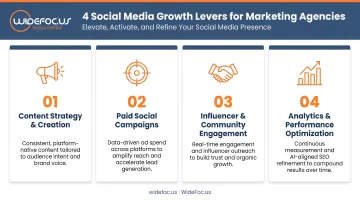
All four outcomes feed from the same content investment — the kind your agency is already equipped to produce for clients.
What to Establish Before You Start Posting
Jumping straight to posting without strategic setup is the most common mistake agencies make with their own social. The infrastructure matters more than the content volume.
Define Goals with Specificity
"Get more clients" is not a goal. "Generate five qualified inbound inquiries per month from LinkedIn" gives you something to measure and optimize toward. Without that specificity, every content decision becomes guesswork.
Know Your Audience Before Choosing Platforms
A B2B-focused agency targeting CMOs and marketing directors needs a fundamentally different approach than one targeting small business owners or e-commerce brands. Your audience determines:
- Which platforms to prioritize
- What content formats to use
- What tone and vocabulary to adopt
- What problems to address in your content
Nail this first, and every platform decision that follows becomes easier to justify.
Establish Brand Voice and Visual Consistency
Consistent branding across channels can increase revenue by up to 23%, according to Marq's State of Brand Consistency research. For agencies, the stakes are higher — inconsistency doesn't just cost revenue, it signals to prospects that you can't manage your own marketing.
Before posting, lock in:
- A defined tone of voice that matches how your best clients speak
- A visual system — colors, fonts, template styles
- Profile copy that communicates who you serve and what makes you credible
- A realistic posting cadence you can maintain
Prospects judge agencies by how they show up for themselves before trusting them with anyone else's brand.
How to Use Social Media to Grow Your Agency: A Step-by-Step Approach
Growing an agency through social follows a defined sequence. Here's how to structure it.
Setting Up Your Agency's Social Foundation
Start with an audit. Before creating anything new, assess what currently exists across all platforms. Look for:
- Outdated profile photos or bios
- Inconsistent branding between platforms
- Inactive accounts that create a negative impression
- Channels where your audience simply isn't present
Spreading thin across six platforms is one of the most common agency mistakes. It's far better to be excellent on two channels than forgettable on six. Decide which platforms to focus on, and either pause or clean up the rest.
Fix your profiles next. A strong agency bio does three things: it tells visitors who you serve, what you do, and why you're credible. Compare these two examples:
- Weak: "Full-service marketing agency helping businesses grow."
- Strong: "B2B social media strategy and content for tech companies, professional services, and growth-stage brands. 19 years of results-driven campaigns."
The second signals positioning immediately. Bios, links, and profile imagery should all communicate the same thing before a visitor reads a single post.
Launching Your Content Strategy
Build a content calendar around 3–5 pillars rather than deciding what to post each day. This approach lets you structure months of content in advance, ensures variety, and ties every post back to a specific business goal.
Set a sustainable cadence. Based on LinkedIn's official guidance and Buffer's research, a starting point for agencies new to managing their own social:
| Platform | Recommended Starting Cadence |
|---|---|
| 3–4 posts per week | |
| 3–5 posts per week | |
| 3–5 posts per week |
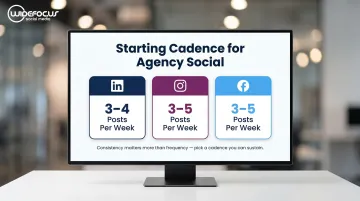
A consistent three-posts-per-week schedule on two platforms outperforms irregular daily posting across five. LinkedIn explicitly states that consistency is more valuable than posting in random bursts — and that principle applies to every platform.
Executing and Engaging
Publishing is only half the work. Responding to comments, joining relevant conversations, and engaging with accounts in your niche signals to algorithms and audiences that your agency is present and worth following.
Employee advocacy deserves particular attention on LinkedIn. Personal LinkedIn profiles generate 8x more engagement than company page posts, and a company's employees collectively reach networks 10x larger than the company page itself. Encouraging team members to share and engage with agency content dramatically extends organic reach — no additional content production required.
Tracking and Iterating
Once engagement becomes consistent, measurement tells you what's actually working. The metrics that matter for an agency trying to grow its own business:
- Profile visits — are prospects landing on your page?
- Inbound inquiries sourced from social — is content generating actual conversations?
- Follower growth among target audiences — are you attracting the right people?
- Engagement rate on case study posts — are results resonating with prospects?
What to deprioritize: total impressions, raw follower counts, and likes on posts that never lead to inquiries. Use native platform analytics monthly to identify which content types drive the most meaningful engagement, then adjust your calendar accordingly. At WideFoc.us, monthly strategy reviews are built into every client engagement — performance data from the previous month directly shapes what gets created next.
Choosing the Right Social Media Platforms for Your Agency
The core principle: strong presence on two or three platforms beats weak presence on six. Platform selection should follow where your ideal clients actually spend time and make professional decisions.
LinkedIn for B2B Client Acquisition
For most agencies, LinkedIn is the non-negotiable priority. 80% of B2B leads generated through social media come from LinkedIn, and 4 out of 5 LinkedIn members drive business decisions at their organizations.
LinkedIn is where buyers evaluate vendor credibility before making contact. Thought leadership earns professional trust here in ways other platforms don't replicate. The company page and individual team profiles can work together, since personal posts typically reach far more people than company page content alone.
A few specific tactics that work well on LinkedIn:
- Executive thought leadership posts that address client pain points directly
- Case study content shared by individuals, not just the company page
- Consistent engagement on prospects' posts to build visibility before pitching
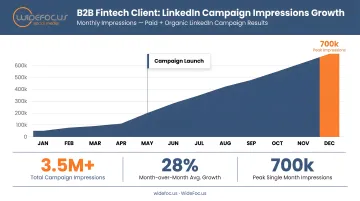
For a WideFoc.us B2B fintech client, a LinkedIn-led strategy combining executive thought leadership with organic content drove more than 1.2 million monthly impressions and made LinkedIn the top marketing-generated traffic source month over month.
Instagram for Showcasing Creativity and Culture
Instagram plays a different role: it's a visual portfolio and culture channel. Reels, carousels, and behind-the-scenes content demonstrate creative capability in ways a LinkedIn post simply can't.
This platform works particularly well for agencies targeting B2C brands, creative-adjacent businesses, or clients who want to see examples of actual work output. If your creative is visually strong, Instagram is where you prove it — with finished work, process clips, and team moments that show what working with your agency actually looks like.
Facebook and YouTube for Authority and Reach
Facebook functions primarily as a paid amplification channel for agencies. Even $500/month in ad spend can generate substantial reach for case study promotions and service announcements. Organic reach is limited, but paid targeting capabilities are strong.
YouTube is a long-form authority channel. Tutorial content, case study walkthroughs, and educational series build SEO-backed visibility over time. These are secondary platforms; they amplify a strategy anchored on LinkedIn and Instagram rather than anchor it themselves.
Emerging Platforms Worth Watching
Threads and TikTok offer lower-stakes environments for experimenting with personality-driven, unfiltered content. Both can show the personality behind an agency brand and reach younger business owners. WideFoc.us has been active on Threads, using it to test voice and engage with a broader audience. Neither should take priority over LinkedIn or Instagram for most agencies, but both are worth monitoring.
What to Post: Content Pillars That Attract Marketing Clients
Rather than deciding what to post each day, establish 4–6 recurring content categories that rotate throughout the month. Each pillar should serve a specific audience need or business goal.
Thought Leadership and Expert Perspective
This is your primary credibility-builder. Original opinions on industry trends, platform changes, and marketing strategy position your agency as a voice worth following. Posts that challenge a common misconception or offer a counterintuitive take typically outperform generic tips — they signal genuine expertise rather than curated information.
Case Studies and Results
Case studies are the most conversion-relevant content you can post. Structure them as problem → strategy → outcome narratives that give prospects real proof. You don't need to reveal client names — WideFoc.us regularly presents results by industry category (B2B fintech, regional home services, cybersecurity brand) rather than company name, which preserves confidentiality while still delivering credible proof.
Results like 20 million impressions and 1 million link clicks achieved across the WideFoc.us client portfolio in 2024 are the kind of concrete outcomes that stop a prospect mid-scroll.
Educational Tips for Business Owners
Content that addresses your ideal clients' pain points generates inbound trust at the top of the funnel. Topics that work well include:
- Common social media mistakes business owners make
- How to evaluate and choose a marketing agency
- Content planning frameworks they can use immediately
Prospects discover this content before they're ready to buy. When they are ready, your agency is already familiar.
Behind-the-Scenes and Culture Content
This pillar serves two purposes: it humanizes your agency for prospects who want to know who they're hiring, and it supports talent recruitment by demonstrating what working there actually looks like. Team spotlights, project brainstorms, creative process moments, and real office interactions outperform polished branded posts in engagement.
Best Practices for Staying Consistent When You're Managing Client Work
Most agencies fail at their own social not because of bad strategy, but because client work always wins. The solution is structural, not motivational.
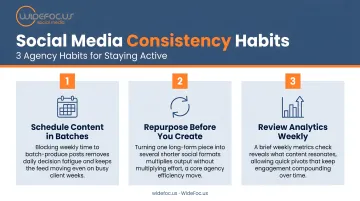
Three habits make the difference between agencies that post consistently and those that go dark for months at a time:
- Treat it like a client account. Assign a dedicated time block, maintain a real content calendar, and hold someone accountable. "We'll post when there's time" is how agencies end up with six months of silence on LinkedIn.
- Batch your content creation. One planning session per month and one creation session per week is far more efficient than daily decisions — it reduces creative fatigue and keeps scheduling tools doing the work.
- Build in a publishing rhythm. Even three posts per week, consistently executed, outperforms sporadic bursts of activity.
When internal bandwidth can't support it, partnering with a dedicated social media agency is a practical option. WideFoc.us offers end-to-end social media services — content creation, community management, paid campaigns, and monthly strategy — so an internal team can focus on client delivery while a dedicated team manages the agency's own presence with the same rigor applied to any client account.
Frequently Asked Questions
Which social media platforms are used for advertising?
The major paid advertising platforms are Facebook, Instagram, LinkedIn, YouTube, and TikTok. For B2B agencies, LinkedIn's targeting capabilities make it the top choice for reaching decision-makers. For B2C-focused campaigns, Facebook and Instagram typically deliver the strongest reach-to-cost ratio.
How can a marketing agency use social media to get clients?
Agencies attract clients by demonstrating expertise before a prospect ever reaches out — through thought leadership, case studies that prove results, and a consistent presence that validates the services being sold. Done well, your social feed makes the case before a sales conversation ever starts.
What kind of content should a marketing agency post on social media?
The most effective mix includes: thought leadership on industry trends, client case studies (problem → solution → outcome), educational tips for business owners, behind-the-scenes culture content, and team spotlights. Rotating across these pillars keeps content varied without losing strategic focus.
How often should a marketing agency post on social media?
Consistency matters more than frequency. A realistic starting point is 3–5 times per week on one or two primary platforms, with quality and regularity prioritized over daily output. Irregular posting — long gaps after bursts — signals inconsistency to both platform algorithms and your audience.
Should a marketing agency be on every social media platform?
No. Spreading across every platform typically produces a weak presence everywhere rather than a strong presence anywhere. Focus on 2–3 platforms where your ideal clients are most active, build a credible presence there, and expand only when that foundation is stable.
How do you measure whether social media is actually growing your marketing agency?
Track inbound inquiries sourced from social, profile visits, follower growth among your target audience, and engagement rates on high-intent content like case studies. Avoid optimizing for total impressions or raw follower counts — neither metric tells you whether social is actually generating qualified leads or new clients.