Introduction
Most financial advisors build their practice on relationships — but those relationships increasingly begin with a Google search, a LinkedIn scroll, or a YouTube video, not a referral call. Prospects size up advisors online long before booking a meeting. Those who aren't showing up consistently are handing that first impression to competitors who are.
The numbers back this up. According to FINRA Foundation research, 60% of investors aged 18–34 use social media to inform their investment decisions — and 61% of that same group have acted on recommendations they found there. That gap isn't sitting empty — unregulated finfluencers are stepping into the space that credentialed advisors leave vacant.
This guide covers everything financial advisors need to build a social media presence that actually generates clients: platform selection, content strategy, content mix frameworks, compliance essentials, and how to measure real growth — think booked discovery calls and referrals, not follower counts.
Key Takeaways
- 60% of younger investors use social media for investment decisions — advisors without a presence are invisible to this group
- LinkedIn drives 68% of advisor social media leads — it's the highest-priority platform for most practices
- Use a structured content mix (80/20 or 5-3-2) to balance education, trust-building, and light promotion
- Compliance isn't optional: archive posts for at least three years and never guarantee returns
- Track profile visits, DMs, and consultation requests rather than follower counts alone
Why Social Media Is Non-Negotiable for Advisor Growth
The Wealth Transfer Stakes
Cerulli Associates projects nearly $124 trillion in wealth will transfer between generations through 2048. That wealth is moving to Gen X, Millennials, and Gen Z heirs — people who research advisors online before they pick up the phone.
Advisors without a social media presence during this transfer period face a straightforward problem: the heirs receiving those assets will hire advisors they trust. No digital presence means you're not on their list.
Trust Before the First Call
Financial advisors aren't selling a product — they're selling a relationship. That's exactly where social media earns its place: prospects can observe your communication style, values, and expertise over weeks or months before committing to a meeting. By the time they reach out, the trust-building work is already done.
Consistent posting also protects existing client relationships. Educational content between annual reviews keeps you visible — and when markets get volatile, that visibility is what keeps clients from calling a competitor instead. Specifically, consistent social content helps you:
- Reinforce your expertise between annual reviews
- Calm client anxiety during market downturns before it escalates to a call
- Demonstrate proactive communication, which clients cite as a top advisor attribute
Picking Your Platform: Where Financial Advisors Should Focus
The One or Two Platform Principle
Spreading yourself across five platforms produces thin, inconsistent results. Pick one or two where your target clients already spend time, and show up there with intention. The right choice depends on your demographic and how you naturally communicate.
LinkedIn: The Primary Platform for Most Advisors
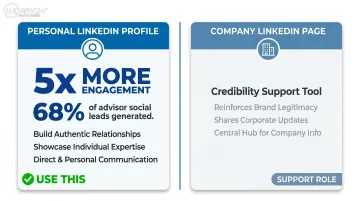
LinkedIn is where professionals, business owners, and high-net-worth prospects spend time already in a financial decision-making mindset. Broadridge Financial Solutions found that LinkedIn accounts for 68% of all social media leads generated by financial advisors — yet more than 60% of advisors have never sourced a single lead from the platform.
Effective LinkedIn content for advisors includes:
- Market commentary and economic perspectives
- Thought leadership articles on retirement, tax planning, or estate strategy
- Short-form posts sharing one practical financial tip
- Client milestone celebrations (with appropriate discretion)
One important distinction: personal profiles generate 5x more engagement than company pages on LinkedIn. Post under your own name. Your firm's page supports credibility, but your personal profile is where real connections form.
Facebook: Best for the 45–65+ Demographic
Facebook's user base skews older — users aged 45 and above represent approximately 38% of U.S. Facebook users, with another 19% in the 35–44 bracket. For advisors targeting established investors approaching retirement, that's a strong case for Facebook.
The tone can be more conversational here. Facebook Groups built around local community or life-stage topics (pre-retirees, small business owners) create ongoing engagement opportunities. Meta's paid targeting also allows precise filtering by age, income level, and interests like retirement planning or investing.
YouTube and Short-Form Video
If Facebook is built for the pre-retirement crowd, video is where you reach the investors still building toward it. Setup doesn't need to be elaborate — a phone, decent lighting, and clear audio are enough to get started.
Short-form content that performs well for advisors:
- "One tax tip in 60 seconds"
- Myth-busting market fears ("No, you shouldn't time the market")
- Explaining financial concepts in plain language ("What is an expense ratio?")
These formats serve different purposes. YouTube favors longer explanations (10–15 minutes) that rank in search and build authority over time. TikTok and Instagram Reels push content through the algorithm to younger audiences who may never have heard of you otherwise.
Building a Content Strategy That Actually Converts
A well-structured content strategy does three things at once: educates prospects, builds personal brand trust, and generates leads. Without that framework, you're just posting into the void.
The Three Content Pillars
Build your content calendar around these three categories:
- Educate — Financial tips, market commentary, "how-to" guides tailored to your clients' life stages (first home purchase, college funding, pre-retirement planning)
- Connect — Behind-the-scenes of your practice, team spotlights, community involvement, client success stories (with names removed unless you have explicit consent)
- Invite — Webinar announcements, free consultations, event invitations
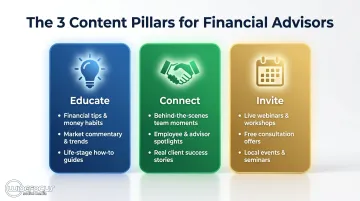
Rotating across all three pillars keeps your feed from reading like a brochure — and keeps people from unfollowing you.
Personal Brand vs. Firm Brand
Advisors who post as individuals — with their own voice, opinions, and stories — outperform advisors who only re-share their firm's corporate content. According to the Edelman Trust Barometer, 76% of people trust content from individuals over content from brands. That gap is particularly relevant in financial services, where personal trust is the whole product.
Develop a consistent point of view. A few ways to make your identity visible:
- State your investment philosophy clearly (e.g., long-term indexing over market timing)
- Name the niche you serve — dentists, tech employees, pre-retirees
- Share your take on market events rather than just forwarding firm commentary
Solving the Time Problem
Batch-creating content once a week or twice a month is far more sustainable than daily improvisation. Spend two hours on a Sunday afternoon writing five LinkedIn posts, and you're covered for the week.
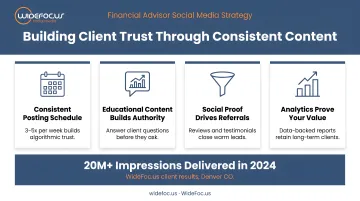
Advisors who want a professional, consistent presence without managing it themselves can work with a specialized agency like WideFoc.us. The agency has built social media strategies for fintech and professional services clients, generating over 1.2 million monthly impressions for one B2B financial technology client and making social their top-performing lead generation channel.
Posting Cadence by Platform
| Platform | Recommended Frequency |
|---|---|
| 3–5 times per week | |
| 3–4 times per week | |
| YouTube | Once per week |
| TikTok / Instagram Reels | 1–3 times per week |
Three posts per week, every week, outperforms seven posts in one week followed by three weeks of silence.
Content Mix Frameworks: How to Structure What You Post
Without a framework, most advisors default to promotional content: why they're great, what they offer. That approach repels audiences. A content mix framework ensures your feed serves readers first and earns trust over time.
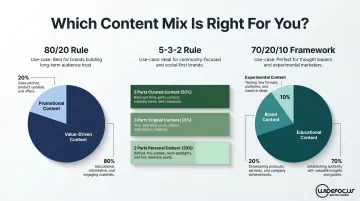
The 80/20 Rule
80% of your content should provide value. 20% can be promotional.
In financial services, where trust is the core product, this ratio matters more than in most industries. An advisor who posts eight educational tips for every two promotional messages builds a reputation as a resource, not a sales pitch.
The 5-3-2 Rule
For every 10 posts:
- 5 — Curated or educational content from external sources (relevant market news, planning articles, economic commentary)
- 3 — Original content you've created (your own insights, videos, written articles)
- 2 — Personal or humanizing content (your values, team moments, community involvement)
This formula prevents two failure modes: the feed that only aggregates news (no personality) and the feed that's entirely self-promotional (no value).
The 70/20/10 Framework
For advisors running paid campaigns alongside organic content:
- 70% — Evergreen educational content
- 20% — Content that reinforces your brand story and differentiators
- 10% — Experimental or promotional content
This framework suits more established practices with the bandwidth to manage a larger content operation.
Choosing and Using Your Framework
The best framework is the one you'll actually follow. Pick one, build a simple monthly content calendar around it, and review quarterly to see what's resonating. Don't switch frameworks every month. Consistency in your approach is what builds audience trust and measurable results over time.
Staying Compliant While Growing Your Presence
Compliance is a professional advantage, not a creative constraint. Advisors who communicate clearly within regulatory boundaries build stronger, more credible reputations — and face far fewer career-ending risks.
The Three Non-Negotiables
Archive everything. SEC Rule 17a-4(b)(4) requires broker-dealers to retain business communications, including social media, for at least three years — with the first two years in an easily accessible place. Use a compliant archiving tool, not a manual screenshot folder.
Never guarantee returns or make specific investment recommendations in public posts. FINRA Rule 2210 prohibits promissory statements, performance projections, and any content that isn't fair, balanced, and complete.
Include required disclosures on content referencing specific products, performance, or advice. When in doubt, disclose. Buried or omitted material information creates regulatory risk.
Compliance Workflows
Knowing the rules is step one — building a repeatable process around them is what protects you long-term. At larger broker-dealers, static content (blog posts, profile pages) typically requires principal pre-approval before publishing. Interactive content (real-time comments, live posts) can be supervised after the fact, but still requires written supervisory procedures.
For independent RIAs, self-review against SEC and FINRA guidelines is required — or use a compliance-friendly social media management tool like Hearsay, Proofpoint, or Smarsh.
Review your broker-dealer's or RIA's specific social media policy before posting. The rules have nuances that vary by firm.
Measuring Growth: Metrics That Matter for Financial Advisors
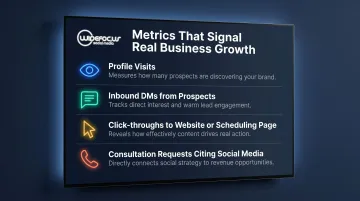
Follower counts don't pay your rent. These are the metrics that signal real business growth:
- Profile visits: are people actually checking you out after seeing your content?
- Inbound DMs from prospects, which signal your content is sparking curiosity
- Click-throughs to your website or scheduling page — the clearest sign of purchase intent
- Consultation requests that cite social media (ask every new prospect: "How did you find me?")
A Simple Quarterly Review Process
Every three months, assess:
- Which content types drove saves, shares, and DMs (not just likes)?
- Which platform generated the most meaningful profile visits?
- Was your posting cadence consistent — or did you go quiet for stretches?
Use that data to adjust your content mix and prioritize the formats that perform. Growth-focused advisors who invest in social media generate 168% more leads per month and are 42% more likely to convert a social media lead into a client than advisors who don't. Consistency, measured and repeated, is what drives that gap.
Frequently Asked Questions
What are the main social media marketing strategies for financial services?
The core strategies are: building thought leadership through educational content, using platform-specific formats to reach target demographics, running compliance-approved paid ads for lead generation, and engaging consistently with followers to nurture trust over time. Most successful advisor strategies combine all four rather than relying on one.
What are common social media content mix rules for financial services?
Popular frameworks include the 80/20 rule (80% value-driven, 20% promotional), the 5-3-2 rule (5 curated, 3 original, 2 personal posts per 10), and the 70/20/10 framework (70% educational, 20% brand-building, 10% promotional). Pick one and apply it consistently. The specific ratios matter less than the discipline of following them.
How often should financial advisors post on social media?
Cadence varies by platform: LinkedIn and Facebook benefit from several posts per week, YouTube from one quality video weekly, and TikTok or Instagram from one to three posts weekly. Consistency matters more than volume. A steady three-posts-per-week schedule beats sporadic bursts followed by long silences.
Do financial advisors need compliance approval before posting on social media?
Advisors at broker-dealers typically must route static content through compliance review before publishing. Independent RIAs must self-monitor against SEC and FINRA guidelines. SEC Rule 17a-4(b)(4) requires all advisors to archive social media communications for at least three years.
Which social media platform is best for financial advisors to get new clients?
LinkedIn is the most effective platform for most advisors — it accounts for 68% of advisor social media leads and reaches a professional audience already in a decision-making mindset. Facebook works well for established investors aged 45 and up, while YouTube and TikTok are increasingly effective for attracting younger investors through educational video content.
Can financial advisors share client testimonials on social media?
The SEC's updated Marketing Rule now permits investment adviser testimonials, provided you disclose the person's client status, any compensation, and material conflicts of interest. Broker-dealer representatives operate under FINRA Rule 2210 separately. Verify your firm's specific policy and include all required disclosures before posting.