Introduction
Most executives know social media matters. Few act on it strategically.
A Stanford GSB study found that fewer than a third of companies use social media to support corporate strategy — despite 90% of leaders acknowledging its potential impact. That gap isn't ignorance. It's a combination of time pressure, risk aversion, and the absence of a clear starting point.
Meanwhile, your customers, investors, and employees are already on these platforms. They're forming opinions about your company based on what they see or don't see from leadership. Silence isn't neutral — it's space that competitors and critics are happy to fill.
This guide gives executives a practical framework for building a social media strategy that protects reputation, builds authority, and connects directly to business outcomes. What follows is a step-by-step approach you can actually put into practice.
Key Takeaways
- Executive social media directly affects brand trust, investor confidence, and employee retention — treat it as a core business function, not an optional marketing activity.
- Start with your business goals; the platform, content, and posting cadence all follow from there.
- LinkedIn is the right first platform for most B2B executives — choose one or two channels and do them well.
- Ghostwriting and communications support preserve your voice — provided the approval process keeps you in control.
- Track business outcome metrics, not just follower counts, to prove ROI to your board.
Why Executive Social Media Presence Is a Business Imperative
The Trust Economy Is Already Pricing You In
According to a 2024 Sprout Social Pulse Survey, 78% of consumers say a brand's social media presence directly impacts whether they trust that brand — rising to 88% among Gen Z. Your brand account plays a role in that, but executive visibility adds something no corporate handle can replicate: a human face with a point of view.
Investors are paying attention too. The Brunswick Group's 2023 Digital Investor Survey found that 91% of institutional investors have made a recommendation or investment decision based on information from digital or social media, with LinkedIn ranking second only to the company IR website as a research source. An active executive presence gives you a direct channel to shape your financial narrative — before analysts do it for you.
What Disengaged Employees Are Actually Telling You
The leadership trust gap is real and measurable. The 2024 Edelman Trust Barometer found that while 75% of respondents believe CEOs are obligated to help bridge trust divides, only 44% say they actually do it well. That 29-point credibility gap doesn't close on its own.
Employee engagement compounds the problem. Gallup's 2024 State of the Global Workplace report shows global engagement declined to just 23% in 2023, costing the global economy roughly $10 trillion in lost productivity. Seventy percent of the variance in engagement traces directly to the manager. When executives communicate visibly — including on social platforms — they model the behavior they want from every layer of leadership beneath them.
The Hidden Cost of Doing Nothing
An absent executive profile doesn't create neutrality. According to MIT Sloan Management Review's research on leadership visibility, silence carries real reputational risk — competitors, critics, and trade press occupy the narrative space by default. A 2025 Forbes analysis noted that employees routinely infer company strategy from a CEO's public social media when internal clarity is missing.
That gap between silence and visibility has a clear fill — but it requires the right channel. A brand account posts on behalf of a company; an executive posts as a person. That distinction is what makes executive content feel credible rather than promotional, and it's why the two assets are stronger together than either is alone.
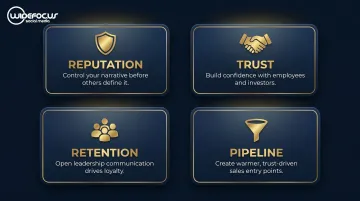
The practical stakes look like this:
- Reputation: Silence lets competitors and critics define your narrative by default
- Trust: Visible leaders score higher on both employee and investor confidence metrics
- Retention: Engaged teams are more likely to stay when leadership communicates openly
- Pipeline: Executives with active LinkedIn profiles give sales teams a warmer entry point into conversations
How to Build an Executive Social Media Strategy Step by Step
Start With Business Goals, Not Posts
Every executive social media strategy should ladder up to a specific company objective. The goal determines everything else: platform selection, content format, posting frequency, and which KPIs you track.
Common executive social goals include:
- Growing recognition among target industry professionals (brand awareness)
- Generating inbound interest from potential clients or partners (lead generation)
- Controlling the company's financial narrative through direct communication (investor relations)
- Attracting candidates who align with company culture and values (talent acquisition)
- Reinforcing confidence among existing clients through visible leadership (customer retention)
To make this concrete: if your goal is brand awareness, a measurable objective might be increasing your LinkedIn follower count among target industry professionals by 25% over six months, tracked through follower demographic data. That objective then determines the content mix, engagement frequency, and how you report progress.
WideFoc.us structures its C-suite thought leadership engagements around this goal-first approach — identifying whether the priority is lead generation, investor awareness, or brand authority before any content gets created.
Research the Executive's Voice, Interests, and Audience
Before drafting a single post, spend time in discovery. Review the executive's existing public communications — keynote speeches, earnings call transcripts, company all-hands videos, published op-eds. Look for:
- Recurring themes or convictions they return to unprompted
- Vocabulary and phrasing that feels natural to them
- The level of formality they use with different audiences
- Topics where they show genuine depth versus surface familiarity
Next, map the audience. Who does the executive need to reach: existing stakeholders, prospective investors, potential hires, or customers in a new market segment? Look at what those audiences engage with when they see similar executives post, and what questions they're actively asking in comment sections.
This research phase prevents the most common failure mode in executive social media: generic content that could have been written by anyone. Once you know the voice and the audience, you're ready to see what competitors are doing with both.
Conduct a Competitive Landscape Analysis
Audit three to five peer executives in your sector. For each profile, look for:
- Content formats that consistently attract engagement (long-form posts, short observations, data-driven threads)
- Topics that spark conversation versus those that generate only passive impressions
- Gaps where your executive can own a distinct point of view rather than repeating what five others already said
This phase doubles as a platform suitability check. For each channel you're considering, ask: Is the executive genuinely comfortable with the media format it requires? Is the target audience actually present? What tone does the platform's culture demand, and does that match the executive's style?
WideFoc.us includes competitive analysis as a standard deliverable in its consulting engagements — specifically looking at executive profile performance alongside brand social benchmarks.
Choosing the Right Platforms for Your Executive Profile
For most B2B executives, LinkedIn is the right starting point. The numbers are hard to argue with: CEO content generates 4x more engagement than standard LinkedIn member content, and executives who post consistently see an average 39% increase in followers. LinkedIn ranks as the most important digital platform for institutional investor research (second only to company IR websites), and with over 310 million monthly active users, the professional audience density is unmatched.
That said, platform selection should be deliberate, not automatic. Use this four-factor framework:
| Factor | Questions to Ask |
|---|---|
| Audience presence | Are the people you need to reach actually active here? |
| Format fit | Is the executive comfortable with short-form video, text posts, or imagery? |
| Executive comfort | Will they engage authentically, or does this platform feel unnatural? |
| Crisis behavior | How do followers on this platform respond during negative news cycles? |
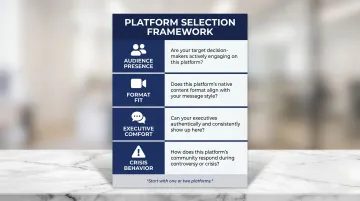
Start with one or two platforms. Spreading across five channels with thin, inconsistent presence is worse than doing one channel exceptionally well.
That fewer-is-better logic extends further: for some executives, the right answer isn't a personal profile at all. Amplifying leadership content through the company's flagship brand accounts works well when content volume is too low to sustain a personal feed, when no platform fits the executive's communication style naturally, or when staff support isn't available. A neglected profile does more damage than no profile — so if those conditions apply, the company account is the smarter channel.
Developing Your Executive Content Voice and Pillars
Defining Your Content Pillars
Content pillars are the three or four topic territories where the executive will consistently show up. Strong pillars sit at the intersection of three things:
- The executive's genuine expertise (not just their job title)
- The company's strategic priorities
- What the target audience actually cares about
Examples of pillar combinations that work well for C-suite executives:
- Industry trends and forward-looking perspective
- Company culture, values, and behind-the-scenes moments
- Leadership and management philosophy
- Community involvement or CSR focus
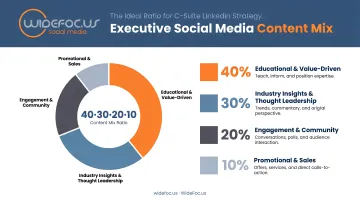
A useful content ratio to start with: roughly 40% thought leadership and industry perspective, 30% company updates and milestones, 20% personal values and behind-the-scenes content, and 10% direct community engagement. A feed that's purely promotional reads as broadcasting, not leading — and audiences disengage quickly.
On Ghostwriting and Authentic Voice
The concern that communications staff drafting posts is somehow inauthentic comes up in almost every executive social media conversation — and it's a fair question with a direct answer.
Ghostwriting for executives is standard practice at the senior leadership level. Business Insider reported in 2024 that major PR firms now run dedicated executive LinkedIn services as a distinct business line. The authenticity question isn't about who types the words; it's about whether the content accurately reflects the executive's actual views, voice, and expertise.
Getting that right requires three things:
- POV development first — the executive's perspective and tone are documented before any content is drafted
- Voice calibration — drafts are written to match how the executive actually speaks, not a generic "thought leader" template
- Approval discipline — the review process exists specifically to catch anything that rings false
WideFoc.us builds this POV development phase into its C-suite thought leadership service to ensure ghostwritten content represents the executive, not a generic persona.
Crisis Content Planning
Every executive social strategy needs a defined crisis protocol established in advance. Three decisions to make now, not during an incident:
- Dark period rule — under what circumstances do executive channels go silent?
- Holding statement process — who drafts it, who approves it, and what's the time threshold?
- Active communication threshold — what types of crises warrant the executive speaking directly, and what message hierarchy applies?
Build the protocol into the strategy from day one — crisis is the worst possible time to figure these things out.
Setting Up Governance, Approvals, and Measuring ROI
Approval Workflow That Protects Without Paralyzing
A practical approval process has three components:
- A designated point of contact — chief of staff, executive assistant, or communications lead who serves as the primary content liaison
- A shared content calendar with fields for post date, channel, copy, approval status, and revision notes
- Clear tiered approval rules — define which content types require executive sign-off versus which the communications team can clear independently
The third component is where most processes break down. When every post requires the same executive review cycle, timeliness dies. Routine industry commentary and company milestone posts shouldn't require the same approval path as statements on sensitive regulatory or reputational topics. Good governance protects the executive's reputation while keeping the content cadence intact.
Measuring What Actually Matters
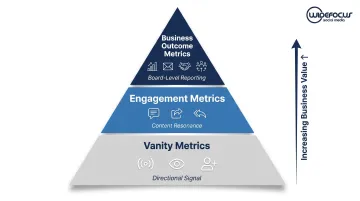
Executive social ROI should be measured in three tiers:
- Vanity metrics (reach, impressions, follower growth) — useful for directional signal, not for board reporting
- Engagement metrics (comments, shares, replies) — indicate whether content actually resonates with the target audience
- Business outcome metrics — website traffic driven by executive posts, inbound inquiries attributed to thought leadership content, investor outreach, and talent pipeline signals
The Edelman-LinkedIn B2B Thought Leadership Impact Report found that 75% of decision-makers researched a product or service after engaging with thought leadership. Separately, 70% of C-suite buyers reconsidered an existing supplier after engaging with a competitor's thought leadership content. Those are pipeline metrics, not social metrics.
WideFoc.us builds custom reporting frameworks that connect executive social activity to business outcomes, translating reach and engagement data into the language of MQLs, pipeline influence, and investor visibility that executive teams and boards can act on.
Frequently Asked Questions
How much does social media management cost?
Executive-specific programs typically range from $4,500 to $11,000 per month for strategy, content creation, ghostwriting, and reporting — higher than standard brand management due to the customization, sensitivity review, and senior-level involvement required. General agency social media management runs $2,000–$20,000+ monthly depending on scope.
What is the difference between a social media manager and a social media executive?
A social media manager handles the day-to-day work: creating, scheduling, monitoring, and reporting on content. A "social media executive" is a company leader — CEO, CMO, and others — who maintains a strategic personal presence on social platforms. In practice, the manager supports and amplifies that executive's content.
What is the 50/30/20 rule for social media?
The 50/30/20 rule splits content into 50% curated industry content, 30% original thought leadership, and 20% promotional posts. It's a useful starting framework, though executives should adjust the ratio to fit their specific goals — investor-relations-focused leaders often need a different mix.
What are the 7 C's of social media strategy?
The 7 C's are Content, Community, Conversation, Channel, Consistency, Credibility, and Conversion. They work as an audit checklist for executive social strategy — covering platform selection, engagement quality, and whether your presence builds enough trust to move people to act.
What are the 4 C's of social media strategy?
The 4 C's are Content, Community, Conversation, and Conversion. It's a streamlined framework for evaluating whether an executive's social activity generates real relationships and measurable business outcomes, not just one-way visibility.