Introduction
Many coaches are excellent at what they do — and genuinely frustrated by social media. They post regularly, share valuable content, and still hear crickets. No comments, no DMs, no discovery calls booked.
The problem usually isn't effort. It's strategy.
Social media is one of the most effective tools a coach can use to build credibility and attract the right clients. But coaching is relationship-first, trust-driven work — which means the tactics that work for an e-commerce brand or SaaS company won't necessarily translate. You need a coach-specific approach.
This guide walks through each piece of that puzzle:
- Choosing the right platform for your niche
- Building a strategy built to generate clients
- Creating content that connects and converts
- Avoiding the mistakes that stall growth
- Tracking metrics that signal real progress
Key Takeaways
- Choose one platform where your ideal clients already spend time — master it before expanding
- Lead with value and relationship-building; selling comes after trust is established
- Consistent posting drives up to 5x more engagement than sporadic activity
- The strongest results come from mixing educational posts, personal stories, and social proof — not just one type
- Track engagement rate, website clicks, and inquiries — not just follower counts
Choosing the Right Social Media Platform for Your Coaching Niche
The single most important platform decision you'll make has nothing to do with your personal preferences. It comes down to one question: where does your ideal client already spend time?
Posting brilliant content on the wrong platform is wasted effort. Here's how the major platforms break down for coaches.
Instagram is the natural home for coaches with a visual or lifestyle angle — wellness, health, life, and relationship coaches especially. With 1.74 billion users as of January 2025, it offers massive reach, and its format variety (Reels, Stories, carousels) suits storytelling-heavy coaching content well.
Organic reach dropped 30–40% across all post formats in 2025. Static image posts now average just 0.37% engagement, while carousels (0.55%) and Reels (0.52%) perform significantly better. The takeaway: prioritize Reels for discovery and carousels for education.
For career coaches, executive coaches, business coaches, and leadership coaches, LinkedIn is the primary platform. It crossed 1.3 billion registered members in early 2026, with approximately 310 million monthly active users. The professional context means your content lands in front of decision-makers — and the competition is less fierce than on Instagram.
Companies and creators posting weekly see a 2x lift in engagement, making consistency especially high-leverage here.
Facebook's organic reach has been declining for years, which makes it a weak choice as a primary platform for most coaches. The exception: Facebook Groups. Niche community groups still generate meaningful engagement, particularly for coaches targeting older demographics or community-focused niches. Globally, Facebook skews 56.7% male, though in the US the split tilts female at approximately 53.4%.
TikTok and YouTube
TikTok operates as a discovery engine. 63% of U.S. adults under 30 use it, and median brand engagement rates peaked at 35.9% in Q3 2025 — the highest of any major platform. For coaches targeting younger audiences or those comfortable on camera, TikTok offers organic reach that's genuinely hard to find elsewhere.
YouTube plays a different role. With 2.53 billion monthly active users, it's a long-term credibility builder. Educational content published there can generate views and inquiries for months or years. Production effort is the real barrier — YouTube rewards quality and depth, so it works best once you have an established practice and some resources to invest in the content.
How to Decide
Follow this simple framework:
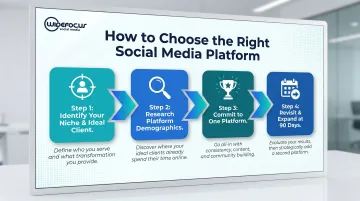
- Identify your coaching niche and your ideal client's profile
- Research where that audience clusters — spend 20 minutes looking up demographics for 2–3 platforms
- Pick one platform and commit to mastering it before adding a second
- Revisit the decision after 90 days of consistent posting, then expand if the results justify it
Building a Social Media Strategy That Gets Coaching Clients
Posting without a strategy is the most common reason coaches see no return from social media. A real strategy starts with goals — brand awareness, lead generation, client retention — and works backward to platform choice, content type, and posting frequency.
Define Your Brand Presence First
Before you create a single post, get your profile right. Consistent profile photo, handle, bio, and visual identity across platforms signals professionalism and makes you recognizable. Potential clients often check multiple platforms before booking a discovery call — inconsistency creates doubt.
Your bio should answer three questions immediately: who you help, what outcome you deliver, and what they should do next (follow, book a call, download your guide).
Build a Realistic Content Calendar
A Buffer study of over 100,000 users found that highly consistent posters receive 5x more engagement per post than inconsistent ones. The engagement sweet spot emerged at 21 weeks of regular posting.
The practical implication: consistency beats volume. A realistic cadence you can sustain beats an ambitious one you'll abandon. As a starting point:
- Instagram/TikTok: 3–5 feed posts per week
- LinkedIn: 3–5 times per week
- YouTube: 1–2 videos per week
Batch-create content in advance: write or film multiple posts in one sitting, then use a scheduling tool to stay consistent without logging in every day.
Stay Authentic, Not Polished
According to research by Nosto, 90% of consumers say authenticity matters when deciding which brands to support, and personal, unscripted content consistently outperforms heavily produced material. For coaches, this is an advantage — your lived experience and honest client stories carry more weight than a studio-quality production setup.
Content that tends to perform well for coaches:
- Behind-the-scenes clips from a coaching session or prep routine
- Short videos sharing one insight from a client breakthrough (anonymized)
- Unfiltered takes on common myths in your niche
- Personal stories that connect your own journey to your clients' challenges
Social Media Is One Piece, Not the Whole Puzzle
Coaches who build their entire client pipeline on social media are exposed to algorithm changes they can't control. Instagram's organic reach fell 30–40% in 2025 alone. Social media works best as part of a multi-channel approach alongside email lists, referrals, and SEO.
Building that multi-channel system takes planning. Coaches who want outside expertise can work with a social media agency like WideFoc.us, which maps target audiences, goals, and KPIs before building a strategy — so your social content connects to a broader plan rather than standing alone.
Content Ideas That Attract and Convert Coaching Clients
Most coaches default to one type of content and wonder why results are inconsistent. The fix is rotating across three content pillars:
- Connect — personal stories, your coaching journey, behind-the-scenes moments
- Educate — tips, frameworks, answers to questions your ideal clients are already asking
- Entertain — relatable observations, polls, trend-based formats that invite participation
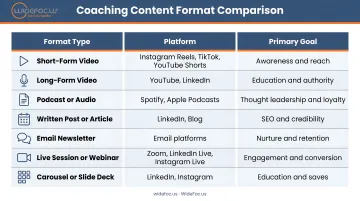
Each pillar serves a different purpose in the client journey. The format you choose determines how far each piece travels — and which goal it serves.
High-Performing Formats to Rotate
| Format | Best Platform | Primary Goal |
|---|---|---|
| Short educational Reels | Instagram, TikTok | Discovery and reach |
| Carousels | Instagram, LinkedIn | Education and saves |
| Written posts with strong hooks | Authority and shares | |
| Client testimonials / transformation stories | All platforms | Social proof and trust |
| Q&A or Live video | Instagram, LinkedIn | Engagement and community |
| Polls and questions | All platforms | Conversation and algorithm boost |
Use Social Proof Strategically
According to BrightLocal's Consumer Review Survey, 98% of consumers read reviews before choosing a local service provider. For coaches, social proof does the conversion work that no amount of clever copy can replicate — it shows skeptical prospects that results are real and repeatable.
Practical formats that work:
- Short written testimonials shared as graphics or carousels
- Video testimonials (even 60-second phone recordings work well)
- Milestone posts that celebrate a client's progress (with their permission)
- Before/after stories that make your coaching impact concrete
Repurpose Rather Than Recreate
One long-form video can branch into a short Reel, a written post that expands on a single key point, and a Stories series that opens the conversation with your audience. That's three pieces of content from one session of work — a smarter use of the time you're already spending.
Common Social Media Mistakes Coaches Make (and How to Fix Them)
Selling Too Soon and Too Often
When every post is a pitch, audiences tune out. The widely used 80/20 guideline — 80% value and connection, 20% promotion — exists for a reason. When the majority of your content genuinely helps your audience, the occasional offer lands as a natural next step rather than an interruption.
Trying to Be Everywhere at Once
Five mediocre profiles deliver worse results than one excellent one. Coaches who are earlier in their practice should especially resist the urge to maintain a presence on every platform. Master one channel, build a genuine following, then expand. Spreading too thin early means expending energy on every platform while gaining traction on none.
Ignoring Engagement After Posting
Posting and disappearing is one of the most costly mistakes coaches make. Buffer's analysis of nearly 2 million posts found that replying to comments boosted engagement by 21% on Instagram and 30% on LinkedIn. Beyond the algorithm benefit, responding to comments builds the relationships that actually turn followers into clients — so if someone takes the time to comment, respond.
Measuring Your Social Media Success as a Coach
Follower count is the most visible metric and one of the least meaningful. What matters is whether your social media activity is generating real business outcomes.
Metrics to Track by Goal
| Goal | Metrics to Watch |
|---|---|
| Brand awareness | Reach, impressions, profile visits |
| Content resonance | Engagement rate, saves, shares |
| Audience interest | Website link clicks, bio link clicks |
| Lead generation | DMs received, inquiry form fills |
Use Native Analytics Tools
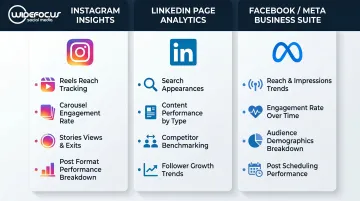
Every major platform provides free analytics. Check them monthly at minimum:
- Instagram Insights: Shows which post formats (Reels, carousels, Stories) drive the most reach and engagement
- LinkedIn Page Analytics: Breaks down content performance by post type, tracks search appearances, and offers basic competitor benchmarking
- Facebook/Meta Business Suite: Surfaces reach, engagement trends, and audience demographic data in one dashboard
Look for patterns in which content types, topics, and posting times generate the most clicks and inquiries — then do more of what works and less of what doesn't. The goal is an iterative loop, not a set-it-and-forget-it posting schedule.
That iterative process takes time — time most coaches would rather spend with clients. WideFoc.us handles the ongoing execution: monthly analytics reporting, content performance refinement, and community management. In one campaign, the agency drove a 512% increase in form fills and 9x qualified leads for a service business within eight weeks.
Frequently Asked Questions
What is the best social media platform for coaches?
It depends on your niche. LinkedIn is the top choice for career, executive, and business coaches. Instagram and TikTok work better for wellness, life, and relationship coaches. Start where your ideal clients already spend time.
How do I advertise myself as a life coach?
Combine organic content with paid options like Facebook, Instagram, or LinkedIn ads for faster reach. Referrals from existing clients and email marketing round out a solid visibility strategy.
What are some niches for life coaches?
Popular niches include career, health and wellness, executive, relationship, business, and mindset coaching. Picking a specific niche makes social media targeting far more effective than trying to appeal to everyone.
How often should coaches post on social media?
For Instagram and TikTok, aim for 3–5 times per week. LinkedIn works well at 3–5 posts per week too. Consistency matters more than hitting a specific number — two excellent posts per week outperform five low-quality ones.
Should coaches focus on one platform or multiple?
Start with one. Find the platform where your target audience is most active, build real traction there, then consider expanding. Spreading across multiple platforms too early usually means doing all of them poorly.
How do I know if my social media marketing is working?
Track engagement rate, website link clicks, DMs received, and whether inquiry volume correlates with your posting activity. Follower count is a vanity metric. What matters is whether those followers eventually become paying clients.