This isn't a content quality problem. It's a distribution problem, and it affects brands across every industry.
The brands breaking through in 2025 aren't just posting more. They're connecting three distinct levers: a credible organic foundation, targeted paid amplification, and authentic creator partnerships that make paid perform better. This article walks through how to build that integrated system — and why each layer depends on the others to work.
Key Takeaways
- Organic content builds trust, paid media scales reach, and creator content is what makes paid campaigns perform
- Creator-led ads drive 70% higher CTR and 159% higher engagement compared to non-creator ads at the same CPM
- Content built for paid amplification from the start outperforms content retrofitted for it after the fact
- Measuring success means tracking CPC, CPA, and ROAS — not just follower count or likes
- Brands that integrate all three layers see compounding returns that isolated organic or paid strategies can't replicate
Why Organic Reach Alone No Longer Scales Your Brand
The Algorithm Has Moved On
Social platforms no longer distribute content primarily to your followers. They distribute content to users most likely to engage with it — and those users may never have heard of your brand.
Instagram made this explicit in a 2026 platform announcement: if most of your posts aren't original, they may stop being recommended to non-followers entirely. That's not a penalty for bad content — it's a structural shift in how reach works.
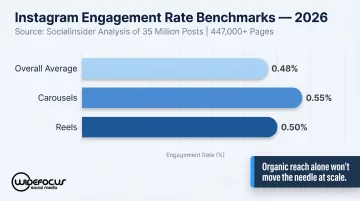
The numbers bear this out. Socialinsider's 2026 benchmark analysis of 35 million posts across 447,000+ Instagram pages shows overall engagement averaging around 0.48% — even for well-performing formats like carousels (0.55%) and Reels (0.50%). Those aren't terrible numbers in isolation, but they confirm something important: organic reach alone will never move the needle at scale.
The Credibility Gap
Organic content builds trust and community. A brand that posts consistently, engages authentically, and develops a recognizable voice earns credibility that paid ads can't manufacture.
But without distribution, even great content reaches a fraction of the audience it deserves. That's the credibility gap — strong content stranded by weak reach.
This is why abandoning organic isn't the answer. Organic content proves your brand's voice and value. Paid media is the engine that puts it in front of the right people at scale. The two roles are different and complementary, not interchangeable.
That gap shows up clearly in client work. Across industries from fintech to auto parts to cybersecurity, WideFoc.us routinely sees brands with solid organic content still missing on engagement and conversions — not because the content is poor, but because there's no distribution strategy behind it.
The answer isn't producing more. It's amplifying what you already have — strategically, and at scale.
The Case for Integrating Paid Media and Creator Marketing
Why Creator Content Changes the Performance Math
There's a simple reason performance marketers have shifted budgets toward creator content: it works better.
According to eMarketer, creator-led ads deliver approximately 70% higher CTR and 159% higher engagement compared to non-creator ads at the same CPM. That gap is large enough to fundamentally change how you should approach creative strategy.
Why the gap? A few factors drive it:
- Audiences have built strong resistance to polished, obviously-produced brand ads
- Content that doesn't feel native gets scrolled past in under a second
- Creator content looks and sounds organic — it fits the feed instead of interrupting it
The Collapsed Funnel Effect
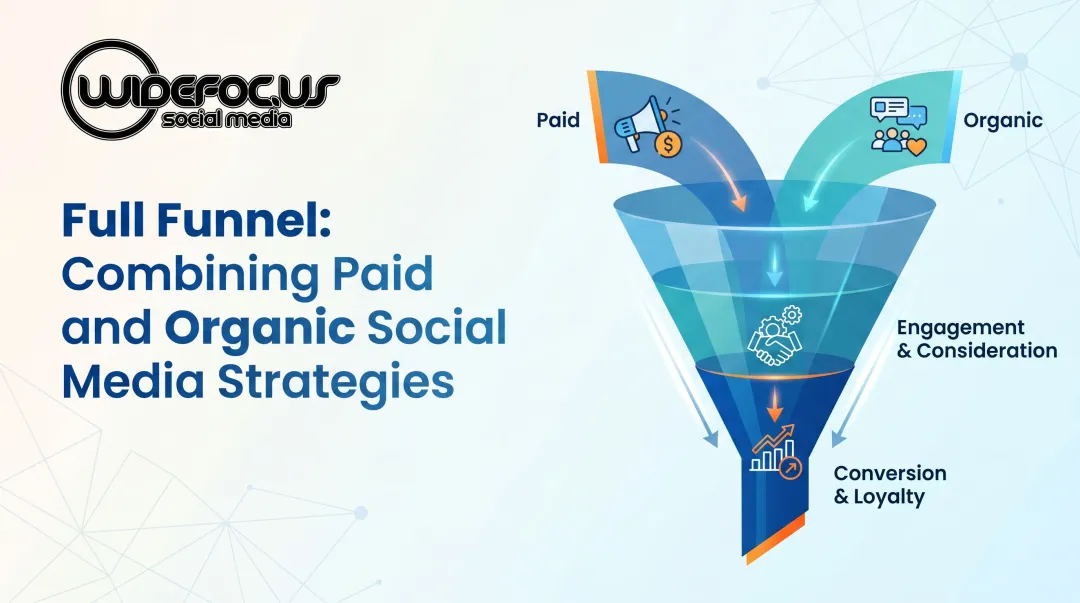
Traditional marketing assumes a multi-stage journey: awareness, then consideration, then purchase intent, then conversion. Creator content on platforms like TikTok and Instagram collapses this sequence.
A single well-crafted creator post can move a viewer from "I've never heard of this brand" to "I want this" within 30 seconds. TikTok's own research with Publicis and WARC documents this discovery-to-purchase compression explicitly — audiences can discover and buy within the same content session when shoppable CTAs and the right format are in place.
This makes creator content unusually efficient when paired with paid distribution. You're not just buying impressions — you're buying compressed conversions.
The Economic Logic
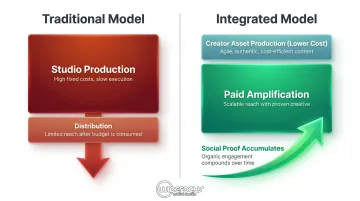
The traditional model: spend heavily on studio production, then spend what's left on distribution.
The integrated model inverts this:
- Creator assets cost far less to produce than studio-produced brand creative
- Paid amplification budget goes further behind content that already performs organically
- Returns compound as winning content accumulates social proof and engagement signals
The IAB projects creator economy ad spend will reach $37 billion in 2025, growing roughly four times faster than total media since 2021. That growth rate signals something concrete: brands across categories — not just B2C product launches, but B2B as well — are seeing results that justify the shift.
The economic model translates directly to B2B — the creator types just look different. Instead of lifestyle influencers, think industry experts, consultants, and niche professionals whose audiences map closely to your target buyers. WideFoc.us runs B2B influencer programs on LinkedIn and industry-specific networks alongside B2C campaigns using lifestyle and tech creators. The core principle — content that fits the audience, not just the brand — holds across both.
How to Build Creator Content Designed for Paid Amplification
The Mindset Shift
Most creator briefs are written for organic reach. Paid amplification requires something different — the brief, format, structure, and hook must all account for distribution before the creator films a single frame.
A paid-ready creator brief specifies:
- Campaign objective — awareness, consideration, or conversion (these require different content structures)
- Target audience persona — who the content needs to resonate with
- Key message or differentiator — the single thing the viewer should remember
- Call-to-action — specific and platform-appropriate
- Format requirements — aspect ratio, length, caption structure, platform
B2B vs. B2C Brief Directives in Practice
The structure is the same; the language and objectives differ significantly.
B2B example directive: "Create a 60-second LinkedIn video from your perspective as a [industry role]. Walk through one specific challenge your clients face with [pain point] and how [solution category] addresses it. End with: 'If your team is dealing with this, the link in my bio goes to a free assessment.' Tone: peer-to-peer, no jargon."
B2C example directive: "Film a 30-second Reel showing your real reaction trying [product] for the first time. Keep it casual — no script. End with a genuine recommendation and tag us. We'll run this as a Partnership Ad from your handle."
The difference comes down to credibility signals: B2B content needs to demonstrate expertise and facilitate peer trust, while B2C content needs authenticity and relatability.
Testing Before Scaling
Those varied briefs serve a second purpose: testing. Platforms like Meta recommend multiple active ad variations to give the algorithm enough signals to optimize delivery. TikTok's official guidance suggests 3–5 creatives per ad group as a baseline.
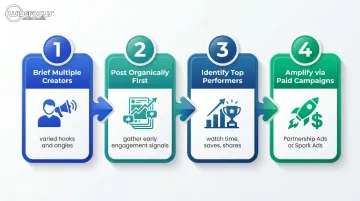
The practical workflow:
- Brief multiple creators with varied hooks and angles — not just one version
- Post content organically first to gather early engagement signals
- Identify top performers based on watch time, saves, and shares
- Amplify proven content through paid campaigns using Partnership Ads (Meta) or Spark Ads (TikTok)
Running paid from the creator's handle — rather than the brand page — preserves the authentic look and feel that drives better performance. On TikTok, Spark Ads attribute all paid engagement back to the original organic post, which builds social proof with every view.
WideFoc.us handles this full cycle for clients — creator briefing, content QA, and paid campaign development — keeping organic and paid aligned under a single strategy rather than siloed across teams.
Platform-by-Platform Paid Amplification Strategies That Work
Meta (Facebook and Instagram)
Meta's algorithm increasingly rewards creative quality and relevance over precise audience targeting. Tools like Advantage+ Campaigns do much of the audience-matching automatically — which means the creative itself has become the primary targeting signal.
What works on Meta right now:
- Reels-first creative for discovery reach (Reels drive the highest recommendation delivery)
- Carousels for depth and retention — Socialinsider data shows carousels still lead engagement at ~0.55%
- Partnership Ads to run creator content from the creator's handle, combining authenticity with Meta's delivery scale
- Multiple creative variations per campaign — the algorithm needs diversity to find the right audience
TikTok
TikTok is where creator-first strategy matters most. Content that doesn't look native gets scrolled past immediately — there's very little tolerance for content that "feels like an ad."
Key TikTok considerations:
- Spark Ads boost existing creator posts directly, preserving likes, comments, and shares as social proof
- Fresh creative on a steady cadence is non-negotiable — TikTok's own guidance acknowledges ad performance can decline within days
- Hook within the first 3 seconds — TikTok's algorithm prioritizes watch time aggressively from the very first frame
- Maintain 3–5 active creatives per ad group to give the algorithm optimization headroom
LinkedIn (B2B)
For B2B brands, LinkedIn's Thought Leader Ads allow brands to sponsor posts from individual member profiles — executives, subject matter experts, or industry creators — rather than brand pages alone.
This matters because the trust signals on LinkedIn come from people, not logos. A post from a recognized voice in your industry consistently outperforms polished corporate content — audiences respond to expertise, not brand polish. WideFoc.us's C-Suite Thought Leadership services are built on exactly this insight: LinkedIn-led content from real professionals drives measurably stronger engagement and lead generation than brand page posts.
The Platform-Agnostic Rule
Each platform favors different creative formats, but the underlying approach to scaling is the same. Test at low spend first, identify top-performing creative using engagement and conversion signals, then scale budget behind proven assets. Never scale behind untested creative.
Measuring the ROI of Your Paid and Creator Strategy
Metrics That Actually Matter
Follower count and likes tell you almost nothing about whether your strategy is working. The metrics tied to business outcomes are:
- CPC (Cost Per Click) (what you're paying for each user to take action from an ad)
- CPA (Cost Per Acquisition) (the total cost to convert one customer or lead)
- ROAS (Return on Ad Spend) (revenue generated per dollar of ad spend; a ROAS of 3.0 means $3 back for every $1 spent)
- Conversion Rate (the percentage of people who click and then complete the desired action)
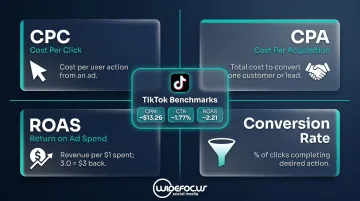
For context on TikTok benchmarks: 2025 cross-brand data from Triple Whale shows average CPM around $13.26, CTR around 1.77%, and ROAS around 2.21 — useful benchmarks for setting expectations before campaigns launch.
Attribution: Knowing What's Actually Working
Understanding which creators, which content formats, and which platforms are driving conversions (not just impressions) requires proper attribution setup before campaigns go live.
The core tools:
- UTM parameters on all creator links and paid URLs to track traffic source through to conversion
- Pixel tracking to connect ad exposure to on-site behavior (Meta Pixel, TikTok Pixel)
- Platform-native analytics for creative-level performance data: Meta Ads Manager, TikTok Ads Manager, LinkedIn Campaign Manager
The biggest attribution mistake brands make is trying to reverse-engineer this after a campaign has already run. Tracking infrastructure needs to be in place before the first post goes live.
WideFoc.us has delivered over 20 million impressions and 1 million link clicks for clients — and that compounding growth comes directly from building reporting frameworks at the start of every engagement, not retrofitting them after the fact. Brands that treat organic, creator, and paid as a single coordinated system consistently outperform those that manage them as separate workstreams.
Frequently Asked Questions
What is the 5-3-1 rule on Instagram?
The 5-3-1 rule is a community-created content guideline suggesting that for every 5 educational or curated posts, 3 should be brand storytelling posts, and 1 should be a direct promotional or CTA post. It's a useful heuristic for avoiding over-promotion, but it's not an official Instagram or Meta framework.
What is the difference between paid social advertising and creator marketing?
Paid social is the practice of paying platforms to distribute content to targeted audiences. Creator marketing involves partnering with individuals who produce authentic content on a brand's behalf. The two work best together — creator content serves as the fuel, and paid media is the distribution engine that scales it.
How much should I budget for paid social amplification versus creator fees?
High-performing brands are increasingly shifting budget toward distribution over production, since creator content costs far less than studio-produced creative. The right split depends on your campaign goals, platforms, and whether you're optimizing for awareness or conversion — there's no single formula that works across every brand.
How do I find the right creators to partner with?
Start with audience alignment — the creator's followers should match your target customer profile. Engagement rate and authenticity matter more than follower count; micro-influencers with highly engaged niche audiences frequently outperform macro-influencers for conversion-focused campaigns.
Can paid media and creator marketing work for B2B brands?
Yes — LinkedIn's Thought Leader Ads and sponsored expert content work especially well for B2B brands. Industry professionals, consultants, and niche creators serve the same trust-building function that lifestyle influencers serve in B2C, just with a different platform mix and content format.