Introduction
Insurance is fundamentally a trust-based business, and today trust is built online long before a prospect ever calls your agency. More than six in ten Americans now use social media when looking for financial and insurance information, up dramatically from 29% in 2019. Among younger buyers, the figures are even higher: 84% of Gen Z and 78% of Millennials rely on social platforms to research and vet insurance agents.
Most agents are already on social media — the problem is that results vary wildly. The difference comes down to strategy, platform choice, content quality, and consistency, not simply having profiles.
This guide covers:
- Which platforms actually move the needle for insurance agencies
- How to build a step-by-step social media strategy
- What content converts browsers into leads
- Common mistakes that waste time and budget
Key Takeaways
- Social media builds credibility and generates leads 24/7 for insurance agencies
- Choose 1-2 platforms where your ideal clients already spend time rather than spreading yourself thin
- Mix educational posts, community engagement, and behind-the-scenes content instead of leading with hard sales
- Consistent posting schedules outperform sporadic daily posts without a plan
- Track engagement rate, link clicks, and website traffic—not just follower counts
Why Social Media Management Matters for Insurance Agencies
Insurance buyers research online and ask peers for referrals before ever contacting an agent. According to LIMRA, 87% of consumers use the internet to research life insurance during the purchase process, and over 50% of Millennials specifically use social media to vet insurance agents. A dormant or incomplete social profile actively works against your credibility—two-thirds of consumers report they would not do business with an advisor who maintains an out-of-date website, and an inactive social presence sends the same signal.
A consistent social presence does more than generate leads. It keeps your agency top of mind between renewals, amplifies referrals, and meets prospects where they already spend time. Here's what the numbers show:
- 73% of social media users will buy from a competitor if a brand doesn't respond on social platforms (Sprout Social Index)
- 81% of consumers check a business's social media before making a purchasing decision
- A well-managed profile signals that your agency is active and accessible before a single conversation happens
Your digital presence directly influences whether prospects move forward with your agency or keep searching. Responsiveness and consistency aren't differentiators—they're baseline expectations.
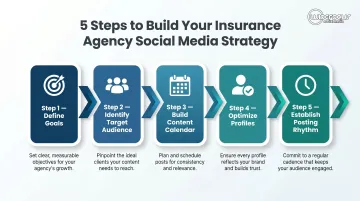
How to Build a Social Media Strategy for Your Insurance Agency
Insurance agencies that post without a strategy almost always end up with inconsistent results — or none at all. Define each element below before a single piece of content goes live.
Step 1: Define Your Goals
The most common goals for insurance agencies on social media include:
- Increase local visibility among potential clients in your service area
- Attract quote inquiries and discovery calls through inbound content
- Stay top of mind with existing clients for renewals and cross-sell opportunities
- Build relationships with community partners and referral sources
Each goal requires a different content approach and success metric. Goals must be specific and measurable. "Generate 5 quote inquiries per month from social channels" is actionable; "get more followers" is not.
Step 2: Identify Your Target Audience
Profile your ideal client in detail:
- Demographics: age, income level, family status, occupation
- Insurance concerns: coverage gaps, premium costs, claim fears
- Platform preferences: where they already spend time online
- Lines of business: personal lines, commercial lines, or both
B2B and B2C audiences behave very differently on social media. A personal lines agency targeting homeowners requires a different platform and content mix than a commercial lines agency selling group benefits to HR directors.
Step 3: Build a Content Calendar
A content calendar prevents "what do I post today?" paralysis. Include:
- Planned post topics aligned with audience concerns
- Post formats (video, image, text, carousel)
- Publishing frequency per platform
- Scheduled review dates
Even a simple monthly calendar keeps content consistent and ensures you're addressing seasonal needs — hurricane season homeowners posts, open enrollment reminders, year-end financial planning.
Step 4: Set Up and Optimize Your Profiles
Every profile must include these non-negotiables:
- Professional agency name consistent across all platforms
- Complete business description with services and contact info
- High-quality logo and cover image
- Website link and accurate hours
- Location details for local search visibility
An incomplete profile undermines credibility. If prospects can't find your phone number or see when you're open, they'll move to a competitor who makes it easy.
Step 5: Establish a Consistent Posting Rhythm
With your profiles optimized, the next priority is showing up regularly. Consistency matters more than frequency — one high-quality post per week on two platforms outperforms daily mediocre posts everywhere. A realistic starting baseline is 3-4 posts per week across your chosen platforms.
Algorithms reward predictable schedules. Erratic posting — bursts of activity followed by weeks of silence — suppresses reach and signals to followers that your agency isn't actively engaged. Pick a cadence you can sustain, then build from there.
Best Platforms and Content Types for Insurance Agencies
No agency needs to be on every platform. The goal is to be effective on the one or two platforms where your ideal clients are already active. Audit competitor channels in your local market to see which platforms generate the most engagement.
Platform Breakdown
Facebook remains the dominant platform for personal lines insurance agencies. Key demographics:
- 68% of all U.S. adults use Facebook
- 80% penetration among 30-49 year-olds
- 70% of users report household incomes above $75,000
- Near-uniform geographic reach (70% urban, 67% suburban, 66% rural)
Facebook's community groups, local business pages, event promotion tools, and highly targeted paid ads make it ideal for local lead generation. You can target by ZIP code, demographic, and life event—such as "recently moved," "new homeowner," or "newly engaged"—events that directly trigger insurance purchasing needs.
LinkedIn is the priority platform for agencies focused on commercial lines, group benefits, or B2B clients. LinkedIn generates 80% of B2B leads from social media and is 277% more effective for lead generation than Facebook and Twitter combined. Four out of five LinkedIn members drive business decisions at their organizations.
Thought leadership posts, industry insights, and connection with business owners and HR decision-makers make LinkedIn uniquely powerful for commercial lines agencies.
Instagram and YouTube/Video
Instagram works well for humanizing the agency brand through visual storytelling and behind-the-scenes content. Short-form video on Instagram Reels, TikTok, and YouTube consistently drives the highest engagement across platforms. Instagram Reels earn more than twice the engagement rate of standard video posts, with Reels achieving engagement rates of 1.23% to 1.48% compared to the financial services median of 0.38% on Instagram overall.
Use video to address complex insurance topics in accessible formats—coverage explainers, claim process walkthroughs, or myth-busting segments.
Content Types That Work
The five core content pillars for insurance agencies:
- Educational/FAQ posts – Break down coverage concepts, decode policy terminology, and answer the questions clients are already Googling
- Client success stories and testimonials – Share how you helped clients (with permission and compliance review)
- Community involvement and local partnerships – Highlight sponsorships, charity work, local events
- Behind-the-scenes agency culture – Introduce team members, share office life, and put faces to the name on the policy
- Timely industry news with expert commentary – Provide context on rate changes, legislation, storm preparation
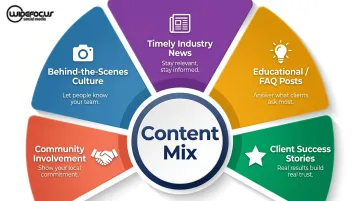
A healthy feed rotates through all five rather than leaning on one type. Clients who see consistent variety are more likely to tag you when a friend asks for an insurance recommendation.
The 4-1-1 Rule
For every one promotional or sales-oriented post, publish at least four posts that provide value, education, or community engagement. Over-promotion causes audience drop-off—and silence makes it worse. The Sprout Social Index found that 73% of consumers will buy from a competitor if a brand doesn't respond on social media, meaning passive, promotion-only accounts lose business twice: once to disengagement, and again to competitors who show up.
Focus on building relationships first. Sales opportunities follow naturally from trust.
Key Variables That Determine Your Social Media Results
Two insurance agencies can follow the same general strategy and get wildly different results. The difference comes down to four controllable variables.
Consistency and Posting Frequency
Inconsistent posting signals low priority to platform algorithms, which suppresses future reach. Platforms reward regular, predictable schedules — a burst of activity followed by weeks of silence actively hurts distribution over time.
Minimum posting frequency for maintaining visibility:
- Facebook: 3-5 times per week
- LinkedIn: 2-4 times per week
- Instagram: 3-5 feed posts per week, plus daily Stories
Remember: one consistent weekly post outperforms seven scattered posts in a single day followed by silence.
Content Quality and Relevance
Content must address your audience's specific concerns. A personal lines agency in a hurricane-prone region, for example, should post storm preparation checklists in May and June, then shift to claim filing guidance in September and October.
Generic, templated content fails because it offers no local or expertise-based value. Your audience can tell the difference between content built for them and content built for everyone.
Audience Engagement and Community Interaction
Social media algorithms reward accounts that actively respond to comments, answer DMs, and engage with other local accounts. Ignoring comments signals low activity to the platform, suppressing post reach.
Recommended response time: within 24 hours for all comments and direct messages. Most consumers expect brands to respond on social media within 24 hours, and 73% will switch to a competitor if you don't respond.
Faster responses drive more engagement, which directly increases how often the algorithm distributes your future posts.
Profile Completeness and Brand Consistency
Inconsistent branding undermines trust before a prospect ever reads your content. Mismatched logos, agency name variations, or outdated contact details across platforms signal disorganization — exactly the opposite of what insurance buyers want to see. Standardize your logo, color scheme, contact information, and brand voice across every profile, then audit them quarterly to catch drift.
Common Mistakes and How to Measure What's Working
Common Mistake 1: Posting Inconsistently or Abandoning Accounts
A Facebook page with the last post from 18 months ago actively harms your credibility. Prospects interpret it as the agency being out of business or unresponsive. If you can't maintain a platform, it's better to not have that profile at all than to have a dormant one.
Common Mistake 2: Treating Every Platform the Same
Copy-pasting the same post to Facebook, LinkedIn, and Instagram simultaneously ignores each platform's unique audience, tone, and format requirements.
Platform-native content examples:
- Facebook: Longer-form storytelling, community-focused posts, local event promotion
- LinkedIn: Industry insights, business advice, professional accomplishments
- Instagram: Visual storytelling, behind-the-scenes glimpses, short captions with strong visuals
Tailor your message to fit the platform's culture and user expectations.
Common Mistake 3: Focusing on Vanity Metrics
Vanity metrics look impressive at a glance but don't necessarily indicate business success. Follower counts and likes are vanity metrics when presented without context.
Performance metrics that actually indicate business impact:
- Engagement rate – Comments, shares, and saves relative to follower count
- Link clicks – How many people click through to your website or quote form
- Profile visits – How often prospects view your profile after seeing a post
- Lead form submissions – Quote requests generated directly from social platforms
- Website traffic from social channels – Track using Google Analytics or UTM parameters
Financial services engagement benchmarks provide realistic baselines: 0.04% on Facebook, 0.38% on Instagram, and 0.41% on LinkedIn. An agency consistently exceeding these rates is outperforming peers.
When to Bring in a Social Media Partner
Clear signals it's time to outsource:
- Posting has stopped because "there's no time"
- The agency has no documented content strategy
- Results have plateaued despite consistent effort
- Comments and DMs go unanswered for days
A specialized partner like WideFoc.us can handle the strategy, content creation, and day-to-day management that most insurance agencies don't have the time or staff to run in-house. In 2024 alone, WideFoc.us delivered over 20 million impressions and 1 million link clicks for clients — results built on consistent posting, paid campaign management, and real-time community engagement.
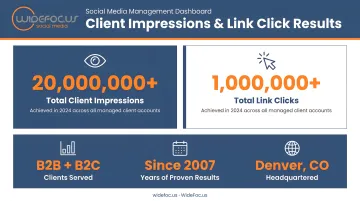
For agencies that want a consistent, compliant social presence without pulling staff away from client service, outsourcing is often the clearest path forward.
Frequently Asked Questions
How often should insurance agencies post on social media?
Start with 3-4 posts per week on your chosen platforms. Consistency and quality matter far more than volume. One well-crafted weekly post that educates your audience outperforms seven rushed posts in a single day.
Which social media platform is best for insurance agents?
It depends on your agency's focus. Facebook is best for personal lines and local community engagement, with 80% penetration among 30-49 year-olds. LinkedIn is essential for commercial lines and B2B-focused agencies, generating 80% of B2B social leads.
What type of content gets the most engagement for insurance agencies?
Educational posts, client success stories, and behind-the-scenes content consistently perform best. Video is especially strong—Instagram Reels drive engagement rates of 1.23-1.48% versus 0.38% for standard posts in financial services.
How do insurance agencies stay compliant on social media?
Review your state insurance department guidelines and carrier content policies before posting. Avoid making specific coverage claims or guarantees in posts. Use pre-approved language where possible and keep records of all published content, as NAIC guidance treats social media as regulated advertising.
Should insurance agencies invest in paid social media ads?
Yes, once you have an organic strategy that's working. Paid ads amplify content that already resonates. Facebook and LinkedIn are especially effective for insurance agencies, thanks to life-event targeting that lets you reach "recently moved" or "new homeowner" audiences when they need coverage most.
How do you measure the ROI of social media for an insurance agency?
Track leads, quote requests, and website visits using Google Analytics UTM links and each platform's built-in analytics. The clearest ROI signal is connecting social activity to actual policy quotes or new client conversations, not just impressions or follower counts.