Introduction
Picture this: it's 9 PM on a Tuesday, and instead of closing a deal or refining your product roadmap, you're hunched over Canva tweaking a social post for tomorrow morning. Your content calendar sits half-finished, last week's comments still need replies, and you have no idea whether any of it is generating leads or sales.
You're not alone. 45% of marketers cite producing consistent, high-quality content as a top challenge, and 76% of consumers expect brands to respond within 24 hours on social. Those pressures add up fast — and when social media consistently pulls founders and teams away from core business priorities, outsourcing becomes a serious option worth examining.
This guide covers how to know when outsourcing makes sense, what it costs, how in-house compares, and what to look for in a partner. Use it to make a decision that fits your business, your budget, and your goals.
Key Takeaways
- Outsourcing social media means handing strategy, content, scheduling, engagement, and analytics to an external team or agency
- Signs it's time to outsource: inconsistent posting, stalled growth, no in-house expertise, and social media eating into core business time
- Costs range from ~$500/month for basic packages to $10,000+/month for full-service enterprise management, usually less expensive than a full-time hire
- Choose partners based on industry experience, communication process, and customized strategy vs. one-size-fits-all packages
What Does Outsourcing Social Media Management Actually Include?
Social media outsourcing means contracting an external agency, freelancer, or specialist team to handle your social activities—from day-to-day posting to long-term brand strategy.
Core services typically covered under full-service arrangements:
- Social media strategy and planning
- Content creation (copy, graphics, video)
- Scheduling and publishing
- Community management and engagement
- Paid social advertising
- Performance reporting and analytics
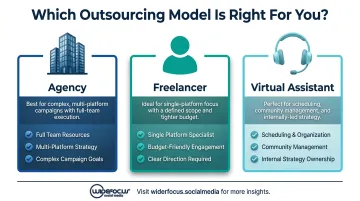
Outsourcing is not all-or-nothing. Some businesses hand over everything; others keep brand direction in-house and delegate execution. The spectrum includes agencies, freelancers, and virtual assistants, each suited to different scales and needs.
When each option makes sense:
- Agencies: Bring a full team — strategist, designer, ad manager — making them the right fit for multi-platform programs or brands with complex goals
- Freelancers: Work well for tighter budgets, single-platform focus, or brands that already have a clear direction and need skilled execution
- Virtual assistants: Handle scheduling and community management reliably when your internal team owns the strategy
Whichever model you choose, the scope should cover more than content output. The American Marketing Association notes that effective social programs require integrated strategy, content planning, and measurement — and any credible partner should deliver all three.
Key Signs It's Time to Outsource Your Social Media
Sign 1 — Inconsistent posting and engagement
Social platforms reward consistent posting. When your team skips days or responds late to comments and messages, brand visibility and credibility both take a hit. Most consumers expect replies within 24 hours or sooner, and 76% say response speed affects their perception of a brand.
Inconsistent posting is often the first visible sign that social media has outgrown what a stretched team can handle — and the first reason to consider outside help.
Sign 2 — Growth has plateaued despite effort
Stagnant follower counts and flat engagement rates often signal that in-house teams have run out of fresh content ideas — or lack the analytical expertise to identify what's not working. 41% of marketers report it's harder to stand out organically, and platform algorithms keep raising the bar.
An outside team brings a fresh perspective and the analytical chops to course-correct quickly.
Sign 3 — Social media is consuming core business time
When founders or marketing leads spend evenings scheduling posts and responding to comments, they're pulling time away from the work that actually grows the business. Social media done properly can consume 10–30 hours per week — time better spent on product development, sales, and operations.
That's a trade-off most leadership teams can't afford to keep making.
Sign 4 — The team lacks specialized skills
Modern social media requires expertise across multiple disciplines:
- Graphic design
- Paid advertising management
- Video editing
- Platform-specific algorithm knowledge
- Community management
- Data analytics
Generalist in-house teams often can't cover all of these without significant training investment or expensive tool overhead.
Sign 5 — Managing multiple platforms feels unmanageable
Each platform has its own audience expectations, content formats, and posting rhythms:
- LinkedIn favors long-form thought leadership and professional insights
- Instagram and TikTok demand short-form video and visually driven content
- Facebook rewards community-building and consistent local engagement
What works on one platform rarely translates to another. When you're stretched thin across all of them, quality drops on every channel — and results follow.
In-House vs. Outsourced Social Media: An Honest Comparison
Cost of in-house
The true cost of an in-house social media manager includes more than just salary. Glassdoor reports an average base salary of $61,000, while Indeed cites $64,094. But salary is only part of the picture.
Fully-loaded in-house costs include:
- Salary: $61,000–$64,000
- Benefits (health, retirement, PTO): +25–40%
- Payroll taxes: +7.65%
- Onboarding and training: $3,000–$5,000
- Software subscriptions (scheduling, design, analytics): $200–$500/month
- Recruitment and HR overhead
Total annual cost: $120,000–$160,000 for a single mid-level manager.
Cost and value of outsourcing
By contrast, professional agency retainers commonly run $2,000–$25,000+ per month depending on scope. For a monthly retainer often less than the all-in cost of a single full-time hire, businesses gain access to a multi-person team:
- Strategist
- Content creator
- Graphic designer
- Video editor
- Paid ad manager
- Community manager
- Analytics specialist
Agencies also cover tools and software within the package, eliminating separate subscription costs.
Depth of expertise
An in-house hire develops deep familiarity with your brand but typically covers a narrower skill range. An experienced agency brings cross-industry knowledge, platform expertise, and current awareness of algorithm changes and trends that a single employee would struggle to maintain alone.
That breadth matters in regulated or technical industries — fintech, cybersecurity, healthcare — where generic content strategies fall flat. Agencies that specialize across sectors bring tested playbooks, not guesswork.
Scalability and flexibility
Outsourced arrangements can scale up for campaign launches or seasonal pushes, then scale down without the fixed costs and HR complexity of adjusting headcount. In-house teams are rigid by comparison — you can't easily hire half a video editor for Q4.
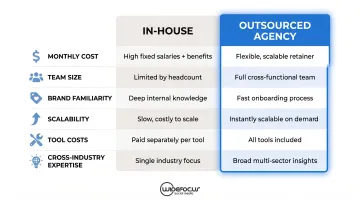
Here's how the two models compare at a glance:
| Factor | In-House | Outsourced Agency |
|---|---|---|
| Monthly cost | $10,000–$13,000+ | $2,000–$25,000+ |
| Team size | 1 generalist | Multi-specialist team |
| Brand familiarity | Deep | Builds over time |
| Scalability | Fixed headcount | Flexible by scope |
| Tool costs | Separate subscriptions | Included in retainer |
| Cross-industry expertise | Limited | Broad |
When in-house might still win
For very large brands with highly specific community needs, mature internal marketing teams, or complex crisis response requirements, a hybrid or fully in-house model can make sense. The right answer depends on your actual workload, budget, and how much specialized expertise your campaigns require — not on what feels most familiar.
How Much Does It Cost to Outsource Social Media Management?
Overview of the pricing spectrum
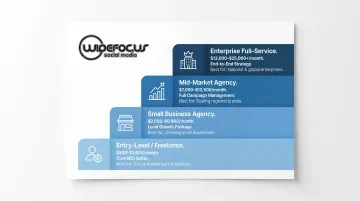
Real-world monthly costs vary widely by tier and scope:
| Tier | Monthly Cost | What's Included |
|---|---|---|
| Entry-level / Freelance | $500–$2,000 | Basic posting, 1–2 platforms, light engagement |
| Small business agency | $2,000–$6,000 | Strategy, original content, proactive community management |
| Mid-market agency | $7,000–$12,500 | Multi-platform, video production, analytics depth |
| Enterprise full-service | $13,000–$25,000+ | Senior strategy, short-form video, integrated paid support, dedicated team |
What drives cost up or down
Pricing reflects several key factors:
- Number of platforms managed (LinkedIn, Instagram, TikTok, Facebook, etc.)
- Posting frequency (daily vs. 3x/week)
- Content type (static graphics vs. short-form video production)
- Paid ad management (strategy, creative, optimization)
- Reporting depth (monthly dashboards vs. detailed attribution analysis)
- Channel bundling — managing multiple platforms together typically costs less than contracting each separately
Pricing models explained
| Model | Best For | Typical Rate |
|---|---|---|
| Monthly retainer | Ongoing, consistent social presence | Varies by tier (see above) |
| Hourly | One-time consulting or short-term projects | $75–$200/hour |
| Project / campaign | Product launches, seasonal pushes | Fixed fee per initiative |
Hidden costs to watch for
Ask for full cost transparency upfront. Additional expenses often excluded from headline quotes include:
- Ad spend (separate from management fees)
- Social media scheduling and analytics tools (some agencies bundle, others pass through)
- Extra revision rounds beyond the standard approval process
- Seasonal campaign production (holiday creative, special events)
- Onboarding or setup fees (commonly $1,000–$3,000)
Once you account for all these variables, the total investment looks quite different from the headline number — which makes a direct comparison with in-house hiring worth doing.
In-house vs. outsourced cost comparison
| Model | Annual Cost | Team Capabilities |
|---|---|---|
| In-house (mid-level manager) | $120,000–$160,000 | Single generalist, limited specialization |
| Outsourced agency ($7,500/month) | $90,000 | Full team: strategist, designer, video editor, ad manager, analyst |
At $90,000 annually, an outsourced agency at the mid-market tier gives you five or more specialists — for less than the fully-loaded cost of one in-house hire.
How to Choose the Right Social Media Partner
Define what "right fit" looks like
The right partner takes time to understand your business goals, audience, and brand voice before proposing anything. That means asking questions before pitching — not leading with a pre-packaged solution. Price and polish matter far less than strategic fit.
Key criteria to evaluate
When vetting a potential partner, push beyond the sales pitch. Here's what actually separates strong agencies from mediocre ones:
- Industry experience: B2B and B2C require fundamentally different approaches. An agency with relevant vertical experience — fintech, cybersecurity, healthcare — will ramp up faster and avoid costly missteps. WideFoc.us, for example, has built campaigns across both B2B and B2C industries since 2007.
- Communication structure: How often will you meet? Who do you contact when something's urgent? Vague answers here signal future frustration.
- Content approval workflow: Understand how drafts are reviewed, how many revision rounds are included, and who has final say.
- Metrics they prioritize: Agencies focused on follower counts are measuring the wrong things. Look for partners tracking CTR, website traffic, and lead conversions.
- Strategy vs. templates: A good agency asks about your goals, audience, and competitive landscape. If they skip those questions, they're selling a package — not a strategy.
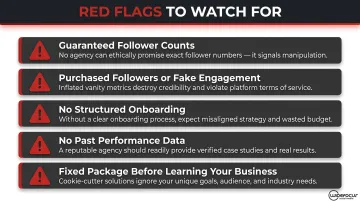
Red flags to avoid
- Guaranteed follower counts or viral results — no credible agency makes these promises
- Purchased followers or fake engagement, which violates platform terms and poisons your analytics
- No structured onboarding process, a reliable sign of disorganized execution
- Can't produce past performance data — ask for case studies, metrics, or client references
- Leads with a fixed package before learning anything about your business
Review case studies and ask pointed questions about how they handle brand voice and content ownership. Ensure contracts grant you full rights to all content and admin access to your accounts.
What to Expect After You Outsource
The transition period
The first 30–60 days are typically an onboarding and calibration phase. A good agency will spend time learning your brand voice, audience, and goals before producing content at full pace.
Expect initial discovery that explores target audiences, business goals, and pain points your brand resolves. The team will ask: Who do you want to reach? What do you want them to do? Results build over months, not days, and a steady, well-executed strategy consistently outperforms reactive changes.
How to measure success
Track metrics that tie back to business outcomes, not vanity numbers:
Avoid vanity metrics:
- Raw follower count
- Impressions alone
- Total likes
Focus on outcome-linked metrics:
- Engagement rate (likes, comments, shares per post)
- Click-through rate (CTR)
- Website traffic from social
- Lead or conversion data
A good partner will provide regular reporting and connect social performance to broader business goals. For example, WideFoc.us delivered over 20 million impressions and 1 million link clicks for clients in 2024. Those campaigns became top-performing traffic sources, driving qualified leads for both B2B and B2C brands.
Look for a partner who reviews platform-level data with you monthly and adjusts strategy based on what's actually working — not just what looks good on a report.
Frequently Asked Questions
How much does it cost to outsource social media?
Monthly costs range from ~$500 for basic freelance arrangements to $10,000+/month for full-service agency management. Cost depends on platforms managed, posting frequency, content type (static vs. video), and whether paid ad management is included.
Why outsource social media management?
The main reasons are access to specialized expertise across strategy, design, video, and analytics; time savings for the core team to focus on business priorities; more consistent content output; and the ability to scale without the overhead of full-time hiring and benefits.
What is an in-house social media manager?
An in-house social media manager is a dedicated employee who manages a brand's social presence from within the organization, typically costing $120,000–$160,000 annually including salary, benefits, and overhead. This contrasts with outsourced models, where brands access a full team — strategist, designer, ad manager, and analyst — under a single retainer.
What is the 5 3 2 rule for social media?
The 5-3-2 rule suggests that for every 10 posts, 5 should be curated content from others relevant to your audience, 3 should be original educational or brand content, and 2 should be personal or humanizing posts. The goal is to prevent feeds from becoming purely self-promotional while maintaining a consistent posting rhythm.
What is the 70/20/10 rule for social media?
The 70/20/10 content mix allocates 70% to value-adding or educational content, 20% to shared or curated content, and 10% to promotional content. This ratio keeps audiences engaged by leading with value rather than constant brand promotion.