At the same time, social media remains one of the most direct paths to the audiences fintech brands need — particularly Gen Z and millennials, where 79% of young adults now use social media for financial information, including investing, budgeting, and credit decisions.
The challenge isn't whether to invest in fintech social media. It's how to do it well — educating and converting audiences on platforms built for entertainment, while staying inside a tight regulatory lane.
This guide covers platform selection, content strategy, compliance, and measurement — with real brand examples and benchmarks throughout.
Key Takeaways
- Financial services brands average 1.6%–3.8% engagement depending on platform, far below cross-industry norms
- Educational content makes consumers 131% more likely to buy immediately after consuming it
- Platform selection should follow your audience: LinkedIn for B2B fintech, Instagram and TikTok for consumer-facing brands
- Compliance is non-negotiable: FINRA fined M1 Finance $850,000 in 2024 for unsupervised influencer content
- Measure business outcomes (cost per lead, link clicks, pipeline), not vanity metrics like likes and follower counts
Why Fintech Social Media Marketing Presents Unique Challenges
Fintech brands operate under a tension that doesn't resolve cleanly: financial topics require precision and compliance, but social media rewards speed, emotion, and brevity.
The numbers reflect this friction. According to Hootsuite's 2025 financial services benchmarks, average engagement rates across platforms look like this:
| Platform | Avg. Engagement Rate |
|---|---|
| 3.8% | |
| 3.2% | |
| Instagram Reels | 3.1% |
| X (Twitter) | 2.1% |
| 1.8% | |
| TikTok | 1.6% |

These figures already lag most consumer industries. Rival IQ's rolling data puts the cross-platform average even lower at 0.11% per post for financial services — a baseline that reflects how much harder fintech brands have to work for attention.
The Trust Deficit Is Real
Nearly one-third of U.S. consumers trust established banks more than fintech solutions, per a 2023 Blumberg Capital survey of 3,000 adults. Top barriers: unexpected fees and data security concerns.
This skepticism shows up directly on social media — in low engagement, high scroll-past rates, and hesitancy to click through to financial products from unfamiliar brands. For fintech brands, building that trust on social isn't optional — it directly determines whether a follower becomes a customer.
The Regulatory Layer
The FTC and FINRA actively govern fintech social content. Testimonials, performance claims, influencer posts, and even how disclaimers are placed can all attract scrutiny. The consequences for getting it wrong are concrete:
- $850,000 fine: FINRA's 2024 action against M1 Finance — its first formal disciplinary action for influencer mismanagement — after the firm failed to review or approve content from roughly 1,700 influencers
Every post needs compliance review built into the workflow, not added at the end.
Choosing the Right Social Platforms for Your Fintech Brand
Platform selection should follow your audience and product type, not what's trending. A B2B payments company and a consumer budgeting app have entirely different platform priorities.
LinkedIn for B2B Fintech
LinkedIn is the primary channel for fintech brands targeting CFOs, procurement leaders, and enterprise buyers. Four out of five LinkedIn members are involved in business decisions at their organizations — making it uniquely suited for B2B fintech content.
Content that performs well here:
- Thought leadership posts from founders and executives
- Data-backed insights and industry commentary
- Short-form video (video posts generate approximately 5x more engagement than static content)
- Expert interview formats and original research
Engagement volume on LinkedIn is lower than consumer platforms, but intent is significantly higher. A CFO who engages with your post is worth far more than a hundred passive Instagram scrolls.
Instagram and TikTok for Consumer Fintech
For consumer fintech brands targeting millennials and Gen Z, Instagram and TikTok are the priority channels. The CFA Institute found that 37% of Gen Z investors cite social media as a top factor that influenced them to start investing — with YouTube, Instagram, and TikTok being their primary platforms.
Brands succeeding here — Chime, Monzo, Step Bank — share a few traits:
- Informal, conversational tone over corporate polish
- Educational short-form video that simplifies complex concepts
- Genuine humor and personality baked into financial content
- Creator partnerships with audiences that already trust them on money topics
Chime generated 764 million total social views and an 87% year-over-year increase in social engagement in 2024 through creator partnerships and sweepstakes campaigns — achieving engagement rates 3x higher than financial services benchmarks.
Facebook for Community and Retargeting
Not every platform needs to anchor in organic virality. Facebook's organic reach has dropped sharply, but it still earns its place for two specific fintech applications: community building through Groups, and paid retargeting of website visitors and app users.
WordStream's 2024 data puts the average cost per lead for Finance & Insurance on Facebook at $38.09, with an average cost per click of $4.57 — useful baselines for budget planning. For fintech brands running retargeting campaigns to warm audiences, Facebook's precision targeting tools still deliver strong results.
Practical guidance: Audit where your target customers are already having financial conversations, then commit to 2–3 platforms rather than spreading thin across all of them. WideFoc.us runs platform discovery audits with fintech clients to pinpoint where their audience is most active — before a single piece of content gets built.
Building a Trust-First Content Strategy for Fintech
The foundation of fintech content strategy is education — not promotion. Research from Conductor found that consumers are 131% more likely to buy from a brand immediately after consuming educational content — and still 48% more likely a week later. When you consistently help your audience understand fees, interest rates, or investing basics, you earn the credibility needed before asking for a transaction.
Content Pillars That Work in Fintech
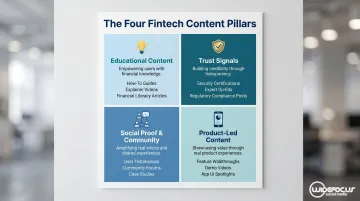
Four pillars consistently perform across fintech social channels:
- Educational content — Plain-language explainers on financial concepts, jargon-free and genuinely useful
- Trust signals — Regulatory badges, security transparency, visible compliance information, and customer testimonials
- Social proof and community — User stories, reviews, behind-the-scenes brand content, and partner shares
- Product-led content — Feature walkthroughs, outcome-focused demos, and real customer results (not just feature lists)
For a B2B fintech client in the embedded payments space, WideFoc.us built a differentiated content approach targeting two distinct audiences: C-suite executives on LinkedIn and Facebook, and software developers on Twitter/X. The result: over 1.2 million monthly impressions and 3,000+ website clicks per month — the company's top-performing marketing traffic source.
Making Complex Topics Visually Accessible
Hootsuite's 2025 data shows carousel posts generate the highest engagement on Instagram for financial services, while infographics and data visualizations consistently outperform text-only posts on LinkedIn. Short-form video fills the same role for consumer fintech — translating concepts like compound interest or credit scores into 30–60 second explainers that actually get watched.
Keeping up that volume across multiple platforms and formats is where many fintech brands hit a wall. Partnering with a full-service agency like WideFoc.us — covering content creation, community management, and paid campaigns — lets teams maintain consistent output across channels without stretching internal resources past their limit.
Tone of Voice as a Trust Tool
Ditching jargon isn't just a style preference — it's a conversion strategy. Monzo built its brand voice around a single principle: "swap formal words for normal ones." Their publicly available tone-of-voice guidelines explicitly ban financial jargon and replace it with plain language equivalents.
The result is a brand that feels approachable without sacrificing credibility. Define your brand voice clearly — conversational, accurate, and always compliant — and apply it consistently across every platform and format.
Fintech Social Media Best Practices That Drive Engagement
Influencer Marketing for Credibility, Not Just Reach
Fintech influencer marketing works when creators are selected for trust and audience alignment — not follower count. For consumer fintech, that means personal finance educators on TikTok and Instagram. For B2B fintech, it means analysts and operators on LinkedIn and YouTube.
Starling Bank's influencer campaign, managed by Goat Agency and Purple Goat Agency, illustrates what rigorous selection produces:
- 27 influencers across Instagram, TikTok, and Facebook
- 94 pieces of content produced
- 929,517 engagements from 2.38 million impressions
Against a financial services baseline of 1.6%–3.8% engagement, those results reflect what happens when creators genuinely align with the audience.
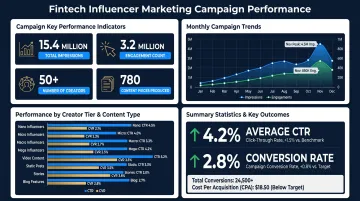
WideFoc.us evaluates influencers across subject expertise, engagement quality, content authenticity, and brand fit — prioritizing audience trust over raw reach. A global cybersecurity campaign using this approach produced 15 million impressions and 1.3 million engagements at $35 CPM.
User-Generated Content and Social Proof
UGC — customer reviews, reposts, hashtag campaigns — gives fintech brands something brand content can't replicate: authentic third-party proof. When real users share financial wins or product experiences, it carries more weight than any brand-produced post.
Chime's approach demonstrates the scale possible with UGC-driven campaigns. Their #WhyIChime activation regularly trends #1 on X within 15 minutes of launch. The MyPay campaign with Kai Cenat generated 155 million views and over 1 million sweepstakes entries.
Practical ways to encourage UGC:
- Branded hashtag campaigns tied to financial milestones
- Sweepstakes or giveaways that require sharing to enter
- Reward programs for customers who refer or review
- Reposting and amplifying customer stories with permission
Short-Form Video as a Conversion Tool
Short-form video is the highest-performing content format for reaching younger fintech audiences right now. Instagram Reels average a 3.1% engagement rate for financial services — with the best-performing videos combining education and personality in under 60 seconds.
The formula that works: pick one financial concept, explain it plainly, make it feel human. The brands doing this well don't produce polished brand videos — they produce content that looks like it belongs on the platform.
Thought Leadership and Expert Insights
On LinkedIn, original expert perspectives drive measurable purchase influence that generic posts simply don't. The 2025 Edelman-LinkedIn B2B Thought Leadership Impact Report, drawing on nearly 2,000 global professionals, confirms that thought leadership directly influences B2B purchase decisions, even among "hidden buyers" who never engage publicly.
Formats that consistently perform on LinkedIn:
- Data commentary on industry news or regulatory shifts
- Founder or executive takes on market trends
- Proprietary research and original findings
- Behind-the-scenes insights into product or company decisions
WideFoc.us supports C-suite thought leadership through LinkedIn profile optimization, ghostwriting, and executive content strategy. Done consistently, this approach positions executives as go-to voices in fintech — generating RFP inquiries, partnership outreach, and demo requests from buyers who were never directly targeted.
Navigating Compliance and Regulations on Social Media
Compliance belongs in the content creation process — not after it. Two regulatory bodies matter most for U.S. fintech brands:
| Body | What It Covers |
|---|---|
| FTC | Advertising disclosures, testimonials, and sponsored posts. The revised 2023 Endorsement Guides require material connections be disclosed within the content itself — not buried in hashtag strings or profile bios. |
| FINRA | Investment-related communications under Rule 2210. Social content is classified as static (requires prior principal approval) or interactive (supervised like correspondence). All communications must be retained. |
Practical Compliance Checklist for Fintech Social Content
- Include required disclaimers on all promotional posts
- Avoid unqualified performance claims ("guaranteed returns," "risk-free")
- Disclose all influencer partnerships with #ad or #sponsored — clearly, not buried
- Build an internal approval workflow before publishing posts that reference product features or financial outcomes
- Retain records of all published social content
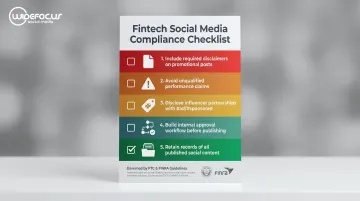
Working through this checklist builds a repeatable process — and a compliant one doesn't have to be a dull one. Monzo's tone-of-voice guidelines show that plain language and legal clarity reinforce each other. Accessible copy is simply harder to misinterpret.
Measuring What Matters: Fintech Social Media KPIs
Follower counts and likes don't pay for growth. Fintech brands should track KPIs that connect social activity to real business outcomes:
- Engagement rate relative to financial services benchmarks (1.6%–3.8% depending on platform)
- Link clicks and UTM-tracked website sessions from social
- Cost per lead from paid campaigns (financial services averages $38.09 on Facebook)
- Lead form submissions and inbound inquiries
- Cost per activated user for consumer fintech with paid social spend
A practical measurement cadence:
- Weekly — Monitor reach, engagement, and video completion rates in platform dashboards
- Monthly — Review UTM-tagged traffic in website analytics; assess which content types drive clicks
- Quarterly — Evaluate conversion attribution to determine which platforms and campaigns are generating pipeline
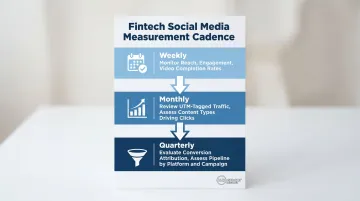
Set realistic baselines before drawing conclusions. If a platform consistently underperforms after 90 days of intentional publishing, that's data — not failure. Reallocate budget and attention toward the channels where your audience is actually converting, and reassess quarterly.
Frequently Asked Questions
Which social media platforms are best for fintech companies?
LinkedIn is the primary platform for B2B fintech brands targeting enterprise buyers and financial decision-makers. Instagram and TikTok work best for consumer fintech brands reaching millennials and Gen Z. The right mix depends on your product type and audience: consumer budgeting apps and B2B payments platforms have very different platform priorities.
How can fintech brands build trust through social media?
Educational content that simplifies financial concepts is the most effective trust-builder — consumers are 131% more likely to buy after engaging with educational content. Pair that with visible compliance signals, customer testimonials, plain-language brand voice, and consistent posting to build credibility over time.
What type of content performs best for fintech on social media?
For fintech brands, short-form video and educational infographics consistently outperform other formats. Expert thought leadership and user-generated content round out the top performers. These formats work because they make complex topics — fees, interest rates, investing basics — approachable without sacrificing credibility.
What is a good social media engagement rate for fintech brands?
Financial services brands average 1.6%–3.8% engagement depending on platform, per Hootsuite's 2025 data. Fintech brands using influencer partnerships, UGC campaigns, and short-form video can exceed those benchmarks by 3x or more. Chime is one example of a brand that has consistently outperformed category averages.
How do fintech companies stay compliant on social media?
Include required disclaimers on all promotional posts, avoid unsubstantiated performance claims, and disclose all influencer partnerships with clear #ad or #sponsored tags. Build an internal approval workflow for any content that references product features or financial outcomes before it's published.
Should fintech startups use influencer marketing?
Yes, but creator selection matters more than follower count. Fintech influencer campaigns work when creators have built genuine trust with their audience on financial topics. Prioritize subject expertise, engagement quality, and audience alignment over raw reach numbers.