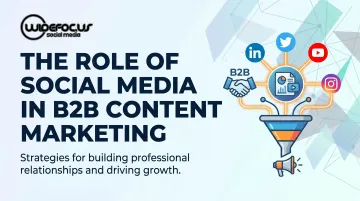
Here's the structural challenge: B2B buying cycles are long, involve multiple stakeholders, and require sustained credibility before anyone signs a contract. Social media addresses this directly. It keeps your brand visible and credible throughout the entire decision-making journey — not just at the moment a buyer raises their hand.
Forrester's 2026 Buyer Insights research — drawing on data from over 17,000 global B2B buyers — found that social media is now the second most meaningful information source for B2B buyers, ranking above company websites. That's not a peripheral channel. That's infrastructure.
Key Takeaways
- Social media functions as a full-funnel B2B distribution channel — not just a brand awareness add-on
- LinkedIn leads for organic B2B reach, but the right platform depends on where your buyers actually spend time
- Content that educates, demonstrates expertise, and builds trust consistently outperforms direct promotional posts
- A documented strategy with a consistent posting cadence separates top performers from everyone else
- Track leads, website traffic, and pipeline contribution — follower counts alone tell you very little
Why Social Media Is the Engine of B2B Content Marketing
The 95-5 Problem
Most B2B marketing treats social media like a demand capture tool — reaching people already looking to buy. That's the wrong frame.
Research by Professor John Dawes at the Ehrenberg-Bass Institute establishes what's now called the 95-5 rule: at any given moment, roughly 95% of your potential B2B buyers are not actively in a purchasing cycle. They're not comparing vendors, not filling out RFPs, not ready to talk to sales. But they'll eventually need what you sell.
Social media is the only channel that reaches this majority cost-effectively and consistently. Blog posts, case studies, and thought leadership distributed through social channels build memory and familiarity with buyers who are months — sometimes years — away from a decision. When they do enter a buying cycle, you're already a known quantity.
WideFoc.us saw this play out with a B2B fintech client: sustained, differentiated posting across LinkedIn and Facebook — targeting C-suite executives and software developers simultaneously — drove over 1.2 million monthly impressions and became the company's top-performing marketing-generated traffic source each month.
The Amplification and Trust Effect
Every piece of content you produce — a whitepaper, a case study, a blog post — gains significantly more reach when distributed through social channels. The network sharing mechanics on LinkedIn alone can extend a single asset far beyond your existing audience.
The trust dimension matters just as much. Consider:
- 75% of B2B buyers use social media to make purchasing decisions (LinkedIn data)
- 54% of decision-makers say thought leadership prompted them to research products they weren't previously considering, per the 2025 Edelman-LinkedIn B2B Thought Leadership Impact Report
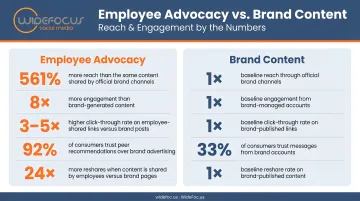
- 92% of B2B buyers trust employee recommendations over traditional advertising
The employee advocacy opportunity flows directly from that third stat. When team members share company content from their personal profiles, it reaches new professional networks organically and carries peer credibility that branded posts can't replicate.
Employee-shared content achieves 8x more engagement than brand-page content and reaches 561% more people than corporate posts. In B2B buying — where vendor selection often hinges on peer validation — few organic tactics move the needle more reliably.
Which Social Platforms Deliver the Most Value for B2B Content
Platform selection should follow audience behavior, not assumptions. That said, the data makes a clear case for where to start.
LinkedIn: The Non-Negotiable Starting Point
93% of B2B content marketers rate LinkedIn as effective for organic content distribution — 60% call it "extremely" or "very" effective. The next-closest platform, YouTube, sits at 38%. No other channel comes close for reaching professional decision-makers.
What makes LinkedIn structurally suited to B2B:
- Targeting by job title, seniority, industry, company size, and even company growth rate
- Content formats built for professional audiences — articles, newsletters, carousels, short video
- A context where users expect and engage with business content
WideFoc.us structures B2B client programs around LinkedIn as the strategic anchor — building executive thought leadership, optimizing profiles for sales teams, and driving team adoption through hands-on training.
Video: The Rising Priority
91% of businesses now use video as a marketing tool (Wyzowl, 2024), and video posts are shared 20x more than any other content type on LinkedIn. For B2B specifically, 93% of buyers say video is important for building trust.
The production bar is lower than most teams assume. LinkedIn's analysis of 13,000 B2B video ads found that "real talk" vertical videos — shorter, lo-fi, smartphone-shot — achieve 103% higher dwell time than standard ads. High-production "blockbuster" formats can drive 129% higher engagement, but creative intentionality consistently matters more than budget.
A well-framed expert speaking directly to a specific buyer problem will outperform a polished brand film with nothing concrete to say.
YouTube also deserves attention: 50.9% of B2B decision-makers prefer YouTube for vendor research, and 88% of B2B buyers have watched product research videos in the past three months.
Other Platforms: Follow the Data
- X/Twitter works for real-time industry commentary and developer-facing audiences
- Instagram supports culture, brand humanization, and behind-the-scenes content
- Niche communities (LinkedIn Groups, Slack channels) drive deeper engagement with specific buyer segments
The caution: trying to maintain a strong presence across all platforms without the resources to do it well produces mediocre results everywhere. Better to own two platforms than to exist weakly on six.
What Types of Content Work Best for B2B on Social Media
Thought Leadership
Original insights, contrarian takes, and expert commentary consistently outperform generic promotional posts in B2B feeds. The Edelman-LinkedIn data is definitive here:
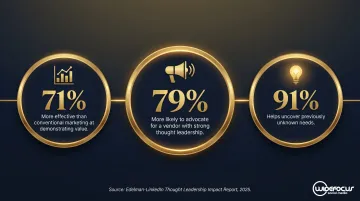
- 71% of B2B buyers say thought leadership is more effective than conventional marketing at demonstrating value
- 79% say they're more likely to advocate for a vendor with strong thought leadership
- 91% say quality thought leadership helps them uncover needs they didn't know they had
Yet 71% of decision-makers also say most thought leadership they encounter lacks value. The quality gap is the opportunity.
Educational and Social Proof Content
Content that helps buyers do their jobs better builds trust and drives repeat engagement. Formats that consistently perform in B2B feeds include:
- How-to posts and tactical explainers
- Data breakdowns and original research
- Short-form video walkthroughs
- Teasers for gated assets (whitepapers, reports) that pull leads into a capture flow
That educational goodwill only goes so far — buyers also need evidence. B2B buyers rely on proof that a vendor has delivered results for companies like theirs. Distributing case studies, client outcomes, and testimonials on social meets them where they're already researching, rather than expecting them to hunt down a case study page on your website.
Consider: 73% of B2B marketing executives rank word-of-mouth and peer recommendations as the most influential factor in vendor selection. Consistently sharing proof points on social is one of the most direct ways to shape that perception before a buyer ever contacts your sales team.
Interactive Content and Repurposing
Polls, Q&A posts, and comment-driven discussions increase algorithmic reach and surface real buyer pain points. They signal responsiveness — which matters in long sales cycles where relationship signals accumulate.
Content repurposing extends the value of every asset produced. A single blog post can become:
- A LinkedIn carousel breaking down key points
- A short video script for a talking-head clip
- A pull-quote graphic
- A LinkedIn article expanding on one section
This approach keeps the posting calendar consistent without burning out the content team, and it meets buyers in whichever format they're most likely to engage with on a given day.
How to Build a B2B Social Media Content Strategy
Start With Goals and Personas
Goals need to be specific to funnel stage:
- Awareness: Impressions, reach, new audience growth
- Consideration: Engagement rate, content downloads, website clicks
- Conversion: Lead form submissions, demo requests, pipeline contribution
Mixing all three into one vague objective produces unfocused content and unmeasurable results.
Effective B2B social content is built around documented buyer personas that capture more than demographics — specifically, the pain points each role carries, the formats they actually consume, and where in the buying journey they engage with social.
Without this groundwork, teams default to creating content the brand wants to share rather than content the audience needs to read.
Build a Sustainable Content Calendar
Consistency matters algorithmically and for brand recall. Posting weekly on LinkedIn delivers 5.6x more follower engagement than posting less frequently, per LinkedIn's own data. The recommended cadence is 2-5 posts per week.
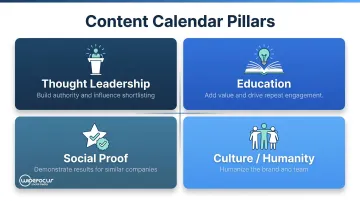
An effective content calendar balances four pillars:
| Pillar | Purpose |
|---|---|
| Thought leadership | Build authority and influence shortlisting |
| Education | Add value and drive repeat engagement |
| Social proof | Demonstrate results for similar companies |
| Culture/humanity | Humanize the brand and team |
Defaulting to all-promotional or all-educational content misses the full range of buyer signals. 83% of top-performing B2B organizations have a documented content strategy, compared to just 38% of the least successful — the correlation is consistent across years of CMI research.
That gap between top and bottom performers often comes down to execution infrastructure — the systems that keep content flowing at quality and frequency across multiple platforms. WideFoc.us builds and runs that infrastructure for B2B brands: content planning, daily posting, and analytics reporting tied to MQL, SQL, and pipeline metrics. In 2024, its client portfolio generated over 20 million impressions and 1 million link clicks.
Layer In Paid Strategically
Organic reach has hard limits on every major platform. LinkedIn Sponsored Content and boosted posts are often necessary to reach net-new audiences beyond existing followers.
The right approach is to let organic content prove itself first, then use budget to amplify what already works:
- Test content organically before committing ad spend
- Boost posts with strong engagement — those are validated signals
- Use paid to extend reach to net-new audiences, not to rescue underperforming content
- Match targeting parameters to your documented buyer personas
Measuring the Impact of Social Media on Your B2B Content Marketing
Vanity Metrics vs. Pipeline Metrics
Likes and follower counts feel rewarding. They rarely correlate with revenue. The KPIs that matter:
- Website traffic from social referrals (tracked by source)
- Content download completions
- Lead form submissions from social-driven traffic
- Opportunities and revenue attributed to social touchpoints
Only 28% of B2B marketers report having the right measurement technology properly in place. That gap explains why social media is routinely undervalued in budget conversations — its pipeline contribution is invisible without the right infrastructure.
Build Attribution Infrastructure First
Before launching campaigns, configure:
- UTM parameters on all links shared through social channels
- CRM integration to connect social leads to pipeline stages
- Multi-touch attribution modeling to account for social's role across a long buying cycle
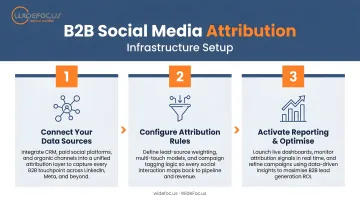
Social rarely gets sole credit for a B2B deal. Multi-touch attribution captures social's contribution at each decision-making touchpoint, giving you the data needed to justify — and grow — your social investment.
Social Listening as Content Intelligence
Monitoring brand mentions, competitor conversations, and industry hashtags reveals the actual language buyers use to describe their problems. That language should feed directly into the next wave of content topics.
Done consistently, social listening connects what your audience is actively asking to what your brand publishes next — turning measurement into a live content planning tool.
Frequently Asked Questions
What is the role of social media in B2B marketing?
Social media serves as a content distribution and relationship-building channel in B2B marketing. It keeps brands visible with buyers throughout long decision-making cycles and builds credibility through consistent thought leadership, educational content, and proof of results — long before a prospect ever engages with sales.
What is B2B social media marketing?
B2B social media marketing is the strategic use of platforms like LinkedIn and YouTube to distribute content, engage professional audiences, generate leads, and build brand authority among business buyers and decision-makers. It differs from B2C in its longer cycles, multi-stakeholder audiences, and emphasis on trust over immediate conversion.
What are the objectives of B2B marketing?
The core objectives are building brand awareness, generating and nurturing qualified leads, supporting the sales cycle, and retaining existing customers. Social media contributes across all of these — from top-of-funnel awareness to late-stage proof and post-sale advocacy.
What are the 3 C's of social media marketing?
The 3 C's are Content (what you share), Community (who you engage with), and Consistency (how reliably you show up). In B2B contexts, consistency is often the most underrated of the three — trust with professional buyers accumulates through repeated, reliable presence rather than occasional bursts.
What is the 95-5 rule for B2B?
Developed by Professor John Dawes at the Ehrenberg-Bass Institute, the 95-5 rule holds that roughly 95% of potential B2B buyers aren't in an active purchasing cycle at any given moment. Consistent social media content keeps your brand familiar and trusted — so when they do start buying, you're already on their radar.