The stakes are real. US social media advertising revenue hit $88.8 billion in 2024, representing 36.7% year-over-year growth and now accounting for roughly a third of all US digital ad spend. More businesses than ever are competing for the same audiences — which means the quality of your agency relationship matters more, not less.
This guide walks through what social media advertising services actually include, which factors separate strong agencies from average ones, how to match your platform strategy to your audience, and what questions to ask before you sign anything.
Key Takeaways
- Know what's included: social media advertising services cover content creation, paid campaigns, community management, and analytics
- Define your goals, audience, and budget before approaching any agency
- Evaluate providers on experience, service integration, strategy customization, and reporting transparency
- Choose platforms based on where your audience actually is — B2B and B2C brands rarely belong in the same places
- Ask hard, specific questions before signing: how they measure success, who manages your account, and what customization actually looks like
What Are Social Media Advertising Services?
Social media advertising services cover the paid and organic strategies used to build brand presence, engage target audiences, and drive business outcomes across platforms like LinkedIn, Facebook, Instagram, and YouTube.
Two distinct categories exist under this umbrella:
- Organic social media management — content scheduling, community engagement, brand voice development
- Paid social advertising — targeted ad campaigns with defined budgets, audience criteria, and performance tracking
Top agencies deliver both, integrated under one strategy.
Content Creation and Campaign Strategy
This goes beyond scheduling posts. It includes ad copy, visual creative, audience segmentation, and the strategic reasoning behind each campaign. Good agencies build content that reflects how your audience actually thinks and behaves, not just what looks polished in a grid.
Paid Media Management
Active campaign management means bid optimization, A/B testing ad formats, pacing budgets across flight windows, and tracking metrics like CPM, CPC, and ROAS. Without active management, ad spend drifts toward underperforming placements and inflated costs.
Analytics and Performance Reporting
Reporting is where agency accountability shows up. The difference between a strong partner and a weak one often comes down to whether they tie campaign activity to your actual business KPIs — lead volume, pipeline impact, cost-per-acquisition — versus sending you a PDF of impressions at month's end.
Community Management
Responding to comments, DMs, and brand mentions shapes how new visitors perceive your brand. It directly affects trust signals and engagement rates in ways that paid reach alone cannot replicate.
Understanding what these services cover is step one. The harder question is knowing which combination your business actually needs — and which agency is equipped to deliver it.
Key Factors to Consider When Choosing Social Media Advertising Services
Choosing a provider isn't a price comparison exercise. The right agency connects its capabilities directly to your business outcomes, growth stage, and audience type.
Agency Experience and Proven Track Record
Industry-relevant experience cuts ramp-up time significantly. An agency that has served businesses similar to yours — by size, sector, or audience — arrives with tested frameworks rather than hypotheses.
When reviewing case studies, don't stop at the visuals. Look for:
- Documented cost-per-lead improvements over a defined period
- ROAS gains tied to specific campaign changes
- Audience growth with engagement data, not just follower counts
- Before-and-after metrics that reflect the client's actual goals
Vague testimonials like "they were great to work with" don't tell you much. Numbers do.
Range and Integration of Services
When strategy, creative, and paid media are managed under one roof, campaigns stay consistent, attribution is cleaner, and iteration cycles are faster. Splitting those responsibilities across multiple vendors rarely works as planned.
Fragmented setups introduce predictable problems: misaligned messaging between organic and paid, conflicting audience signals, and slower feedback loops when something needs to change.
Strategy Customization vs. Cookie-Cutter Packages
This is where many agencies fall short. Tiered packages offer predictable pricing, but they rarely account for the differences that actually drive results: your sales cycle, your audience behavior, your competitive landscape.
Genuine customization looks like:
- A structured discovery process before any strategy is proposed
- A tailored channel mix recommendation based on where your audience actually is
- Content that reflects your brand voice, not a generic template
- Strategy that evolves with your business goals, promotions, and seasonal priorities
If an agency's proposal looks like it could have been sent to any client in your industry, it probably was.
Reporting Transparency and Communication Style
Reporting cadence and data access are non-negotiable accountability signals. Clients should expect regular reporting tied to agreed KPIs — not end-of-month summaries with no actionable context.
Communication style matters too. Platforms shift quickly, and if your agency takes three days to flag a campaign that's underperforming or a trending moment worth activating on, you've already missed the window.
Ask specifically: How often will we review performance? Who shares the report? What happens when metrics miss target?
Budget Alignment and Pricing Model
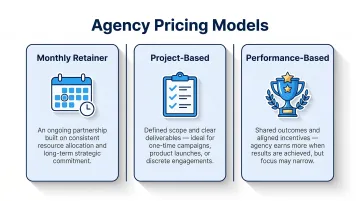
Most agencies use one of three pricing structures, each signaling something different about how they work:
| Model | What It Signals |
|---|---|
| Monthly retainer | Ongoing strategic partnership, consistent resource allocation |
| Project-based | Defined scope, good for one-time campaigns or launches |
| Performance-based | Agency shares in outcomes — aligns incentives, but can narrow focus |
Evaluate deliverables and strategy depth, not just the monthly number. A $3,000/month retainer that includes discovery, content creation, paid media management, and monthly reporting is a different product from one that only covers posting.
How to Choose the Right Platform for Your Business
Spending budget on the wrong platform is one of the most common and costly mistakes in social media advertising. Platform selection should follow your audience — not assumptions, trends, or what a competitor appears to be doing.
B2B vs. B2C Platform Considerations
The data here is clear. According to the Content Marketing Institute's B2B research, 84% of B2B marketers say LinkedIn delivers the best value among organic social platforms — compared to just 29% for Facebook and 22% for YouTube.
LinkedIn's advantage comes from its targeting precision: job title, company size, industry, seniority. For B2B brands trying to reach decision-makers, that specificity justifies the typically higher CPMs.
B2C brands operate in different territory:
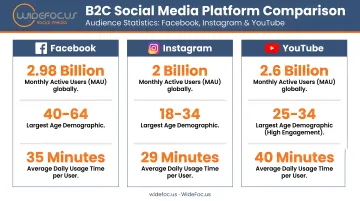
- Facebook reaches 68% of US adults and offers granular demographic targeting at scale
- Instagram skews younger and female (54% of women vs. 39% of men), making it strong for lifestyle, retail, and visual-first brands
- YouTube drives results for product demos, tutorials, and any campaign that benefits from longer attention windows
How Audience Behavior Should Guide Platform Choice
Knowing your category is a starting point — validating it with data is what actually protects your budget. Before committing spend, audit where your target audience spends time using platform usage data segmented by age, income, and content preference. Pew Research publishes this annually and is the most reliable free benchmark available.
From there, resist the pull toward being everywhere at once. Two or three well-managed platforms consistently outperform a fragmented presence spread across six channels with divided attention and diluted creative. A good agency helps you make that call based on evidence, not channel enthusiasm.
Questions to Ask Before You Sign With an Agency
The pitch conversation reveals as much about an agency as their portfolio. The right questions separate genuine strategic partners from commoditized service providers.
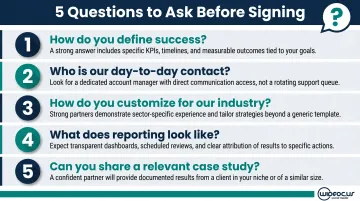
Ask these five before signing anything:
How do you define and measure success for clients with our goals? A strong answer names specific KPIs — follower growth, cost-per-lead, conversion rate — and explains exactly how they're tracked. "We'll grow your presence" is not an answer.
Who will be the day-to-day contact on our account? Find out whether the person pitching you is the person running your account, or if you'll be handed off to a junior coordinator after you sign.
How do you customize your approach for our industry and audience? Listen for specifics: discovery process, channel rationale, audience research methodology. If they can't explain why they'd choose LinkedIn over Instagram for your business, that's a problem.
What does your reporting process look like? You should get clear answers on cadence (weekly? monthly?), format, and which metrics are included by default — not a vague promise to "keep you informed."
Can you share a case study from a client similar to us? Push past impressive results from unrelated industries. You want something that maps to your business type, size, and goals. If they don't have one, ask how they'd approach your specific situation.
Pay attention to how they respond, not just what they say. An agency that pivots back to their capabilities deck instead of answering directly is showing you exactly how they'll handle hard questions once you're a client.
How WideFoc.us Can Help
WideFoc.us is a full-service social media agency based in Denver, Colorado, operating since 2007 across B2B and B2C brands, nonprofits, and global corporations. Their portfolio includes work in cybersecurity, fintech, automotive aftermarket, real estate development, e-commerce, and professional services.
The results speak for themselves: a global cybersecurity campaign generated 15 million+ impressions and 1.3 million engagements through influencer partnerships. A B2B fintech client achieved 1.2 million monthly impressions with social becoming the top marketing-generated traffic source. A master-planned community campaign drove 12,000+ website clicks at $0.14 CPC using paid social across Pinterest, Facebook, and Instagram.
What sets WideFoc.us apart from typical agencies:
- No templated packages — every engagement starts with a structured discovery process to understand audience, goals, and KPIs before any strategy is proposed
- Integrated delivery — content creation, community management, and paid campaigns are managed under one strategy, not siloed across vendors
- Defined methodology — the Discover, Strategize, Implement, and Assess framework ensures strategies evolve with client priorities, not just run on autopilot
- B2B and B2C fluency — LinkedIn-led thought leadership for professional services and SaaS clients; visual, conversion-focused campaigns for consumer brands

Monthly reporting and strategy meetings are standard across all engagements. Performance is tied to business outcomes (ROAS, cost-per-lead, pipeline impact), not vanity metrics.
If you're evaluating social media advertising partners, reach out to WideFoc.us directly at info@widefoc.us or call 303.219.0453.
Conclusion
Choosing the right social media advertising services means finding alignment on three fronts: what the agency can actually do, which platforms your audience uses, and whether the value justifies what you're spending. Get those three right, and everything else becomes easier to evaluate.
The goal isn't the biggest agency or the most impressive pitch deck. It's the one that treats your brand as a priority, communicates transparently, and builds campaigns around real outcomes rather than activity metrics.
This is also not a one-time decision. Business goals shift, platforms evolve, and the agency that was right for you two years ago may not be the right fit now. Revisiting your agency relationship as your business grows isn't a failure — it's how you stay competitive. If you're ready to find a partner that builds around your goals from day one, WideFoc.us has been doing exactly that for B2B and B2C brands since 2007.
Frequently Asked Questions
How do you choose the right social media agency?
Start by defining your goals — brand awareness, lead generation, or conversions. Then assess the agency's experience, service range, and case studies for measurable outcomes. Prioritize agencies that customize strategy through a real discovery process rather than dropping you into a pre-built package.
How do you choose social media platforms for your business?
Base platform selection on where your target audience actually spends time, your business type (B2B vs. B2C), and your campaign objective. A strong agency will recommend the right platform mix during onboarding rather than defaulting to every channel regardless of fit.
Which platform is best for B2B lead generation?
LinkedIn is the leading B2B platform, with 84% of B2B marketers rating it as their best-performing organic social channel. Its targeting by job title, industry, and company size makes it particularly effective for reaching professional decision-makers.
What services should a social media advertising agency offer?
Look for content creation, paid campaign management, community engagement, platform strategy, and analytics reporting as core offerings.
How much do social media advertising services cost?
Pricing varies widely by scope. WideFoc.us structures organic social retainers between $4,500–$11,000/month, with paid social management starting at $300/month or 20% of ad spend — while industry averages sit around $2,107/month. Evaluate what's included, not just the price tag.
What's the difference between social media marketing and social media advertising?
Social media marketing covers the full range of organic and paid activity — content, community management, and engagement. Social media advertising refers specifically to paid placements with defined targeting, budgets, and performance tracking.