The risks of neglecting this are concrete: eroding consumer trust, declining organic reach, missed crisis windows, and long-term damage that compounds quietly until it's visible to everyone. The good news is that reputation management, done right, is a structured practice — not a scramble.
This guide covers why reputation management matters, the four core pillars every brand needs active simultaneously, warning signs your standing is slipping, and how to build a routine that keeps you ahead of problems instead of reacting to them.
Key Takeaways
- Social media reputation management is an ongoing discipline: monitoring, responding, content, and crisis planning must run simultaneously
- 75% of consumers read reviews before choosing a local business — social proof directly affects revenue
- Ignoring negative mentions or failing to respond publicly signals indifference — and potential customers notice
- Early warning signs (engagement drops, rising negative reviews, unacknowledged mentions) are measurable and catchable before they escalate
- A defined routine with clear ownership outperforms reactive damage control every time
Why Social Media Reputation Management Matters
Advertising tells people what you want them to think. Social media shows them what others actually think. For brands, the gap between those two realities is where reputation is won or lost.
According to BrightLocal's 2025 Local Consumer Review Survey, 75% of consumers "always" or "regularly" read reviews before choosing a local business — and 41% want those reviews to be from the last month to consider them relevant. Stale or ignored feedback doesn't just fail to convert; it actively works against you.
The revenue connection is direct. A Harvard Business School study found that a one-star increase on Yelp correlates with 5–9% revenue growth in the restaurant sector — a figure that reinforces what most marketers already sense: reputation isn't a soft metric.
The Compounding Effect
Positive social proof does two things at once: it builds credibility with new audiences and reinforces loyalty with existing customers. Unaddressed negative content does the opposite — it grows louder over time because fresh complaints layer on top of old ones, and silence from the brand amplifies the damage.
That dynamic makes social media fundamentally different from traditional PR. The rules of engagement have changed:
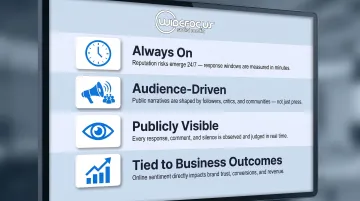
- Always on — conversations happen at 2am on a Saturday
- Partially audience-driven — you don't control who posts or what they say
- Publicly visible — how you respond is seen by far more people than just the original poster
- Tied to business outcomes — reputation affects hiring, partnerships, and competitive positioning, not just brand image
Brands that treat reputation management as reactive damage control consistently fall behind those that approach it as an ongoing, structured discipline.
The Four Pillars of Social Media Reputation Management
Effective reputation management isn't a single task or a platform setting. It's four interconnected practices that must run simultaneously. Let one lapse and the others lose their effectiveness.
Monitor: Track What's Being Said
Monitoring goes well beyond checking your tagged notifications. It means setting up listening tools and keyword alerts across social platforms, review sites, and industry forums to catch conversations as they happen — including the ones where no one tags you directly.
What to track:
- Brand name mentions (both tagged and untagged)
- Relevant hashtags and product/service terms
- Competitor comparisons that include your brand
- Sentiment shifts in comment sections over time
- Review volume and star rating trends on Google, Facebook, and Yelp
BrightLocal's 2026 research shows 71% of consumers used Google to read reviews, with Facebook and Yelp as the next most common platforms. That's where monitoring priority should start.
WideFoc.us builds real-time monitoring into its full-service social media management, covering customer questions, reputation signals, and emerging issues across all active channels — including review platforms, not just social feeds.
Respond: Engage Every Mention With Intention
How a brand responds publicly is as important as what it says. A thoughtful reply to a complaint — or a genuine acknowledgment of positive feedback — signals values and accountability to every person who scrolls past it, not just the original commenter.
The numbers support this. HBR's analysis of TripAdvisor data found that when businesses start responding to reviews consistently, they receive 12% more reviews and see average ratings climb by +0.12 stars. BrightLocal 2025 puts it more directly: 88% of consumers say they're more likely to use a business when they see the owner responds to all reviews — positive and negative.
A simple response framework:
- Positive mentions: Acknowledge warmly and specifically — reference what they said, keep the tone human
- Complaints or criticism: Open with empathy, move to resolution quickly, and offer to continue the conversation privately if needed
- Bad-faith or troll behavior: Respond once with calm professionalism, or don't respond at all — never match the energy
For brands managing high engagement volume across multiple platforms, partnering with a social media agency like WideFoc.us ensures consistent community management — so mentions don't fall through the cracks during busy periods or after-hours.
Build: Shape Your Own Narrative
Brands that only respond to problems never get ahead of them. Those that actively publish content — customer success stories, behind-the-scenes moments, thought leadership, employee spotlights — build a body of positive social proof that contextualizes any criticism that does appear.
Content types that build positive perception:
- Customer testimonials and case studies carry more weight than brand claims — third-party validation is inherently more credible
- Thought leadership posts, especially on LinkedIn, signal authority to B2B audiences who are actively evaluating vendors
- Behind-the-scenes content humanizes the brand and builds connection that polished marketing rarely achieves
- Educational content positions the brand as a resource rather than just a seller
A brand that sounds warm and approachable on Instagram but corporate and distant on LinkedIn creates a dissonance that erodes trust over time. WideFoc.us addresses this directly — brand voice development is part of its discovery process, so tone stays coherent whether content appears on LinkedIn, Facebook, or Instagram.
Plan for Crisis: Build the Framework Before You Need It
Most brands that handle crises well didn't figure it out under pressure. They had a plan.
A basic crisis response framework:
- Pause all scheduled content — nothing looks worse than a promotional post going live during a controversy
- Assess scope using listening tools — determine whether this is a localized complaint or a spreading narrative
- Respond with a unified, transparent message — don't issue a different statement on each platform
- Monitor sentiment as the response lands — track whether the tone is shifting or escalating
- Debrief after resolution — update the plan based on what you learned

WideFoc.us has applied this approach in practice, including work with a municipal law enforcement agency facing pervasive negative coverage and rising hostile social commentary. By monitoring local media and social channels proactively, the agency was able to respond before issues escalated — eventually shifting community sentiment and driving 762% growth in Facebook page likes.
Warning Signs Your Social Media Reputation Is Slipping
Reputation decline rarely announces itself. It shows up in measurable signals that most brands miss because they're not watching closely enough.
Declining Engagement or Shifting Sentiment
A consistent drop in likes, shares, comments, or saves — without any change in posting frequency or content quality — often points to audience disengagement or trust erosion. Pay attention to what people are saying in comments, not just whether they're engaging at all.
Hootsuite's 2025 benchmarks put average organic engagement at roughly 3.4–3.5% on Instagram, 3.4% on LinkedIn, 1.5% on TikTok, and 1.3% on Facebook. Sustained underperformance against these platform baselines — especially when paired with an increase in neutral or negative sentiment — is a signal worth diagnosing before it becomes a public problem.
Rising Volume of Negative Reviews or Unresolved Complaints
An uptick in negative reviews across Google, Yelp, or Facebook isn't always random. When multiple reviews share a common theme — slow response times, a specific product issue, a recurring service gap — that pattern points to an operational problem, not just a perception one.
Leaving those reviews unanswered compounds the damage. Potential customers read both the review and the silence. BrightLocal data shows 88% of consumers are more likely to choose a business that responds to all reviews, which means non-response is a measurable conversion killer.
Brand Mentions That Go Unacknowledged
Untagged mentions — complaints or questions shared without a direct @ — are easy to miss and easy to underestimate. If customers repeatedly reach out or mention your brand without getting a response, they stop doing it. When that happens, the silence itself is a warning sign — your audience has given up on getting a response and disengaged entirely.
Your Social Media Reputation Management Routine
Reputation management only works when it's structured. The right cadence depends on your brand's size, platform activity, and engagement volume — but every business needs a defined schedule to stay proactive.
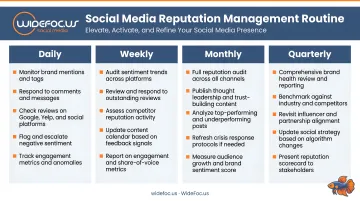
| Frequency | Tasks |
|---|---|
| Daily | Monitor mentions and comments; respond to reviews and messages within 24 hours |
| Weekly | Review sentiment trends; check for untagged mentions; assess content performance |
| Monthly | Audit review volume and ratings across Google, Facebook, Yelp; review crisis plan; compare share of voice vs. competitors |
| Quarterly | Full reputation audit; assess brand voice consistency across platforms; adjust strategy based on analytics |
For brands managing multiple platforms or significant engagement volume, keeping up with this cadence consistently takes more bandwidth than most in-house teams have. WideFoc.us handles the monitoring, community management, and strategic oversight required to run it at scale — with real-time alerts, monthly performance reporting, and crisis support built into its full-service social media management.
Conclusion
Social media reputation management is a core business function — one that protects revenue, customer relationships, and the brand credibility you've spent years building.
The right approach combines proactive monitoring, intentional public engagement, consistent content that shapes your narrative, and a crisis framework that's ready before you need it. None of these work in isolation. Executed consistently on a defined schedule, they reinforce each other.
Brands that invest in reputation consistently — rather than scrambling after something goes wrong — build the kind of credibility that holds up under pressure. Start with the structure, own the routine, and make it a standard part of how you operate.
Frequently Asked Questions
What is social media online reputation management?
It's the practice of monitoring, influencing, and maintaining how a brand is perceived across social platforms and review sites. That includes tracking mentions, responding to feedback, and proactively publishing content that shapes public perception.
Why is social media online reputation management important?
Consumers increasingly rely on social proof and third-party reviews to make purchase decisions. How a brand behaves publicly — especially how it responds to criticism — directly shapes trust, loyalty, and revenue.
What is the role of PR in social media online reputation management?
PR and social reputation management overlap in crisis response and narrative control. PR shapes the messaging strategy; social media is where that message gets delivered, tested, and refined in real time.
Which social media platforms are best for online reputation management?
It depends on where your audience is most active. Google, Facebook, and Instagram are typically highest priority for reviews and engagement, while B2B brands tend to lean heavily on LinkedIn.
What is the difference between SEO and ORM?
SEO focuses on improving search visibility through keyword optimization and content. ORM focuses on shaping public perception through review management, social engagement, and sentiment monitoring — though both can indirectly support each other.
How much do social media online reputation management services cost?
Costs vary based on scope. In-house management requires tool investments plus staff time, while agency retainers depend on the level of monitoring, content creation, and community management involved. WideFoc.us quotes retainers based on platform needs and engagement volume — contact them directly for an accurate estimate.