In most local markets, the martial arts schools generating consistent new student inquiries aren't necessarily the best schools. They're the ones showing up where parents and adults are already spending their time: Facebook, Instagram, and TikTok. Organic posts alone won't get you there anymore — business content on Instagram now reaches roughly 3–4% of followers, according to Sprout Social's 2026 organic reach analysis. That's not a lever worth relying on for growth.
This guide covers everything a martial arts school owner needs to run paid social campaigns that actually fill enrollment slots — from platform selection and ad creative to targeting, budgets, and measuring what's working.
Key Takeaways
- Organic reach alone won't generate consistent enrollment; paid campaigns are now essential for local visibility
- Facebook and Instagram are the strongest starting platforms for most schools; TikTok works for reaching teens and younger adults
- Structure campaigns as a three-stage funnel — awareness, consideration, then conversion. Don't cold-target prospects with "Sign Up Now" ads
- Paid intro offers (like "$49 for 6 weeks") convert 50–60% of prospects to paying members — free trials rarely break 20%
- Always send ad traffic to a dedicated landing page — not your homepage
Why Paid Social Campaigns Are Essential for Martial Arts Schools
Organic Reach Isn't Enough Anymore
Facebook organic engagement rates sit between 1.52% and 2.58% (Hootsuite data, 2024). Instagram is worse for reach. If your school has 800 followers, a typical post reaches maybe 30 people — most of whom already train with you.
Paid campaigns solve a different problem: reaching people who have never heard of your school but are exactly the right fit. Organic builds community with people who already know you. Paid introduces you to people who don't.
Why Paid Social Works for Local Schools Specifically
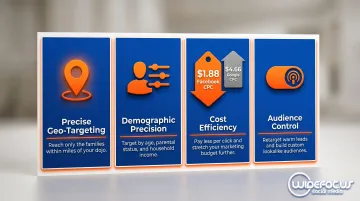
Key advantages for brick-and-mortar martial arts businesses:
- Precise geo-targeting — limit ad delivery to realistic commute zones around your school
- Demographic precision — reach parents searching for kids' programs, or adults interested in self-defense, separately and with different messaging
- Cost efficiency — the average Facebook ad CPC is $1.88 versus $4.66 for Google Ads (WordStream, 2024), making paid social the more accessible channel for studios with limited budgets
- Audience control — you decide who sees your message, when, and how many times
WideFoc.us has seen this play out directly with local service clients. A regional home services company running geo-targeted Meta campaigns achieved a 512% increase in form fills and 9x qualified leads in eight weeks. Those same local lead generation mechanics translate directly to martial arts enrollment.
Choosing the Right Platforms for Your Martial Arts Paid Campaigns
Facebook Ads
Facebook is the anchor platform for most martial arts schools, and the numbers back it up. Pew Research Center (2024) found that 75% of U.S. adults aged 30–49 use Facebook — the primary parent demographic making decisions about kids' programs and family memberships.
Facebook's targeting infrastructure is also the deepest available for local businesses: custom audiences, lookalike audiences, detailed demographic filters, and parental status targeting all live here. If your school runs youth programs, no other platform gets you in front of the decision-makers more efficiently.
Instagram Ads
Instagram complements Facebook campaigns rather than replacing them. The platform reaches 59% of adults aged 30–49 and 78% of 18–29-year-olds, making it strong for both parent targeting and adult beginner programs.
The real advantage for martial arts content: training footage, belt promotions, and student transformations are inherently visual. Video ads on Instagram Reels achieve CPMs as low as $5.00 compared to $7.20 for image ads in the same placement — a meaningful gap when you're running awareness campaigns on a fixed monthly budget.
Since Facebook and Instagram share the same Ads Manager, you can run cross-platform campaigns without managing two separate systems.
TikTok Ads
For demographics that Facebook/Instagram don't fully cover, TikTok fills the gap. The platform is especially relevant for schools targeting teens and adults under 35. 62% of U.S. adults aged 18–29 use the platform. For adult beginner programs or teen classes, short-form video ads can reach an audience that's harder to access on Facebook.
The creative approach is different, though. Polished, promotional-style ads consistently underperform here. Raw, energetic, behind-the-scenes content does far better — and schools with an existing organic TikTok presence will see stronger paid results than those building from zero.
How to Build High-Converting Martial Arts Ad Campaigns
The Three-Stage Funnel
Running only "Sign Up Now" ads to cold audiences is the single most common mistake martial arts schools make with paid social. People don't enroll at a school they've never heard of from one ad. A three-stage funnel fixes this:
- Awareness — Introduce your school to cold audiences using engaging video content (classes in action, instructor introductions, student stories). Goal: generate views and brand recognition.
- Consideration — Retarget people who watched your video or engaged with your content. Use student testimonials, program-specific messaging, and answers to common hesitations ("I'm not fit enough," "I'm too old to start").
- Conversion — Target warm audiences with a specific, low-friction offer: a free trial class, a discounted intro week, or a limited-spots beginner program.
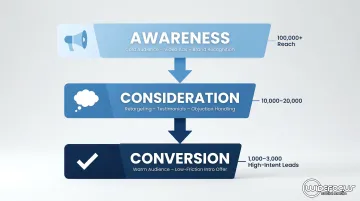
Each stage uses different creative, different objectives, and speaks to people at different levels of readiness.
What Makes Effective Ad Creative
Video outperforms static images for awareness. Video ads generate a 3.2% engagement rate versus 1.8% for images and produce significantly better ad recall. For conversion campaigns, image ads can actually deliver cheaper CPAs — so the format choice should match the funnel stage.
Effective martial arts ad creative:
- Features real students, not stock imagery or polished actor shoots
- Shows visible progress — belt promotions, first sparring sessions, before/after fitness changes
- Addresses hesitations directly ("No experience needed," "All fitness levels welcome")
- Keeps branding consistent across formats — same logo, colors, and tone
Writing Ad Copy That Converts
Lead with a specific transformation, not a generic description of your school. "Your kid will build real confidence — not just kicks" outperforms "Join Our Kids' Karate Program" every time.
Segment your messaging by audience:
- Parents of young children → focus on confidence, discipline, and social skills
- Adults interested in fitness → focus on functional strength and stress relief
- Beginners who feel intimidated → directly acknowledge the hesitation and address it
Always include one clear CTA. Strong structures that work:
- "Claim Your Free Trial Class"
- "Book Your First Week for $49"
- "See Our Kids' Program Schedule"
Offer Structure and Landing Pages
Research from Vibefam (2025) found that paid introductory offers convert at 50–60% to membership, while completely free trials convert at below 20%. A "$29 for 2 weeks" or "$49 for 6 classes" structure qualifies leads who are genuinely interested — and produces better enrollment ROI per ad dollar spent.
Every ad should point to a dedicated landing page, not your homepage. Landing pages convert 4–5x better than homepages for paid traffic. That page needs:
- A headline that matches the ad's offer exactly
- Brief program benefits (3–4 bullets)
- A student testimonial or photo
- One simple form or booking button
Executing all of this across multiple platforms — creative production, audience segmentation, A/B testing, budget pacing — is time-intensive work. School owners who want results without the learning curve often partner with a paid social agency. WideFoc.us handles the full stack: Meta Pixel setup, retargeting funnels, and lookalike audience expansion, so you can focus on running your school.
How to Target the Right Audience for Your Martial Arts School
Geographic Targeting: Start Here
Every paid campaign for a physical martial arts school should be anchored to a realistic radius around your location — typically 5–10 miles in suburban areas, tighter in dense urban markets. Sending traffic from outside a realistic commute range wastes budget on people who will never walk through your door.
In Meta Ads Manager, set location targeting using your school's address as the pin-drop center and adjust the radius based on your market density.
Layering Demographics and Interests
On top of geographic targeting, add:
- For kids' programs: Parents aged 28–45, family and parenting interest signals, household profile filters
- For adult programs: Adults aged 25–50, fitness and health interests, self-defense interest signals
- For both: Martial arts, combat sports, and local gym/fitness behaviors
Avoid audiences that are too narrow (under 50,000 people — the algorithm can't optimize) or too broad (entire metro area with no demographic filters — dilutes relevance and raises costs).
Custom and Lookalike Audiences
Custom Audiences let you target people who already have a relationship with your school:
- Upload email lists of past leads or lapsed students
- Retarget website visitors (requires Meta Pixel installation)
- Build audiences from video viewers — people who watched 50%+ of a previous ad
These warm audiences convert at lower cost than cold audiences. Once you've built strong Custom Audiences, the next step is extending your reach to people who look just like your best students.
Lookalike Audiences take your best Custom Audience (current enrolled students, trial class sign-ups) and find statistically similar people in your local area. A 1–2% Lookalike produces the highest similarity to your source audience. The Pixel setup and audience configuration involved can get technically complex — working with a paid social specialist ensures these foundations are built correctly from the start.
Retargeting: Highest ROI Layer
Retargeting re-engages people who showed interest but didn't convert:
- Visited your landing page but didn't submit the form
- Watched a video ad but didn't click through
- Started a lead form but abandoned it
Retargeting creative should be different from first-touch ads. Address hesitation directly, reinforce social proof, and make the next step feel easy.
Setting and Allocating Your Ad Budget
Minimum Effective Spend
Most martial arts schools need at least $500–$1,000 per month to run paid social campaigns that generate consistent leads. At $30/day (roughly $900/month), local fitness studios typically reach the threshold needed for the algorithm to gather meaningful data.
Meta's algorithm requires approximately 50 conversion events within 7 days to exit the "Learning Phase" and optimize delivery. If your target CPL is $25, you need roughly $179/day to hit that threshold.
At lower budgets, consider optimizing for easier conversion events like landing page views rather than lead form submissions. This gives the algorithm more signal to work with while you scale.
Budget Allocation Across the Funnel
A practical starting split for schools new to paid social:
| Stage | Budget Share | Purpose |
|---|---|---|
| Awareness | 50–60% | Video ads to cold audiences |
| Consideration | 25–30% | Retargeting engaged viewers |
| Conversion | 15–20% | Warm audience offer campaigns |
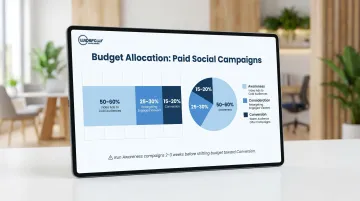
Schools often make the mistake of front-loading conversion campaigns before building enough audience data. Let awareness campaigns run for 2–3 weeks before shifting budget toward conversion.
Cost Benchmarks to Know
CPL in the fitness and martial arts category varies widely. WordStream (2024) reports a Health & Fitness CPL of $57.40 on Facebook lead campaigns, while SuperAds (2025) found Fitness & Training Centers averaged $29.70, with seasonal swings from $13.50 in April to $48.33 in July.
Track your own CPL from day one. Industry benchmarks set expectations — your actual numbers will reflect your market, creative quality, and offer strength.
Measuring and Optimizing Your Paid Social Campaigns
Key Metrics to Track
| Metric | What It Tells You |
|---|---|
| CTR | Whether the ad creative and hook are working |
| Cost Per Lead (CPL) | Overall campaign efficiency |
| Landing Page Conversion Rate | Whether the page and offer are compelling |
| Cost Per Trial Class Booked | True acquisition cost |
| ROAS | Revenue return once enrollment data is available |
A high CTR with a low conversion rate points to a landing page problem, not an ad problem. A low CTR points to the creative or audience targeting.
Meta Pixel: Non-Negotiable Setup
Without the Meta Pixel installed on your website, Meta's algorithm has no data to work with. The Pixel tracks page visits, form submissions, and trial class bookings, feeding that signal back into the delivery system to sharpen who sees your ads.
Verify the Pixel is firing correctly using Meta's Pixel Helper browser extension. Pair it with the Conversions API for more reliable tracking — browser-based attribution is eroding as privacy restrictions tighten.
A/B Testing and Creative Rotation
Test one variable at a time — ad creative, headline, offer type, or audience segment — and run each test until you have statistically meaningful data (typically 7–14 days with sufficient spend).
One hard data point on creative rotation: CTR drops 23% when ad frequency hits 4 and 50% at 5–8 exposures, with costs rising 50–80%. Refresh creative every 7–14 days for active campaigns. Meta's Ads Manager now includes a Creative Fatigue tracking feature that flags this automatically.
Diagnosing Underperforming Campaigns
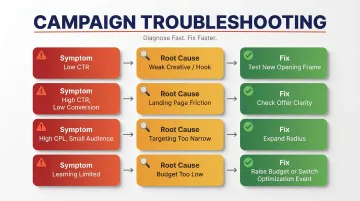
Once your Pixel and creative rotation are dialed in, the next skill is reading what's actually wrong. If a campaign runs 7–10 days without hitting CPL targets, work through these scenarios:
- Low CTR → Creative or hook needs work. Test a new opening frame or headline.
- High CTR, low conversion → Landing page problem. Check offer clarity and form friction.
- High CPL with small audience → Targeting too narrow. Expand radius or loosen demographic filters.
- Campaign stuck in Learning Limited → Budget too low to generate 50 conversions/week. Raise budget or switch to a higher-volume optimization event.
Common Paid Social Mistakes Martial Arts Schools Make
Most martial arts schools waste ad spend on the same fixable mistakes. Here are the three that hurt performance most.
Sending Traffic to the Homepage
Your homepage has navigation menus, multiple calls to action, and information about every program you offer. For someone who clicked an ad about a kids' beginner class, that's noise — and most people leave without converting.
A dedicated landing page removes all of that friction. It has one offer, one form, and nothing else to click. Dedicated landing pages convert 4–5x better than homepages for paid traffic.
Running One Ad Until It Stops Working
Creative fatigue is real and measurable. Many school owners run a single ad for months, watch performance decline, and conclude that "paid ads don't work." What actually happened: the same people saw the same ad too many times and tuned it out.
The fix is systematic: build a small library of 3–5 ad variations, rotate them every 1–2 weeks, and continuously test new creative. What works in September may not work in January.
Targeting Everyone with One Message
Running a single "Sign Up Now" campaign aimed at everyone within 20 miles — without warming audiences first or retargeting engaged prospects — produces high CPL and low conversion. Different people need different messages at different stages. A parent who's never heard of your school needs a different ad than someone who watched your intro video last week.
Segment your audiences by where they are in the decision process — cold, warm, and ready to convert — and tailor your message accordingly. That single shift typically cuts cost-per-lead in half.
Frequently Asked Questions
How do I generate leads with social media for my martial arts school?
Run targeted paid campaigns with a low-friction offer (free or discounted trial class), drive traffic to a dedicated landing page with a simple sign-up form, and follow up with retargeting ads for people who visited but didn't convert.
How much should a martial arts school spend on paid social ads?
Most local schools need $500–$1,000 per month to generate consistent leads and give the algorithm enough data to optimize. Start at a level you can sustain for at least 90 days, then scale spend based on CPL performance once you have reliable benchmarks from your own campaigns.
Which social media platform is best for martial arts school ads?
Facebook and Instagram (managed together through Meta Ads Manager) are the strongest starting point — they offer the deepest targeting options and reach 75% of adults aged 30–49. TikTok is worth testing for schools targeting teens and adults under 30, but requires a different creative approach than Meta campaigns.
How do I target the right audience for my martial arts paid ads?
Start with a geographic radius around your school (5–10 miles depending on market density). Layer on demographic filters (age, parental status) and interest signals (fitness, self-defense, martial arts), then enhance with Custom Audiences built from your website visitors and email list for retargeting.
What type of content works best in martial arts paid ads?
Short videos of real classes, student progress milestones, and instructor demonstrations consistently outperform stock imagery. Authentic content featuring actual students — not polished production shoots — builds trust and reduces the intimidation factor that keeps many beginners from taking the first step.
What's the difference between a boosted post and a paid ad campaign?
Boosting a post is a simplified promotion built from existing content with limited targeting options and basic engagement metrics. A campaign built in Meta Ads Manager gives you full control over objectives, audience targeting (including custom and lookalike audiences), creative formats, budget scheduling, and conversion tracking — everything you need for actual lead generation.