Introduction
Choosing the wrong social media management agency in 2026 can drain your budget, damage your brand reputation, and waste months of runway. The stakes are higher than most companies realize.
63.1% of companies now outsource social media work, up sharply from 46.2% the prior year. With hundreds of agencies offering overlapping services, it's increasingly difficult to distinguish a true strategic partner from a basic content vendor that simply schedules posts without tying them to measurable business outcomes.
This guide helps you evaluate agencies based on what actually drives results: strategic depth, industry experience, platform expertise, and transparent reporting. You'll learn what social media management agencies actually do, the key selection factors that separate high performers from underperformers, red flags to watch for during the vetting process, and critical questions to ask before signing a contract.
Key Takeaways
- Look for an agency that connects strategy, content, community engagement, and paid campaigns to real business outcomes—not just follower counts
- Define your objectives (brand awareness, lead generation, engagement) before evaluating any agency
- Prioritize agencies with proven industry experience, transparent reporting, and a clear strategic framework
- Watch for red flags: vague pricing, outsourced work without disclosure, no case studies, and agencies that pitch before asking about your business
- The right agency acts as a true partner: embedded in your goals, proactive with communication, and accountable for results
What Is a Social Media Management Agency?
A social media management agency is a dedicated partner that plans, creates, publishes, and optimizes a brand's social presence across platforms—going well beyond scheduling posts to include audience strategy, community building, paid amplification, and performance analysis tied to business KPIs.
The distinction between agency types matters when matching a partner to your goals:
- Full-service social media agencies provide strategy, execution, and reporting under one roof
- Point-solution vendors offer content-only or posting-only services without community management or strategic planning
- Generalist digital marketing agencies treat social as one of many channels, which can result in less platform fluency and shallower social strategy
Choosing the wrong type creates gaps that only surface months into the engagement. A content-only partner with no community management, for instance, leaves audience conversations unattended — and 73% of consumers say they will buy from a competitor when a brand fails to respond on social media.
Core Services a Social Media Management Agency Should Deliver
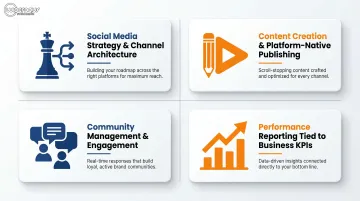
Every credible agency should cover four foundational pillars:
- Social media strategy and channel architecture – Audience segmentation, platform selection, KPI definition, and content frameworks tied to business objectives
- Content creation and platform-native publishing – Original posts, graphics, and short-form video (Reels, TikTok, YouTube Shorts) tailored to each platform's algorithm and audience
- Community management and engagement – Real-time monitoring, response handling, relationship building, and escalation of high-quality prospects to sales teams
- Performance reporting tied to business KPIs – Regular insights meetings, trend analysis, campaign optimization, and clear explanations of what's working and what's being adjusted
When any of these pillars is missing, the results tend to follow a predictable pattern. Bigeye Agency's breakdown of common agency failures points to the same recurring culprits: absent content calendars, brand voice inconsistency, missed deadlines, no strategic framework, and reactive approaches that never get ahead of the conversation.
Key Factors to Consider When Choosing a Social Media Management Agency
The "right" agency depends entirely on your goals, industry, and stage of growth. The factors below help you connect agency capabilities to your specific business outcomes.
Strategic Depth and Approach
The most critical differentiator between agencies is whether they lead with strategy or lead with content. A strong agency should produce a written strategic roadmap tied to your brand objectives, not just a content calendar.
What a strategy-first agency looks like in practice:
- Audience and channel architecture based on where your buyers actually spend time
- Defined KPIs tied to business outcomes (website traffic, lead generation, pipeline influence) rather than vanity metrics (follower counts, raw likes)
- Content plans that adapt based on performance data rather than running on autopilot
The data backs this up: dissatisfaction with strategic approach is the #1 reason clients end agency relationships—not budget cuts, which ranks only #8 among client-reported reasons. Agencies mistakenly believe budget is the top issue. Researchers call this disconnect "The Relationship Gap."
Evaluate agencies primarily on strategic capability — not just creative portfolios or the lowest price point.
Industry Experience and Proven Results
Industry-specific experience matters because agencies with relevant vertical knowledge understand your audience's behavior, buying cycle, and content preferences—shortening the learning curve and improving results from day one.
Look for case studies that demonstrate measurable outcomes in industries similar to yours:
- Impressions growth – Did reach increase among target audiences?
- Engagement rates – Did audiences interact with content?
- Lead generation – Did campaigns drive form fills, demo requests, or sales inquiries?
- Traffic increases – Did social drive qualified visitors to the website?
Engagement benchmarks vary dramatically by industry. According to Hootsuite's 2025 data, average engagement rates range from 2.7% to 3.9% on LinkedIn and 3.0% to 4.2% on Instagram depending on sector. Education leads on Instagram (4.2%) and TikTok (2.3%), while agencies themselves show low TikTok engagement (0.7%).
Any agency worth hiring benchmarks against your specific sector — not generic averages. Ask for case studies with results from brands similar to yours.
Platform Expertise and 2026 Relevance
Platform landscapes shift rapidly, and in 2026, a credible agency must demonstrate fluency in short-form video (TikTok, Reels, YouTube Shorts), the convergence of social media and search behavior, and how AI-assisted content tools are being used responsibly to scale without sacrificing authenticity.
Short-form video dominance:
- TikTok holds approximately 40% of short-form video platform market share, with YouTube Shorts and Instagram Reels each at roughly 20%
- 73% of marketers say short-form videos under two minutes are the most effective content format
Social search trends:
- 46% of Gen Z and 35% of millennials prefer social media over traditional search engines for discovery
- Nearly half of Gen Z starts product research on TikTok or Instagram
AI adoption creates new risks:
- 88% of marketers now use AI in day-to-day roles
- Over 70% have encountered AI-related incidents including hallucinations, bias, or off-brand content
- Only 15% of consumers highly trust AI influencers
These numbers set the bar. Here's what to actually evaluate when assessing an agency's platform fluency:
What to look for in platform expertise:
- Platform-native content creation (not repurposed blog posts or stock graphics)
- Understanding of algorithm behavior by platform (Instagram prioritizes Reels and reciprocal engagement; LinkedIn rewards thought leadership documents; TikTok emphasizes watch time and completion rate)
- Evidence that they adapt content formats per channel rather than cross-posting uniformly
- Disclosure of AI tool usage and demonstration of human-in-the-loop quality controls
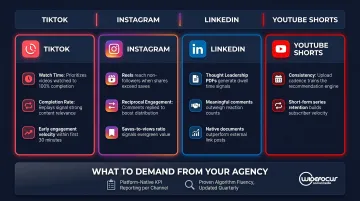
Demand that agencies show fluency across all three short-form video platforms and explain — specifically — how they maintain brand authenticity when using AI tools.
Service Scope and Full-Service Capability
Many agencies specialize in only one or two services — content creation, paid ads, or community management. Brands cobbling together multiple point-solution vendors often end up with inconsistent messaging, siloed reporting, and channels that don't reinforce each other.
Evaluate whether an agency offers end-to-end capabilities:
- Organic strategy – Content planning, posting calendars, and audience engagement
- Content production – Platform-specific posts, short-form video, graphics, and copy
- Community management – Real-time monitoring, response handling, and relationship building
- Paid social amplification – Campaigns across Facebook, Instagram, LinkedIn, TikTok, and Pinterest
- Unified reporting – Performance insights across all channels with clear trend analysis
Ask explicitly how these services are coordinated internally. Do the same strategists oversee both organic and paid? Is community management handled by the content team or a separate specialist? Siloed services create disconnects. A full-service agency like WideFoc.us, for example, coordinates strategy, content, community, and paid campaigns under one roof — so messaging stays consistent across every channel.
The coordination advantage alone is often worth the investment.
Reporting Transparency and Measurement
Vanity metrics (follower counts, raw likes) are easy to inflate and rarely reflect business impact. The right agency should measure what actually matters:
- Reach among target audiences – Not just total impressions, but impressions among your ideal customer profile
- Engagement quality – Saves, shares, and meaningful comments (stronger signals than likes)
- Website traffic from social – Click-through rates and landing page conversions
- Lead or conversion attribution – Form fills, demo requests, or sales influenced by social
What good reporting looks like:
- Regular cadence – Monthly at minimum, with structured insights meetings
- Trend analysis – Not just raw numbers, but explanations of what changed and why
- Plain-language explanations – Clear descriptions of what's working and what's being adjusted
- Willingness to tie back to business outcomes – Social performance connected to pipeline, revenue, or other company KPIs
According to Robus Marketing's 2025 analysis, the metrics that drive revenue include engagement rate (the "golden metric"), saves and shares (stronger trust signals than likes), click-through rate and website clicks, cost per lead and customer acquisition cost, and conversion rate from social traffic.
Demand monthly reporting with trend analysis and plain-language explanations — not just spreadsheets of raw numbers dropped in your inbox.
Pricing Model and Contract Terms
Common agency pricing structures include:
| Pricing Model | Best For | Pros | Cons |
|---|---|---|---|
| Monthly retainers | Ongoing strategy and management | Predictable costs, continuous optimization | Requires longer commitment |
| Project-based pricing | One-time audits, campaigns, or setups | Defined scope and budget | No ongoing optimization |
| Performance-tied models | Brands comfortable with variable costs | Aligns incentives with results | Complex attribution, variable monthly costs |
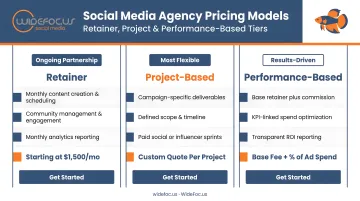
According to a 2024 survey of 100+ agency and freelance social media managers, the average monthly retainer was $2,107. However, meaningful retainers where "legitimate work happens" typically range from $1,500 to $10,000+ per month depending on scope.
Key cost drivers:
- Number of platforms managed
- Posting frequency and content complexity (especially video)
- Whether paid social/ad management is included
- Level of community management
- Reporting depth
Contract transparency checklist:
- ✅ Scope of deliverables itemized (not vague language like "social media management")
- ✅ Contract length and exit terms clear before signing
- ✅ Additional fees disclosed upfront (ad spend management, extra revisions, platform setup)
- ✅ Payment terms and invoice schedule defined
Prioritize value and transparency over the lowest price point. Vague contracts and rock-bottom pricing often signal overworked account managers or offshore execution — neither delivers the strategic results your business needs.
Red Flags and Questions to Ask Before You Sign
Common red flags to watch for during the vetting process:
- Pitching before discovery – Any agency that leads with a proposal before understanding your goals is selling a template, not a strategy
- No recent case studies or references – Agencies that can't show current results likely don't have results worth showing
- Undisclosed outsourcing – You have a right to know who's actually writing your content and managing your channels
- Suspiciously low pricing – Bargain rates typically mean overloaded account managers, offshore execution, or both
- Inactive or low-engagement social profiles on their own channels – If they can't manage their own social, how will they manage yours?
Essential questions to ask any agency before committing:
- Who will actually work on my account day-to-day? Don't settle for "we have a great team." Get names and bios of the specific strategist, content creator, and community manager assigned to you.
- How do you define and measure success for a brand like mine? Their answer should reference specific KPIs tied to your business objectives — not impressions alone or follower counts.
- What does your onboarding process look like? Look for structured discovery, defined strategy development phases, and clear timelines — not a vague "we'll get started right away."
- How do you handle it when a strategy isn't performing? The right answer includes proactive monitoring, honest communication, and a defined process for pivoting — not blame-shifting or silence.
- What are the contract exit terms? – Understand the minimum commitment, renewal process, and what happens if you need to end the relationship.
What the Sales Process Tells You
The sales process is a preview of the working relationship. Pay attention to how quickly they respond, how clearly they explain their approach, and whether they ask real questions about your business before proposing anything.
Before signing, check third-party reviews and request 2-3 client references you can call directly. Consistent feedback around communication, strategy quality, and results carries far more weight than curated testimonials on the agency's own website.
Agencies that are pushy, evasive, or unprepared during the pitch don't improve after you sign — that's just who they are. What you see in the sales process is what you get in the work.
How WideFoc.us Can Help You Build a Smarter Social Media Strategy
WideFoc.us is a full-service social media agency founded in 2007, with nearly two decades of experience helping B2B businesses, B2C brands, nonprofits, and global corporations elevate, activate, and refine their social media presence. In 2024 alone, WideFoc.us delivered over 20 million impressions and 1 million link clicks for clients across fintech, cybersecurity, auto parts, healthcare, real estate, and eCommerce.
Every engagement starts with a customized, data-informed strategy — no templated packages. Services cover:
- Content creation tailored by platform and audience
- Real-time community management
- Paid social campaigns across Facebook, Instagram, LinkedIn, TikTok, and Pinterest
- Monthly performance reporting with actionable insights
Goals drive everything, whether that's generating qualified B2B leads, driving eCommerce conversions, or establishing C-suite executives as thought leaders on LinkedIn.
WideFoc.us's core differentiators:
- Tailors B2B and B2C strategies to match audience behavior and buying cycles — from enterprise fintech to eCommerce
- Delivers measurable results: 1.2M monthly impressions for a fintech client, 15M+ impressions for a cybersecurity brand, 9x lead growth in eight weeks for a home services company
- Led by CEO Eric Elkins, whose 20+ years of marketing and communications expertise shapes every client strategy
- Provides monthly insights meetings covering organic and paid performance, platform-level data, and forward-looking recommendations
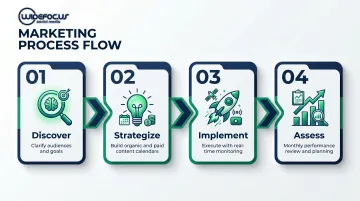
WideFoc.us follows a four-phase methodology:
- Discover — Clarify target audiences and business goals
- Strategize — Build organic posting calendars integrated with paid campaigns
- Implement — Execute consistently with real-time monitoring
- Assess — Review performance monthly and plan next steps
Based in Denver, Colorado, WideFoc.us serves clients across the United States with a focus on measurable outcomes tied to real business KPIs. To schedule a consultation, reach out at info@widefoc.us or call +1 303-219-0453.
Conclusion
The right social media management agency is one whose strategic capabilities, industry experience, and communication style match your specific growth goals — not simply the biggest name or the lowest bid. Start by defining your objectives before evaluating anyone. Then use those objectives as your filter.
When comparing agencies, prioritize:
- Proven experience in your industry or a comparable vertical
- Transparent reporting tied to metrics that matter to your business
- A clear strategic framework — not just a content calendar and monthly posts
- Honest communication about what's in-house versus outsourced
And watch for the red flags: vague pricing structures, undisclosed outsourcing, and agencies that pitch solutions before they've asked a single question about your business.
The social media landscape keeps shifting — new platforms, algorithm changes, and audience behaviors can all upend a strategy that worked six months ago. The agency relationship you build should account for that. Performance reviews, strategy adjustments, and proactive recommendations shouldn't be exceptions — they should be built into how you work together.
The agency you choose isn't just managing posts. They're shaping how your brand shows up, who it reaches, and whether that reach actually converts. Choose accordingly.
Frequently Asked Questions
How do I choose the right social media management agency?
Define your goals first (brand awareness, leads, engagement), then evaluate agencies on strategic depth, industry experience, service scope, and communication transparency. Prioritize proven results over impressive sales decks, and ask for case studies with measurable outcomes from brands similar to yours.
What is the 5-5-5 rule for social media?
The 5-5-5 rule suggests spending 5 minutes engaging with others' content before posting, 5 minutes after posting, and repeating the cycle. It's a reminder that community management—not just publishing—drives real social growth.
What is the 70/20/10 rule for social media?
The 70/20/10 rule is a content mix guideline: 70% value-driven or educational content, 20% curated content, and 10% promotional. Ask any agency candidate how they approach content balance—defaulting to promotional posts is a red flag.
What is the 3-3-3 rule in social media marketing?
The 3-3-3 rule is a posting and engagement framework—commonly: post 3 times per week, engage with 3 accounts daily, and rotate 3 content types. Definitions vary, but the principle is consistency and variety, adapted to your specific audience and goals.
How much does a social media management agency cost?
Most agencies work on monthly retainers ranging from $1,500 to $10,000+, depending on scope, platform count, and strategic depth. Unusually low pricing often signals thin account management—prioritize transparency and demonstrated value over the cheapest option.
What is the difference between a social media management agency and a general marketing agency?
A dedicated social media management agency specializes in platform strategy, content creation, community engagement, and social-specific analytics—whereas a general marketing agency treats social as one of many channels, which can result in less platform fluency and shallower social strategy.