Introduction
Platforms like Instagram, TikTok, and Facebook have become the primary discovery tools for hungry customers — and the numbers back it up. According to Grand View Research, the US online food delivery market generated $52.67 billion in 2024 and is projected to reach $93.36 billion by 2030, a 9.6% annual growth rate. That scale means fierce competition, and a strong social media presence is now a baseline requirement, not a bonus.
Yet most food delivery operators face a critical challenge: they know they should be active on social media but lack a clear, consistent strategy. This results in sporadic posts, low engagement, and missed orders. The good news: a focused strategy changes that quickly.
This guide covers everything you need to turn social media into a reliable order-driving channel: platform selection, content strategy, paid ads, influencer marketing, community management, and measurement.
TLDR
- Social media drives orders and brand trust directly — it's not just a visibility tool
- Instagram and TikTok deliver the highest visual impact; Facebook excels for local targeting and community engagement
- Use the 70/20/10 content framework to balance value, community, and promotion
- Geo-targeted ads and micro-influencer partnerships convert local, high-intent customers
- Track engagement rate, click-to-order rate, and ROAS to continuously refine your strategy
Why Social Media Is a Growth Engine for Food Delivery Services
Social media platforms function as both a discovery engine and a trust-building tool for food delivery brands. Sprout Social reports that 78% of consumers agree a brand's social media presence impacts whether they buy from that brand. Potential customers routinely check a brand's Instagram or Facebook before placing their first order, which means your social presence directly influences whether that first order ever happens.
The link between social media engagement and order volume is direct and measurable. Platforms like TikTok and Instagram can generate viral moments that lead to order spikes overnight — TikTok Kitchen launched as a delivery-only concept to capitalize on viral recipes, illustrating how content can directly convert to orders. Meanwhile, consistent posting builds a loyal repeat-customer base that drives sustainable revenue.
That revenue potential matters even more for smaller food delivery brands and ghost kitchens. A well-managed social presence can outperform deep-pocketed competitors whose feeds feel generic or neglected. Independent operators benefit most from:
- Authentic storytelling that resonates more than polished corporate content
- Hyper-local targeting that large aggregators rarely prioritize
- Community engagement that builds word-of-mouth within specific neighborhoods
- Lower-cost organic reach through consistent, platform-native content
Choosing the Right Social Media Platforms for Your Delivery Brand
Platform selection should be audience-driven, not random. Food delivery brands should research where their target customers — busy professionals, college students, families — are most active before investing time and budget. Research shows food and beverage brands on TikTok average about 3.7% engagement, significantly outperforming Instagram (about 0.3% engagement by follower base) and Facebook (0.04% engagement for food and beverage).
Instagram for Visual Impact
Instagram serves as the visual centerpiece for food delivery brands. High-quality food photography, Reels showcasing dishes being prepared or delivered, Stories for time-sensitive promotions, and a link-in-bio to direct traffic to the ordering page form the foundation of an effective Instagram strategy.
Instagram's algorithm currently favors Reels, making short video content essential. Captiv8's 2024 benchmarks show Reels achieve 2.54% engagement, compared to 1.26% for carousels and 1.03% for static images. Prioritize Reels for menu drops, limited-time offers, and behind-the-scenes content to maximize reach.
TikTok for Viral Reach and New Audiences
TikTok's organic reach outpaces nearly every other platform, making it the strongest channel for introducing your brand to younger audiences who discover restaurants through short-form video. Effective TikTok formats for food delivery include "watch me eat" hauls, packing and prep behind-the-scenes, and trending sound pairings with food visuals.
TikTok's organic reach remains far higher than most platforms for new accounts, making it ideal for discovery. Food and beverage brands on TikTok post about twice per week on average, a cadence that delivers solid engagement when content quality is consistent.
Facebook for Community and Paid Targeting
Facebook works best for community-building through local groups, reviews, and event promotions. More critically, it offers the most precise paid advertising tool for food delivery — with geographic, demographic, and interest-based targeting that other platforms can't match.
Use Facebook Ads to serve offers exclusively to users within your delivery radius — a level of geographic precision that makes it essential for local marketing despite its lower organic engagement.
Beyond the big three, a few secondary platforms are worth considering based on your content mix:
- Pinterest: Strong for recipe inspiration and meal kit promotions
- YouTube: Well-suited for longer cooking content and brand storytelling
- LinkedIn / X (Twitter): Low priority unless your brand targets corporate lunch orders or media partnerships
Building a Winning Content Strategy for Food Delivery
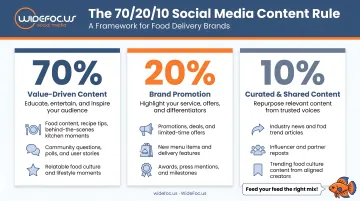
The 70/20/10 content rule gives food delivery brands a practical framework for what to post — and how often. Over-promoting kills engagement; this split keeps audiences interested without burning them out:
- 70% value-driven content: food visuals, behind-the-scenes prep, customer stories
- 20% interactive or shared content: UGC reposts, polls, Q&As
- 10% direct promotions: discount codes, limited-time offers
Visual Content Excellence
High-quality visual content drives performance on food delivery social media. Professional or well-lit smartphone food photography, short Reels and TikToks of dishes in motion (steam rising, sauce drizzling, packaging being sealed) consistently outperform static images.
Practical visual content tips:
- Use natural lighting whenever possible
- Shoot from overhead angles for full dish visibility
- Keep backgrounds clean and uncluttered
- Maintain brand color consistency across all visuals
- Show movement and texture through video
Strong visuals lay the groundwork, but they work best when real customers amplify them — which is where a UGC strategy pays off.
User-Generated Content Strategy
User-generated content typically performs better than brand-created content in terms of trust and authenticity. BrightLocal's 2024 research shows 88% of consumers would use a business that responds to reviews, highlighting the power of customer voices.
Build your UGC strategy:
- Encourage customers to post orders using a branded hashtag
- Reshare customer content to build social proof
- Run simple photo contests to incentivize participation
- Feature loyal customers in your content
- Always credit and thank customers when reposting
Content Timing and Cadence
Post when your audience is hungry and ordering. Sprout Social data shows Instagram engagement peaks Tuesday 1-7 p.m. and Wednesday 12-9 p.m., aligning with pre-lunch and pre-dinner decision windows. TikTok engagement concentrates Tuesday through Friday afternoons.
Recommended posting frequency for food delivery brands:
- TikTok: 2-4 posts per week
- Instagram: 3-5 posts per week (Reels-heavy)
- Facebook: 2-4 posts per week
Consistency and quality matter more than volume. A well-timed, visually compelling post three times a week will outperform daily filler that blends into the feed.
Seasonal and Event-Based Content
Seasonal and event-based content drives urgency and orders. Game day specials, holiday bundles, National Pizza Day posts, and weather-triggered promotions ("Rainy day? Stay in — we deliver") create timely relevance that converts.
Build a content calendar tied to key food moments throughout the year: major sporting events, holidays, food-specific national days, and local events. Planning ahead ensures you're ready when purchase intent is already high — not scrambling to react after the moment passes.
Driving Orders with Paid Social and Influencer Partnerships
Geo-targeted paid social ads let you serve ads exclusively to users within your delivery radius — which means every dollar reaches someone who can actually place an order. Set up delivery zone-specific campaigns in Facebook and Instagram Ads Manager using radius targeting around your locations or ghost kitchen addresses.
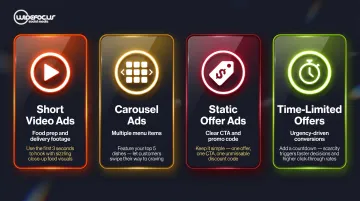
Once your targeting is configured, the format of each ad determines whether a hungry scroller stops to order. The best-performing options:
- Short video ads showing food preparation and delivery
- Carousel ads featuring multiple menu items
- Static offer ads with clear CTAs and promo codes
- Time-limited offers that create urgency
Retargeting Strategies
Retargeting brings back warm audiences at lower cost per acquisition than cold campaigns. Serve ads to users who have previously visited your ordering page, interacted with a post, or abandoned a cart. Build retargeting audiences from your website pixel data and social media engagement.
A well-structured retargeting funnel recovers lost orders by reminding interested customers to complete their purchase. Pair those ads with a limited-time incentive and conversion rates climb further.
Choosing the Right Food Influencers
Paid ads handle scale — influencers handle trust. Prioritize local micro-influencers (5,000–100,000 followers) with highly engaged, geographically relevant audiences over macro-influencers with diffuse national reach. Micro-influencers deliver higher engagement rates and more authentic content at a fraction of the cost.
What to look for in influencer partnerships:
- Authentic food content and genuine audience engagement
- Local geographic relevance to your delivery area
- Engagement rate above 3% (not just follower count)
- Audience demographics matching your target customer
- Clear disclosure and professional communication
Effective Influencer Campaign Formats
Structure influencer campaigns around formats that naturally showcase your delivery service: unboxing and delivery reveal videos, "ordering from [brand]" TikToks, honest taste-test reviews, and exclusive promo codes tracked per influencer to measure ROI.
All paid partnerships must comply with FTC guidelines. The FTC requires clear disclosure of any material connection using labels like "ad," "advertisement," or "sponsored." For video content, place disclosures inside the video with both audio and visual cues.
Community Management and Customer Service on Social Media
Social media has become a primary customer service channel for food delivery brands. Customers post complaints, order issues, and praise publicly and expect fast responses. Sprout Social reports nearly 75% of customers want a brand response within 24 hours or less, setting clear expectations for response time.
Handling Negative Reviews Publicly
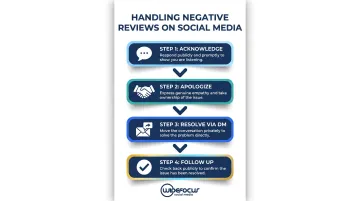
A framework for managing complaints publicly can protect your reputation and build trust. Follow these four steps consistently:
- Acknowledge the issue promptly
- Apologize without deflecting blame
- Offer to resolve it via DM or direct contact
- Follow up once the issue is closed
How you respond matters as much as the response itself — others are watching. BrightLocal found that 88% would use a business that responds to both positive and negative reviews versus only 47% if it does not respond, a gap that makes response strategy one of the highest-ROI habits you can build.
Building a Loyal Community
Build community beyond complaint management through interactive content. Tactics that consistently drive engagement include:
- Running polls on new menu items or delivery windows
- Asking "what should we add next?" to invite direct input
- Spotlighting loyal customers with shoutouts or UGC features
- Maintaining a consistent brand voice followers recognize and enjoy
Brands that engage this way see measurable payoffs: higher repeat order rates, stronger follower retention, and organic referrals from customers who feel like insiders, not just recipients of a delivery.
Measuring What Matters: Analytics and Optimization
The KPIs most relevant to food delivery brands include engagement rate, reach and impressions, link clicks to ordering pages, cost per click for paid campaigns, and return on ad spend. Vanity metrics like follower count matter less than conversion-focused metrics that directly tie to orders and revenue.
Priority metrics by campaign type:
| Metric | Organic Content | Paid Campaigns |
|---|---|---|
| Engagement rate | Track weekly | Track by ad set |
| Link clicks | Monthly total | Cost per click |
| Reach/impressions | Trend over time | CPM |
| Conversion rate | N/A | ROAS |
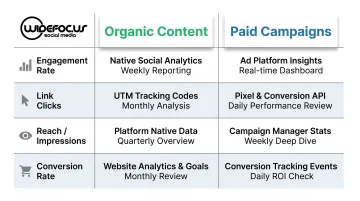
Once you know which metrics matter, the next step is tracking them consistently. Use native platform analytics (Instagram Insights, TikTok Analytics, Facebook Ads Manager) plus third-party tools to monitor performance, identify top-performing content, and understand peak audience activity times. Stick to a regular review cadence: weekly for paid campaigns, monthly for organic strategy.
For brands that want to move faster, working with an agency that specializes in social analytics can shorten the learning curve. WideFoc.us, for example, has driven over 20 million impressions and 1 million link clicks for clients by combining consistent A/B testing on creative and copy with ongoing strategy refinement tied to actual order data.
Frequently Asked Questions
What is the 70/20/10 rule in social media?
The 70/20/10 rule divides content into 70% valuable and engaging posts (food visuals, stories, education), 20% shared or interactive content (UGC, polls, questions), and 10% direct promotional posts (discounts, offers). This balance keeps audiences engaged rather than feeling constantly sold to.
What are the 4 P's of food marketing?
The 4 P's — Product, Price, Place, and Promotion — apply to food delivery social media by highlighting food quality (Product), communicating value and deals (Price), promoting delivery availability and radius (Place), and using the right channels to reach target audiences (Promotion).
Which social media platform is best for food delivery services?
Instagram and TikTok work best for visual discovery and organic reach, while Facebook excels for community-building and geo-targeted paid advertising. The ideal approach combines all three platforms, with strategies tailored to each platform's strengths and audience.
How often should a food delivery service post on social media?
Post 3-5 times per week on Instagram (Reels-focused), 2-4 times per week on TikTok, and 2-4 times per week on Facebook. Quality matters more than volume — consistent, well-crafted posts outperform daily filler every time.
How do you handle negative reviews on social media for a food delivery service?
Respond quickly and publicly with empathy, acknowledge the specific issue, and offer to resolve it privately via DM. Following up once resolved shows accountability — and turns a visible complaint into a trust-building moment for everyone watching.
What type of content performs best for food delivery brands on social media?
Short-form video — Instagram Reels and TikToks — featuring food visuals, behind-the-scenes prep, and authentic customer reactions outperform static images. User-generated content typically earns the highest trust and engagement, making customer posts and testimonials your strongest lever for driving orders.