The stakes are high: a poor hire burns budget with zero ROI, while the right consultant increases brand visibility, boosts social commerce conversions, and builds a base of repeat customers. According to eMarketer research, US social commerce sales reached $87.02 billion in 2025, up 21.5% year-over-year, with nearly 48% of US social network users now social buyers. This massive addressable audience makes hiring specialized expertise a strategic investment, not an expense.
This guide covers what an ecommerce social media consultant does, when to hire one, how to evaluate candidates, and what to prioritize specifically for product-based businesses.
Key Takeaways
- An ecommerce social media consultant manages strategy, content, community, and paid campaigns tailored to product-based businesses
- Look for ecommerce experience, platform expertise (Instagram Shopping, TikTok Shop), strong content skills, and clear pricing
- Hire when social sales stagnate, you lack platform strategy, or in-house bandwidth is maxed out
- Choose freelancers for focused, affordable support or agencies for end-to-end execution across multiple platforms
- Before hiring, define your goals, set a budget, and document your current social performance
What Does an Ecommerce Social Media Consultant Do?
An ecommerce social media consultant develops and executes strategies specifically for product-based businesses — driving brand awareness, engagement, and online sales in tandem.
Unlike general social media consultants who manage corporate or service-based accounts, ecommerce specialists understand product launches, seasonal campaigns, shopping platform integrations, and conversion-focused content.
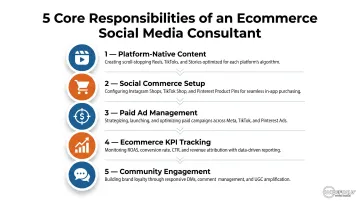
Core responsibilities include:
- Creates platform-native content — Reels, TikToks, Pinterest boards, and Stories optimized for each platform's discovery algorithm
- Sets up and optimizes social commerce features: product tags, shoppable posts, Instagram Shopping, TikTok Shop storefronts, and Pinterest Product Pins
- Launches and manages paid social ads aligned to product drops, seasonal promotions, and inventory cycles
- Tracks ecommerce KPIs — ROAS, cost per purchase, social-attributed revenue, and conversion rates — not vanity metrics
- Responds to product questions, reviews, and post-purchase comments to support retention
Consultant vs. Manager: What's the Difference?
A social media consultant is typically external and strategic, often project-based. They diagnose problems, build strategies, and recommend tactics but may not execute daily posting. A social media manager is usually in-house, handling day-to-day content creation, scheduling, and community engagement.
Early-stage ecommerce brands often start with a consultant to establish strategy, then hire a manager for execution. As the business grows, many brands run both in parallel — a consultant for quarterly planning and a manager for day-to-day implementation.
Signs It's Time to Hire an Ecommerce Social Media Consultant
Stagnant or Declining Social-Attributed Sales
If your follower count is growing but conversions aren't, your current approach needs a strategic overhaul. Triple Whale's analysis of 35,000 ecommerce brands found that Meta platforms delivered an overall ROAS of just 1.86 in 2025, up only 1.29% from 2024, while CPMs rose 20% year-over-year.
If your paid social ROAS hovers near or below 1.86x, or your organic posts generate engagement but no purchases, you're underperforming industry benchmarks. A specialist can diagnose targeting issues, creative fatigue, or funnel gaps that in-house generalists miss.
No Clear Platform Strategy
These warning signs point to a strategy gap:
- Posting inconsistently without a content calendar
- Using the same content across Instagram, TikTok, and Pinterest without platform-specific adaptation
- No alignment between social activity and product launches or seasonal promotions
- Ignoring social commerce tools like Instagram Shopping or TikTok Shop
In-House Bandwidth Is Maxed Out
Small business owners spend an average of 3-10 hours per week managing social media, with content creation alone consuming 40-50% of that time. At a founder's hourly value of $75-$100, that's $4,500-$6,000/month in opportunity cost — before accounting for underperforming campaigns.
When social media competes with every other priority on your plate, execution suffers. A dedicated consultant brings focused attention that a stretched in-house team simply can't match.
What to Look for When Hiring an Ecommerce Social Media Consultant
Not all social media consultants are built for ecommerce. The following factors help narrow the field and match the right hire to your specific needs.
Ecommerce-Specific Industry Experience
Ask whether the consultant has worked with product-based businesses in your category — fashion, home goods, CPG, beauty, supplements. Ecommerce social media has distinct demands: seasonal campaign planning, inventory-tied promotions, and fluency with shopping platforms.
Request case studies or performance data:
Look for metrics like social-attributed revenue, ROAS on paid campaigns, or follower-to-customer conversion rates. Avoid consultants who only share impressions or follower growth without tying activity to sales.
Platform Knowledge and Social Commerce Fluency
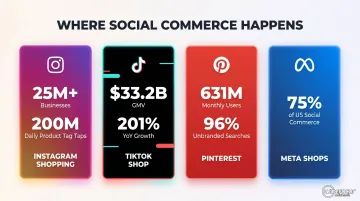
Social commerce now represents nearly 7% of total US retail ecommerce, projected to reach 9.3% by 2029 (eMarketer, December 2025). The four major platforms drive this growth:
- Instagram Shopping: 25M+ businesses use shoppable features, with 200M daily product tag taps
- TikTok Shop: Reached $33.2 billion in global GMV in 2024 (201% YoY growth) with 500K+ US merchants
- Pinterest: 631M monthly active users, with 96% of top searches unbranded — ideal for discovery
- Meta Shops: Dominates the remaining 75% of US social commerce outside TikTok Shop
A consultant unfamiliar with these platforms will miss the moments where purchase decisions get made.
Ask platform-specific questions during vetting:
- How would they approach a TikTok content strategy for a product launch?
- How do they optimize a Pinterest catalog for seasonal traffic?
- What's their experience setting up Instagram Shopping product tags?
Their answers reveal whether they know these platforms firsthand — not just in theory.
Content Creation Capabilities
Understand whether the consultant creates content (copy, visuals, video) or only directs it. Ecommerce brands need high-volume, platform-native content that reflects product quality and brand identity.
Look for consultants experienced with:
- Unboxing videos and product demos
- UGC integration and creator partnerships
- Lifestyle photography briefs
- Shoppable video (Instagram Reels, TikTok, YouTube Shorts)
Research from Bazaarvoice shows that featuring UGC increases revenue per visitor by 154%, and ads with UGC achieve 4x higher click-through rates. Consultants who can build and manage UGC programs deliver measurable conversion gains.
Analytics, Reporting, and KPI Alignment
Confirm the consultant tracks ecommerce-specific KPIs tied to the buyer journey:
- Click-through rate to product pages
- Add-to-cart events from social
- Cost per acquisition (CPA)
- Revenue attributed to social channels
- Return on ad spend (ROAS)
Ask how they measure success and what reporting cadence they follow. A qualified consultant should explain how their work connects to your bottom line, not just follower counts. They should be comfortable with UTM parameters, platform pixels (Meta Pixel, TikTok Pixel), and Google Analytics 4 for multi-touch attribution.
Transparent Pricing and Contract Terms
Pricing varies widely based on experience, scope, and whether you hire a freelancer or agency:
| Provider Type | Hourly Rate | Monthly Retainer |
|---|---|---|
| Freelancer | $25-$150/hr | $500-$2,500 |
| Boutique Agency | $50-$190/hr | $2,500-$7,500 |
| Full-Service Agency | $75-$300+/hr | $5,000-$40,000+ |
Source: Clutch (May 2026), Sprout Social (April 2026), SocialSellinator (2025)
Review these contract terms carefully:
- Minimum engagement lengths (common: 90 days to allow optimization cycles)
- What deliverables are included (content creation, community management, reporting)
- Whether paid ad spend is separate from the management fee (it should be)
- What happens if KPIs are not met (adjustment clauses, exit terms)
Communication Style and Strategic Fit
The best consultant understands your brand voice, asks informed questions about your product and customer, and communicates results clearly. During the initial discovery call, evaluate whether they ask about:
- Your sales funnel and customer journey
- Your target audience and buyer personas
- Your current analytics and attribution setup
- Your seasonal sales calendar and inventory cycles
Red flags include overpromising results ("We'll 10x your sales in 30 days") and refusing to set realistic benchmarks. Any consultant who jumps straight to pitching a package without asking about your business isn't worth your time.
Freelancer vs. Agency: Choosing the Right Fit for Your Ecommerce Brand
Key Trade-offs
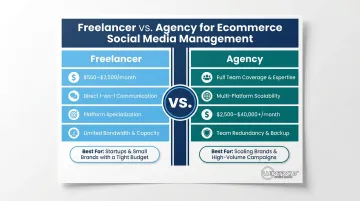
Freelance consultants offer:
- Lower cost ($500-$2,500/month)
- Direct relationship and communication
- Deep specialization in one or two platforms
But they have limited bandwidth and may lack cross-functional skills (e.g., a content specialist who can't run paid ads).
Agencies provide:
- Full teams (strategist, designer, copywriter, paid ads specialist)
- Multi-platform capability and scalability
- Team redundancy (no gaps if one person is unavailable)
But they require higher investment ($2,500-$40,000+/month) and typically enforce longer contracts (3-6 month minimums).
These trade-offs point to a straightforward question: what does your ecommerce brand actually need right now? The framework below makes that call easier.
Practical Decision Framework
Choose a freelancer if:
- You're an early-stage or bootstrapped brand
- You need organic strategy for 1-2 platforms
- Your budget is under $3,000/month
- You have internal resources to handle some execution
Choose an agency if:
- You're scaling with multi-platform needs
- You're running paid ad campaigns across Meta, TikTok, and Pinterest
- You need end-to-end execution (strategy + content + ads + community management)
- You've outgrown freelance support and need consistent, reliable delivery
For ecommerce brands that need end-to-end execution, WideFoc.us offers integrated social media plans covering content creation, community management, and paid campaigns — built specifically for B2C product brands and larger ecommerce operations.
How WideFoc.us Helps Ecommerce Brands Win on Social Media
WideFoc.us is a full-service social media agency founded in 2007 with over 19 years of experience building tailored strategies for B2B and B2C brands. Every engagement starts with a data-informed strategy built around each client's specific audience, platform mix, and seasonal patterns.
Services relevant to ecommerce brands include:
- Platform-specific posts, product-focused video, UGC integration, and lifestyle photography
- Real-time community monitoring tied to product questions, reviews, and customer service
- Conversion-optimized paid ads across Meta, Pinterest, and TikTok with advanced audience targeting and retargeting
- Monthly performance reporting tied to measurable outcomes, not vanity metrics
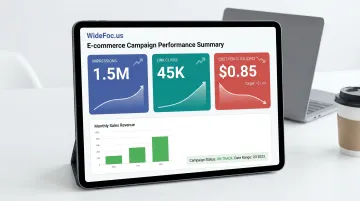
Those services translate directly into results. In 2024, WideFoc.us delivered over 20 million impressions and 1 million link clicks across its client portfolio. For one ecommerce supplement brand, the agency generated over 1 million impressions in the first month, driving 4,030 link clicks at just $0.45 cost-per-click using custom audiences built from consumer purchasing data.
Because WideFoc.us handles both strategy and execution in-house, ecommerce clients work with a single integrated team — no juggling multiple vendors, no gaps between planning and delivery.
Conclusion
The right ecommerce social media consultant brings more than follower counts and content calendars. What matters is finding a partner whose ecommerce experience, platform knowledge, and reporting practices genuinely align with your business goals.
Start by defining your goals and current performance gaps, then use the factors in this guide to evaluate candidates. Social media strategy for ecommerce is an iterative process — one that needs regular refinement as your product catalog, audience, and platforms shift.
With US social commerce projected to exceed $100 billion in 2026 — and platforms like TikTok Shop growing 201% year-over-year — the window to build a competitive social commerce presence is open now. Finding the right consultant sooner means compounding that advantage longer.
Frequently Asked Questions
How much does it cost to hire a social media consultant?
Costs range from $500-$2,500/month for freelancers to $5,000-$40,000+/month for full-service agencies. Hourly rates run $25-$150/hr for freelancers and $75-$300+/hr for agencies. Cost depends on platform count, content format complexity (video costs more), and whether paid ad management is included.
What does an ecommerce consultant do?
An ecommerce social media consultant develops platform strategies, manages shoppable content and social commerce features (Instagram Shopping, TikTok Shop), runs paid campaigns, and tracks KPIs tied to online sales like ROAS and social-attributed revenue. Unlike generic social media consultants, they specialize in product launches, seasonal promotions, and conversion optimization for product-based businesses.
What is the difference between a social media consultant and a social media manager?
A consultant is typically external and project-based, providing strategy frameworks and recommendations. A manager is usually in-house, handling day-to-day execution like content creation, scheduling, and community engagement. Early-stage ecommerce brands often start with a consultant to build strategy, then hire a manager for implementation. Scaling brands may need both roles working together.
What platforms should an ecommerce social media consultant focus on?
Prioritize Instagram, TikTok, Pinterest, and Facebook based on where your target audience shops and discovers products. Instagram Shopping and Meta Shops dominate social commerce, TikTok Shop grew 201% in 2024, and Pinterest drives unbranded discovery with 631M monthly users. The right platform depends on your product category, audience demographics, and where similar brands already convert.
How do I measure the ROI of a social media consultant for my ecommerce store?
Track ecommerce-specific metrics: social-attributed revenue (via UTM parameters and platform pixels), ROAS on paid campaigns, cost per acquisition, click-through rates to product pages, and average order value from social traffic. Use Google Analytics 4 and platform dashboards (Meta Business Suite, TikTok Analytics) to monitor which channels drive conversions — not just follower growth or impressions.