Introduction
The message of the gospel hasn't changed in two thousand years. The places where people gather have.
Church communicators today face a real tension: the mission is eternal, but the platforms shaping daily attention are algorithm-driven, constantly shifting, and not designed with ministry in mind. For churches, social media is less a marketing channel and more a modern extension of the Great Commission.
The numbers make ignoring it difficult to justify. As of early 2025, over 94% of all internet users worldwide are active on at least one social media platform, and the average person spends nearly 2.5 hours per day scrolling, watching, and engaging. That's time the church can either show up in, or leave to other voices entirely.
This guide covers what churches actually need to build a sustainable digital presence: a biblical foundation for social media use, how to choose the right platforms, a sermon-based content strategy, community-building tactics, and how to measure what actually matters.
Key Takeaways
- Social media is a natural extension of the Great Commission: same mission, adapted methods
- Focus on 2 platforms max; Facebook and YouTube reach the widest church audiences
- One sermon can generate 5–7 pieces of content across an entire week
- Consistency (3–4 posts/week) outperforms daily posting that exhausts volunteers
- Measure saves, shares, DMs, and first-time visit attribution — not just follower counts
The Biblical Case for Church Social Media Outreach
The Mission Is the Same. The Gathering Place Has Shifted.
Matthew 28:19-20 doesn't specify a location. "Go and make disciples of all nations" is a directional command, not a venue requirement. The early church in Acts 2 didn't build a building and wait for people to walk in — they went where people gathered: temple courts, marketplaces, households.
Today, people gather on Facebook, Instagram, and YouTube. Billions of them, every day — and that doesn't mean churches should chase every trend or perform for an algorithm. It means the instinct that drove Paul to the Areopagus — meeting people where they already are — is exactly the instinct that should drive a church's digital presence.
The Real Challenge: Organic Reach Is Shrinking
Understanding the platform landscape honestly matters. Facebook Page posts now reach an average of just 1.37% of followers organically — meaning if your church has 1,000 followers, roughly 14 people see any given post without paid promotion. The trend is consistent across platforms and has declined sharply over the past decade.
Faith-based content also competes in a crowded, values-conflicted environment. Algorithms prioritize content that generates immediate reaction, which isn't always where thoughtful, substantive ministry content lands.
Why This Sharpens Strategy, Not Discourages It
Knowing the constraints is clarifying, not defeating. Churches that show up consistently, respond to people genuinely, and create content worth saving and sharing can still reach well beyond their walls. The limitations just reframe the goal:
- Show up with purpose, not just frequency
- Prioritize content people want to share over content that simply fills a schedule
- Treat engagement as ministry, not metrics
That's a healthier approach to digital presence — and a more sustainable one.
Build a Social Media Strategy Grounded in Your Mission
Most churches start posting before they've answered the questions that make posting worthwhile.
Before choosing a platform, posting schedule, or graphic template, church leaders need to answer three questions:
- Who are we trying to reach? Members, occasional visitors, spiritual seekers, the broader neighborhood?
- What do we want them to do? Watch a sermon, visit in person, join a small group, find community?
- What value will our content provide? Beyond announcements — what does someone gain by following us?
These questions prevent the most common church social media failure: posting just to post.
Content Pillars: A Framework for a Balanced Feed
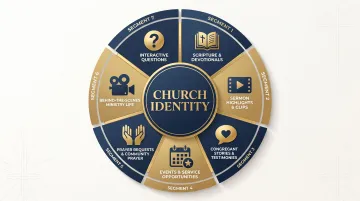
Content pillars are recurring categories that give your feed structure and reflect the full life of the church. A rotating system of 5–7 categories removes the daily guesswork of "what should we post today?" and ensures the church's identity comes through over time.
Strong content pillars for churches might include:
- Scripture and devotionals
- Sermon highlights and clips
- Congregant stories and testimonies
- Events and service opportunities
- Prayer requests and community prayer
- Behind-the-scenes ministry life
- Questions that invite interaction
Consistency Over Frequency
For most churches — especially those relying on volunteers — 3–4 posts per week on 1–2 platforms is both sustainable and effective. Committing to a realistic cadence beats an ambitious one you can't maintain.
Build a simple content calendar aligned to your sermon series, the liturgical calendar, and key community moments. The calendar doesn't need to be elaborate; a shared spreadsheet or free scheduling tool does the job.
Every Post Needs a Next Step
Social media functions best as the top of a discipleship funnel, not a destination. Every post should invite the audience somewhere:
- Watch the full sermon (link in bio)
- DM us your prayer request
- Sign up for the small group starting this week
- Visit us this Sunday
Without a clear next step, even great content becomes a dead end.
Building this kind of system from scratch takes time churches often don't have. Agencies like WideFoc.us specialize in developing customized social media strategies for nonprofits and mission-driven organizations — particularly those without dedicated staff to manage it in-house.
Which Platforms Should Your Church Prioritize?
One clear principle: don't try to be everywhere. A church with limited volunteers should focus on 2 platforms maximum and do them well. Choose based on where your audience already spends time and what content you can realistically produce.
Facebook and YouTube — The Reach and Depth Platforms
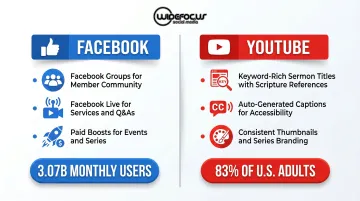
Facebook remains the most widely used social platform globally, with 3.07 billion monthly active users. Among U.S. adults, 75% of those aged 30–49 and 69% of those aged 50–64 use Facebook — which maps closely to the core demographic of most congregations.
Key Facebook strategies for churches:
- Facebook Groups (not just Pages) for member community — group posts reach a higher percentage of members than page posts reach followers
- Facebook Live for services, Q&As, and informal pastoral conversations
- Paid post boosts for events and sermon series to overcome organic reach limits
YouTube is the most powerful platform for long-term sermon discoverability. It functions as a search engine — 83% of U.S. adults use it — and people actively search for messages on specific Scripture passages or life topics. A sermon titled "Finding Peace in Anxiety — Philippians 4:6-7" will be found by someone who needs it months or years after it's posted.
Best practices for church YouTube:
- Keyword-rich titles with Scripture references
- Auto-generated captions enabled (accessibility and searchability)
- Consistent thumbnails and series branding
Instagram and TikTok — The Visual and Next-Generation Platforms
Instagram is the primary platform for reaching 18–40-year-olds. Among U.S. adults aged 18–29, 78% use Instagram, and the 18–34 cohort makes up roughly 63% of its global user base.
The highest-leverage content type on Instagram is Reels. Buffer's analysis found that Reels generate 36% more reach than other post types, with approximately 55% of Reels views coming from non-followers. That reach beyond your existing congregation is exactly what outreach-focused content should accomplish.
TikTok serves a distinct purpose: reaching teens and young adults who rarely scroll Facebook or YouTube. Approximately 66% of U.S. TikTok users are under 35, and 62% of adults aged 18–29 are active on the platform. Churches starting out don't need a separate content workflow to get there:
- Repurpose existing Instagram Reels directly to TikTok
- Keep videos under 60 seconds for stronger completion rates
- Use worship clips, short devotionals, or behind-the-scenes footage rather than full sermons
Transform Sunday Sermons Into a Full Week of Engaging Content
A single sermon is not a Sunday event — it's a week's worth of content waiting to be used.
This is the most practical efficiency available to any church communicator. One message already contains quotes, questions, Scripture, stories, and practical applications. The work of extracting them takes far less effort than creating content from scratch.
A Weekly Content Framework from One Sermon
| Day | Content Type | Purpose |
|---|---|---|
| Saturday | Teaser question or story | Build anticipation |
| Sunday | Key quote graphic or short clip | Capture the moment |
| Monday | Full sermon clip or devotional | Extend reach post-service |
| Wednesday | Scripture deep-dive or reflection question | Prompt community dialogue |
| Friday | Prayer or encouragement post | Connect the theme to daily life |
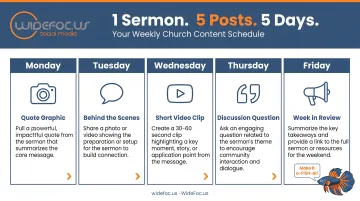
Five posts, one source, with minimal extra production work.
Video First
Short video clips — 60 to 90 seconds, formatted vertically for Reels and TikTok — outperform static graphics across most major platforms. Designate one person each Sunday to capture usable footage. It doesn't require professional equipment; a steady phone shot with decent audio is enough to start.
Storytelling Over Announcements
A bare announcement — "Join us Sunday at 10am" — tells people when to show up but gives them no reason to. A post that hints at what the message actually addresses, and why it matters to someone's real life, creates the curiosity an announcement never can. The goal isn't to promote attendance; it's to surface relevance.
Personal testimonies and real congregant stories — shared with permission — tend to generate more comments and shares than any other content type. They demonstrate that the church is made of real people navigating real life.
Platform-Native Content
Repurposing doesn't mean copy-pasting the same caption everywhere. Each platform expects a different voice:
- Instagram: visual-first, concise caption, strong opening line
- YouTube: keyword-rich title, timestamped description, searchable tags
- Facebook Group: conversational prompt designed to invite replies
- TikTok: hook in the first two seconds, no assumption of prior context
Adapting the presentation for each platform isn't extra work — it's what determines whether the content actually reaches people where they already are.
Engage, Don't Just Broadcast: Building Real Community Online
Most church social media accounts default to broadcasting — pushing content out without creating space for real interaction. The result is a feed that looks active but feels hollow. Building community means designing for participation, not just consumption.
Two-Way Interaction Drives Both Community and Reach
Buffer's analysis of nearly 2 million social media posts found that replying to comments boosts engagement by 5–42% across major platforms. The algorithmic reason is straightforward: platforms interpret replies as signals that content is worth surfacing to more people.
The pastoral reason matters more: people stay where they feel seen.
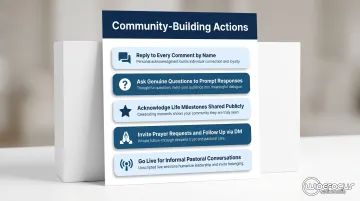
Practical community-building actions:
- Respond to every comment, by name where possible
- Ask genuine questions — "What verse has carried you through a hard week?"
- Acknowledge life milestones shared in comments publicly
- Invite prayer requests and follow up via DM
- Go live occasionally for informal pastoral conversations
Leverage Your Congregation as Storytellers
Invite members to post photos, share testimonies, or use a church hashtag during events — then reshare that content with permission. Member-generated posts carry weight that polished staff content simply can't replicate.
This approach does several things at once:
- Demonstrates that the church is made of real people, not a marketing department
- Reduces the content creation burden on staff and volunteers
- Creates authentic social proof for people considering visiting
When members see themselves represented, they engage. When seekers see genuine community, they're more likely to show up.
Measuring What Matters: Social Media Metrics for Churches
Follower count is not a ministry metric. Neither are total likes.
A church's social media goal isn't to go viral — it's to deepen relationships and extend reach to people searching for community and faith. The numbers worth tracking should reflect that.
Metrics That Actually Matter
| Metric | Why It Matters |
|---|---|
| Saves | Content valuable enough to return to |
| Shares | Content worth passing to someone else |
| DMs and substantive comments | Real conversations started |
| Link clicks | People moving from social to deeper engagement |
| First-time visit attribution | "I found you on Instagram" — the ultimate outcome |
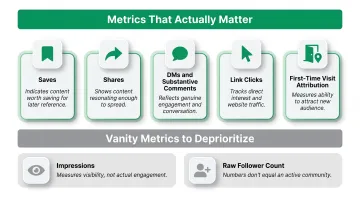
Vanity metrics — impressions, raw follower growth — measure visibility. The metrics above measure whether anyone's actually connecting with your church. Those are very different goals.
A Simple Monthly Review Practice
Once a month, spend 30 minutes asking:
- Which content types drove the most meaningful engagement?
- What topics sparked actual conversation?
- Did anyone mention social media when they visited for the first time?
- What should we do more of next month?
Data should inform strategy, not replace pastoral discernment about what your congregation actually needs. Let the numbers surface patterns — then decide with your team what those patterns mean for ministry.
Frequently Asked Questions
Which social media platform is best for churches?
The best platform depends on your congregation's demographics and what you can realistically produce. Facebook suits community engagement, YouTube builds long-term sermon discoverability, and Instagram is the stronger choice for reaching adults under 40.
How often should a church post on social media?
Consistency matters more than frequency. Three to four posts per week on one or two platforms is a sustainable and effective starting point for most churches, particularly those relying on volunteers rather than dedicated staff.
What type of content performs best for church social media?
Short video — Reels and sermon clips — personal testimonies, and interactive questions consistently outperform static graphics and event announcements across every major platform. Content that invites a response drives measurably more engagement than content that only announces.
How can a small church with limited volunteers manage social media consistently?
The sermon-repurposing framework is your best tool — one sermon generates five or more posts across the week. Pair that with a rotating content calendar and two to three volunteers each owning a single role (photography, copywriting, or scheduling) and consistency becomes manageable.
Should churches use paid social media advertising?
Even a modest budget — $15 to $20 per boosted post — can noticeably extend your reach beyond the roughly 1–2% organic reach that Facebook Pages currently average. Paid promotion works best for events, sermon series launches, and outreach campaigns targeting people not yet connected with the church.
How does a church know if its social media is actually working?
Track saves, shares, DMs, link clicks, and whether first-time visitors mention finding the church on social media. Those metrics reflect actual relationship-building. Follower counts and total likes tell you about visibility, not impact.