Introduction
Homeowners don't buy solar on impulse — they research, compare, and need to trust you before committing. The average solar buying cycle stretches across months, requiring multiple educational touchpoints before a homeowner requests a quote. This creates a unique challenge for solar companies: how do you stay visible and build trust throughout a lengthy, high-consideration purchase process?
Social media bridges that trust gap more effectively than most channels. Unlike traditional advertising, social platforms let you nurture prospects consistently, address objections as they arise, and demonstrate credibility through customer stories and educational content.
This guide covers what solar companies need to build a social media presence that actually converts:
- Which platforms to prioritize for residential and commercial audiences
- A content strategy that educates first and sells second
- Lead generation tactics built for the solar buying cycle
- Paid advertising best practices for solar campaigns
- How to measure performance and refine over time
Key Takeaways
- Social media builds trust throughout the multi-month solar buyer journey — keeping you visible while homeowners decide
- Focus on Facebook and Instagram for residential homeowners, LinkedIn for B2B/commercial solar, and YouTube for long-form education
- Educational content (80%) outperforms promotional content (20%) in the solar space — trust first, sell second
- Combine organic community-building with paid ads to expand reach and capture qualified leads
- Consistent posting, engagement, and performance tracking separate high-performing solar brands from the rest
Why Solar Companies Can't Afford to Ignore Social Media
Solar is a high-cost, high-consideration purchase with a decision timeline measured in months, not days. Industry guidance confirms that solar sales cycles typically take months and require multi-touch nurturing throughout the buyer's journey. Unlike impulse buys, homeowners need repeated educational touchpoints before they're ready to request a quote. They want to understand how solar works, compare financing options, verify ROI projections, and trust the installer who will put panels on their roof.
Social media is uniquely suited for this because it allows consistent, low-pressure nurturing at every stage of the funnel. About one-third of homeowners report spending 25% or more on home improvement projects due to social media content, and YouTube is cited as the most influential platform for home improvement decisions. With 71% of U.S. adults on Facebook and 84% on YouTube, solar companies can reach core homeowner demographics where they already spend their time.
The core benefits specific to solar businesses include:
- Builds local brand recognition with homeowners who prefer a trusted nearby installer over a national brand
- Establishes industry authority by answering real questions about incentives, net metering, and ROI
- Generates inbound leads from prospects who find you organically and arrive already engaged
- Addresses skepticism publicly — cost, aesthetics, reliability concerns — in ways that build credibility at scale
- Maintains top-of-mind visibility across a months-long research and decision window
Research indicates 77% of surveyed U.S. homeowners either have solar or are interested. That's a substantial pool of potential buyers actively researching — and social media is where much of that research happens.
Choose the Right Platforms for Your Solar Audience
Solar companies don't need to be everywhere — they need to be strategic. Platform choice should align with your target customer demographics, business model, and content strengths. Here's where to focus:
Primary Platforms for Residential Solar:
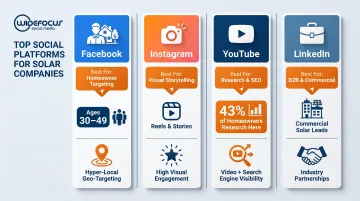
- Facebook: The strongest platform for local community targeting and homeowner demographics. Daily Facebook usage is highest among 30-49 (58%) and 50-64 (54%) age groups, which aligns perfectly with solar buyers. Facebook's geo-targeting tools let you reach homeowners in specific zip codes or service areas.
- Instagram: Ideal for visual storytelling: before-and-after installations, short customer testimonials, time-lapse install videos, and behind-the-scenes team content. Instagram's engagement features (Stories, Reels, polls) drive interaction and algorithm visibility.
- YouTube : 43% of homeowners use YouTube as a top source for home improvement research. Long-form videos also surface in Google search, making it a dual-purpose platform for both SEO and social reach. Publish explainer videos, installation walkthroughs, financing guides, and ROI breakdowns.
Primary Platform for Commercial Solar:
- LinkedIn : Best for B2B partnerships and reaching facility managers or corporate decision-makers directly. It's the go-to platform for commercial and industrial solar proposals.
Emerging Platforms Worth Considering:
- TikTok : Reaches first-time homebuyers and younger demographics through short-form content — solar myths debunked, quick savings tips, behind-the-scenes installs. 37% of U.S. adults use TikTok, with strong representation among younger homeowners.
- Pinterest : Functions as a long-tail visual search engine for home improvement. Pinterest reaches 40% of U.S. households earning $150k+ and 96% of searches are unbranded, meaning users are in discovery mode — perfect for educational solar content that drives traffic years after posting.
Strategic Guidance:
Start with 1-2 platforms where your target customers are most active, master those channels, then expand. Residential installers should prioritize Facebook and Instagram; B2B-focused solar companies should anchor on LinkedIn and supplement with Facebook for local awareness. Spreading across five platforms with thin, inconsistent content produces far weaker results than owning two channels with strong, regular posts.
Build a Content Strategy That Educates and Converts
Lead with Education, Not Sales Pitches
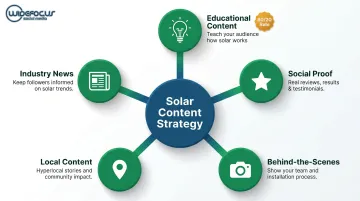
The 80/20 rule is critical for solar: 80% of content should educate, entertain, or add value; only 20% should directly promote services. Solar audiences are skeptical of sales pitches and respond better to brands that help them understand their options first. For a high-consideration purchase like solar, that trust has to be earned before a sale is ever possible.
89% of businesses now use video, and 93% of marketers report strong video ROI, making video the backbone of effective solar content strategies. Educational video addresses homeowner objections, simplifies complex topics, and builds credibility faster than text alone.
Core Content Pillars for Solar Companies
1. Educational Content
Explain how solar works, financing options (loans, leases, PPAs), federal and state incentives, ROI timelines, and net metering policies. Break down complex topics into accessible formats: 3-5 minute explainer videos, infographics, carousel posts, and blog summaries. 3-5 minute how-to videos average 74% engagement, making them the ideal length for solar education.
2. Social Proof
Feature video testimonials from real customers, before-and-after installation photos, and case studies with tangible savings data. Homeowners trust other homeowners more than they trust advertisers. Authentic customer stories close that gap, giving undecided prospects the social validation they need to take the next step.
3. Behind-the-Scenes Content
Show your team in action, document the installation process from start to finish, and highlight company culture. This humanizes your brand and demonstrates craftsmanship. Time-lapse installation videos work especially well here. They're visually compelling, short enough for social feeds, and communicate speed and professionalism without a single word of copy.
4. Local Content
Spotlight recognizable neighborhoods, feature local project installs, and participate in community events. Solar buyers want a local installer they can trust — local content reinforces that you're part of their community, not a distant corporation.
5. Industry News
When utility rates shift or federal incentive rules change, most homeowners have no idea what it means for them. Translate those updates into plain language — a quick Facebook post or short video explaining the impact positions your company as the local expert worth following.
The Power of Visual Content for Solar
High-quality visuals address a key homeowner objection: that solar panels will look bad on their roof. Use:
- Before-and-after installation photos showcasing clean, professional work
- Drone footage highlighting roof aesthetics and neighborhood context
- Time-lapse installation videos demonstrating speed and professionalism
- Infographics showing long-term savings projections and payback timelines
When a homeowner sees a clean, well-documented installation on a house that looks like theirs, the aesthetic objection largely disappears on its own.
Maintain Consistency with a Content Calendar
Plan posts around key dates:
- Tax filing season — educate homeowners about ITC deadlines and tax credit eligibility
- Sunny season months — highlight peak production periods and summer savings
- Local utility rate changes — explain how rising electricity costs increase solar ROI
Recommended posting frequency:
- Facebook: 3-5 times per week
- Instagram: 4-7 times per week (including Stories)
- LinkedIn: 2-3 times per week
- YouTube: 1-2 times per week
64% of marketers now post less than daily, prioritizing quality over volume. Batch-create content to stay ahead and maintain consistency without burnout.
Boost Engagement with Interactive Content
Interactive formats drive higher engagement and improve algorithm performance:
- Polls asking followers about their electricity bills or energy concerns
- Q&A sessions addressing common solar myths
- Live walkthroughs of completed installations
- "Ask me anything" Stories about financing, incentives, or installation timelines
Posts that prompt real responses — votes, comments, questions — get broader distribution from platform algorithms, extending your reach without additional ad spend.
Turn Your Social Following Into Solar Leads
Use Strategic Lead Magnets
Not every follower is ready to buy — and that's okay. The goal is to convert followers into leads at their own pace using low-friction entry points:
- Solar savings calculators — Let homeowners estimate their potential savings based on location, roof size, and electricity usage
- Downloadable incentive guides — Summarize federal, state, and local incentives in a simple PDF
- ROI worksheets — Help prospects understand payback timelines and long-term savings
- Free consultation offers — Remove risk by offering no-obligation site assessments or virtual consultations
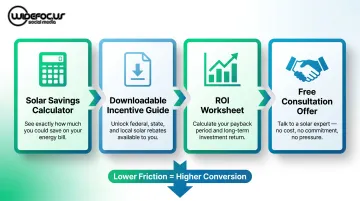
Promote lead magnets through bio links, Stories, pinned posts, and lead capture ads. Every friction point you remove between interest and contact increases conversion.
Optimize Profiles for Lead Generation
Your profile is often the first impression prospects get. Optimize for conversions:
- Clear bio stating service area and unique value proposition ("Denver's Most Trusted Solar Installer Since 2010")
- Prominent contact info (phone, email, website)
- Strong CTAs: "Get Your Free Quote," "Calculate Your Savings," "Schedule a Consultation"
- Facebook Lead Forms and Instagram action buttons for one-tap contact
- Instagram Highlight reels organized by category (FAQ, Testimonials, Installations, Financing)
Each of these touchpoints works together to reduce drop-off between discovery and contact.
Build Community to Create Warm Leads
Engaged communities generate the highest-quality referrals and repeat business:
- Create a Facebook Group for solar customers and prospects — share tips, answer questions, and foster peer-to-peer recommendations
- Feature monthly customer spotlights — celebrate customers who've gone solar and share their stories
- Encourage user-generated content with branded hashtags (#PoweredBy[YourCompany])
- Respond promptly to all comments and DMs — speed and attentiveness build trust
Partner with Local Micro-Influencers
Local micro-influencers carry trust that paid ads can't manufacture. Target:
- Home improvement bloggers and YouTubers
- Sustainability advocates and environmental nonprofits
- Real estate agents who work with eco-conscious buyers
- Neighborhood association leaders and community organizers
Micro-influencers can achieve engagement rates up to 7% vs. 1-3% for celebrity endorsers, and 21% of social users ages 18-54 report purchasing based on influencer recommendations. Identify partners by searching relevant hashtags, checking engagement rates, and verifying value alignment. Collaborations might include sponsored installation posts, co-hosted Q&As, or referral arrangements.
When to Partner with a Social Media Agency
Solar companies that struggle to execute these strategies consistently often benefit from partnering with a dedicated social media agency. WideFoc.us, for example, specializes in building customized, analytics-backed social media strategies for B2B and B2C brands. The agency helped a regional home services company achieve a 512% increase in form fills and 9x qualified leads in just eight weeks through coordinated paid and organic campaigns. For solar companies looking to accelerate results without adding in-house headcount, partnering with experts who understand big-ticket buying decisions can deliver measurable ROI faster.
Amplify Your Reach with Paid Social Advertising
Why Paid Social Is Essential for Solar Companies
Organic content builds community and credibility; paid ads extend reach to homeowners who haven't found you yet. In competitive local markets, relying solely on organic reach means leaving qualified, in-market leads to competitors. The two approaches work best together — and paid ads are where you capture buyers who are actively researching right now.
Targeting Strategies That Work for Solar
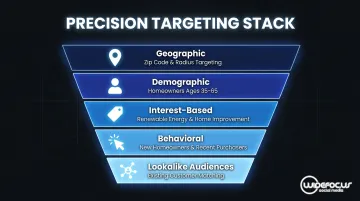
Precision targeting is what separates wasted ad spend from real leads. Layer these audience types for the strongest results:
- Geographic: Target by zip code, city, or radius around your service area. Solar buyers need local installers — stay inside your coverage zone.
- Demographic: Focus on homeowners (not renters), typically ages 35–65, with household incomes that support financing or upfront costs.
- Interest-based: Reach users interested in renewable energy, home improvement, sustainability, and energy efficiency.
- Behavioral: Target new homeowners, recent home improvement purchasers, and users who've engaged with solar content or competitor pages.
- Lookalike audiences: Upload your existing customer list to Facebook or Instagram and let the platform find prospects with matching profiles — a reliable way to scale beyond your current reach.
Ad Formats That Perform Best for Solar
- Before-and-after video ads — show the transformation from a traditional roof to a solar installation, emphasizing aesthetics and craftsmanship
- Carousel ads — feature multiple customer stories, financing options, or key benefits in a single scrollable unit
- Lead generation ads with instant forms — Meta Lead Ads pre-fill user data and support CRM integrations, capturing leads without requiring users to leave Facebook or Instagram
- Retargeting ads — re-engage website visitors who didn't convert with a reminder of your value proposition and a time-sensitive offer
The most effective solar ads combine a real customer story, a tangible savings claim (e.g., "$1,200 saved in Year 1"), and a low-commitment CTA ("Get Your Free Estimate").
Budget and Testing Guidance
Start with a modest monthly budget per platform — research current benchmarks for solar lead ad cost-per-lead (CPL) in your market. One commercial solar Facebook campaign reported approximately $24 CPL with 88 leads over 3 months, though CPL varies widely by market competition, creative quality, and lead qualification criteria.
Best Practices:
- Use automated bidding initially while gathering performance data
- Run A/B tests on creative (video vs. static, testimonial vs. educational), copy, and CTAs
- Scale spend on what proves to convert — measure cost-per-lead AND lead quality, not just clicks
- Track downstream metrics: consultation bookings, proposals sent, and closed deals attributed to social touchpoints
Lead volume is a vanity metric without deal velocity behind it. Set minimum qualification criteria upfront — homeowner status, zip code, roof age — and filter for those before routing leads to your sales team.
Track, Learn, and Refine Your Strategy
Key Metrics Solar Companies Should Track
Organize your metrics by business goal:
| Goal | Metrics to Track |
|---|---|
| Awareness | Reach, impressions, follower growth |
| Engagement | Likes, comments, shares, saves, engagement rate |
| Traffic | Link clicks, website sessions from social |
| Leads | Form submissions, quote requests, consultation bookings |
| Conversions | Closed deals attributed to social touchpoints, revenue generated |
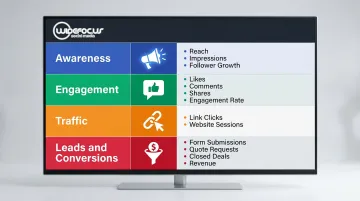
Vanity metrics like follower count mean nothing without downstream lead and revenue data. Use the table above as your baseline, then benchmark against current platform norms — Instagram engagements rose 28% year-over-year in 2024, while Facebook climbed 9%. Measure replies per post, not just likes.
Set Up Proper Tracking Infrastructure
- Facebook Pixel — Track conversions, build retargeting audiences, and optimize ad delivery based on user actions
- Google Analytics UTM parameters — Tag all social links to track traffic sources, campaign performance, and conversion paths
- Platform-native analytics — Review Facebook Insights, Instagram Insights, LinkedIn Analytics, and YouTube Analytics monthly for performance trends
- Third-party management tools — Consider Hootsuite, Buffer, or Sprout Social for cross-platform reporting, scheduling, and team collaboration
Once this infrastructure is in place, review data monthly to identify what's gaining traction and quarterly to assess your overall direction. Scale high-performing content formats and pause or redirect what isn't moving the needle.
Handle Negative Feedback Professionally
Negative reviews and comments are inevitable — how you respond builds or erodes trust:
- Respond quickly and calmly — acknowledge concerns publicly within 24 hours
- Take resolution conversations offline — provide contact info and move detailed discussions to private channels
- Never delete legitimate criticism — unless it's spam or violates platform policies, leave it visible and show how you resolve issues
- Demonstrate accountability — apologize when appropriate and explain corrective actions
A solar company that publicly resolves a complaint about a delayed installation can convert a frustrated customer into a visible endorsement — and prospects notice that.
Frequently Asked Questions
How can I use social media to promote my solar company and find clients?
Focus on educational content that addresses homeowner concerns — ROI, financing, and aesthetics. Optimize profiles with strong CTAs and contact info, then combine organic posting with lead magnets (savings calculators, free consultations) and targeted paid ads to capture qualified leads within your service area.
Which social media platform is best for solar companies?
Facebook and Instagram are strongest for residential solar due to homeowner demographics, visual storytelling tools, and precise targeting capabilities. LinkedIn works best for commercial or B2B solar projects, while YouTube supports long-term educational content that also ranks in Google search.
What type of content performs best for solar companies on social media?
Before-and-after installation visuals, customer video testimonials, educational explainers (how solar works, incentive guides, savings breakdowns), and behind-the-scenes team content consistently generate the strongest engagement and trust-building for solar brands. Video formats deliver the highest ROI.
How much should a solar company spend on social media marketing?
Budget depends on company size and market competitiveness. Small to mid-sized installers typically start at $1,000–$3,000 per platform per month, focusing on Facebook and Instagram first. Track cost-per-lead and closed deals — not just clicks — then scale spend as results prove out.
How long does it take to see results from social media for a solar business?
Brand awareness typically builds within 1–3 months of consistent posting, lead generation materializes around 3–6 months, and meaningful revenue attribution usually requires 6–12 months of sustained effort. The solar buying cycle takes months, not days, so plan your content calendar and ad spend accordingly.
Should solar companies handle social media in-house or hire an agency?
In-house management works for smaller teams with bandwidth, content creation skills, and platform expertise. Solar companies looking to scale paid campaigns or accelerate lead generation often benefit from a dedicated agency — WideFoc.us, for example, has helped home services and B2C brands build consistent pipelines through targeted social strategies.